
Impact of the 2026-2027 Australian Federal Budget on Commercial Real Estate
Executive Summary
The 2026-2027 Australian Federal Budget introduces the most aggressive structural tax reforms witnessed in the Australian property sector in over two decades. Delivered during an ongoing macroeconomic environment characterised by a global oil shock, 5% peak inflation forecasts, and severe supply chain constraints, the Federal Government has pivoted heavily toward revenue generation and redistributive "intergenerational equity" measures.
For the commercial real estate (CRE) sector, the Budget represents a profound dichotomy. While punitive new taxes have been levied on the capital gains and discretionary trust structures predominantly used by private commercial investors, the commercial asset class itself has been uniquely shielded from the controversial restrictions applied to residential negative gearing. This dynamic is expected to fundamentally alter domestic capital flows, driving a historic migration of private capital out of established residential housing and into the commercial property sector.
To provide a simple, highly structured analysis, the following report utilises exhaustive bulleted narrative and comparative tables to dissect the macroeconomic drivers, the systemic overhaul of capital gains and trust taxation, the Real Estate Institute of Queensland (REIQ) critique of the negative gearing changes, and the sector-specific implications for commercial real estate.
Core Commercial Real Estate Impacts at a Glance
| Policy Area | Budget 2026-2027 Reform | Direct Commercial Real Estate Impact |
| Capital Gains Tax (CGT) | 50% discount abolished from July 1, 2027; replaced with CPI indexation and a 30% minimum tax floor. | Reduces after-tax returns on commercial asset sales; eliminates the incentive to sell during low-income years; brings pre-1985 assets into the tax net. |
| Discretionary Trusts | 30% minimum tax imposed from July 1, 2028; elimination of tax credits for "bucket companies". | Destroys the primary holding structure for private commercial property; forces structural migration to Corporations Act entities; double-taxation cascade up to 63.39%. |
| Negative Gearing | Residential negative gearing ring-fenced to new builds only; full deductibility preserved for commercial property. | Creates a massive competitive advantage for CRE; triggers "The Pivot" as private retail investors shift capital to commercial assets to maintain tax shelters. |
| Depreciation & Allowances | Permanent extension of the $20,000 instant asset write-off for SMEs; Division 43 and Division 40 preserved. | Supports commercial tenant viability; enhances cash-flow returns for industrial and retail properties via capital works deductions. |
| Institutional Capital (MITs) | Concessional 15% withholding tax preserved for widely-held and foreign pension funds. | Creates a severe tax arbitrage favouring foreign capital over domestic private syndicates; accelerates the corporatisation of prime CRE assets. |
Macroeconomic Context and Budget Winners/Losers
The legislative levers pulled in the 2026-2027 Budget are inextricably linked to the broader macroeconomic environment. The Federal Treasurer framed the budget around the concepts of "resilience and reform," attempting to suppress inflation while managing an underlying cash deficit of $28.3 billion for 2025-26 and aggregate deficits of $150.5 billion over the forward estimates to 2029-30.
The following breakdown utilises the government's official metrics to highlight the macroeconomic drivers influencing the commercial property landscape.
-
The Global Oil Shock and Inflation: The budget was delivered against the backdrop of a severe conflict in the Middle East, which has disrupted shipping routes and triggered a global oil crisis. Treasury forecasts inflation to peak at 5% by the middle of 2026. However, modelling suggests that a protracted conflict driving oil to $US200 a barrel could push inflation beyond 7% and spike unemployment to pre-pandemic levels. This directly elevates construction costs, utilities, and transport expenses for commercial real estate operators.
-
GDP Growth and Spending Constraints: GDP growth is forecast to drop to 1.75% in the next financial year. To combat the deficit, the government has identified $63.8 billion in savings, including massive spending curbs on the National Disability Insurance Scheme (NDIS) totalling over $35 billion, and a freeze on public sector wages.
-
Fuel Resilience Spending: To protect domestic supply chains - a critical factor for the industrial and logistics real estate sector - the government has committed $14.7 billion to a Strengthening Australia's Fuel Resilience Package. This includes the establishment of a $3.2 billion government-controlled Australian Fuel Security Reserve and expanded minimum stockholding obligations for diesel and jet fuel.
Budget Winners and Losers Matrix
To fund cost-of-living relief, the budget aggressively redistributes wealth from private asset holders toward essential services and working-class taxpayers.
| Stakeholder Group | Budget Outcome | Mechanism and Implication |
| Working Australians | Winner | A new $250 Working Australians Tax Offset will benefit 13.3 million workers, effectively raising the tax-free threshold and boosting discretionary retail spending. |
| Small and Medium Enterprises | Winner | Permanent $20,000 instant asset write-off for businesses under $10 million turnover; loss carry-backs for startups. Boosts commercial tenant viability. |
| Public Infrastructure & Hospitals | Winner | $25 billion over five years for public hospitals; $2 billion for local infrastructure (power, roads, drains) to enable 65,000 new homes. Unlocks new commercial development corridors. |
| Top 10% Wealthy Households | Loser | Targeted by the 30% minimum tax on discretionary trusts. This cohort holds over 90% of the value of assets in private trusts, including significant private commercial property portfolios. |
| Private Property Investors | Loser | Abolition of the 50% CGT discount and restrictive ring-fencing of negative gearing for established residential assets; reduction of after-tax yields. Commercial Impact: While targeted at residential housing, these overhauls historically create uncertainty across all property asset classes. Reductions in CGT discounts may deter investors from taking risks on value-add commercial assets and developments. |
| Green Industries & EV Market | Loser | $1 billion slashed from the green hydrogen subsidy scheme; progressive pullback of electric vehicle tax breaks from April 2027. Slows commercial transition to green infrastructure. |
| Government Consultants | Loser | $2.7 billion cut from departmental budgets for external labour hire to shift work to a 150-staff in-house consulting service. Reduces demand for prime CBD office space by "Big Four" firms. |
The Structural Overhaul of Capital Gains Tax (CGT)
For commercial real estate investors, the 2026-2027 Budget marks the definitive end of the highly lucrative 50% CGT discount. The explicit policy intent is to ensure that only "real" (inflation-adjusted) capital gains are subject to taxation, while simultaneously disincentivising the strategic timing of asset sales.
Mechanics of the New CGT Regime
From July 1, 2027, the taxation of commercial property capital gains will transition to a highly restrictive dual-mechanism system.
-
Abolition of the 50% Discount: The blanket 50% discount - introduced in 1999 - will be eliminated for individuals, partnerships, and trusts. Companies remain unaffected, as they never qualified for the discount.
-
Return to CPI Indexation: To replace the discount, the government is reintroducing cost base indexation for assets held longer than 12 months. The original purchase price of the commercial asset will be adjusted upward annually in line with the Consumer Price Index (CPI). Taxation will only be applied to the nominal gain that exceeds this inflation-adjusted cost base.
-
The 30% Minimum Tax Floor: Indexation is strictly paired with a mandatory 30% minimum tax on the real capital gain. If an investor's marginal tax rate applied to the gain falls below 30%, they will be subjected to a "top-up" tax to bridge the gap. This fundamentally neutralises the prevalent strategy of holding commercial assets until low-income years (e.g., sabbaticals, retirement, or during business loss periods) to liquidate and pay minimal capital gains tax.
-
Eradication of the Pre-1985 (Pre-CGT) Exemption: In an unprecedented revenue-raising measure, all pre-CGT assets (those acquired before September 20, 1985) will be dragged into the tax net. Any capital appreciation occurring after July 1, 2027, on these legacy assets will be subject to the new indexation and 30% minimum tax regime, ending a 40-year tax sanctuary for generational commercial property holders.
Transitional Arrangements and Asset Valuations
To prevent an immediate collapse in asset values, the government has engineered complex transitional rules for commercial properties acquired before the July 1, 2027, cutoff but sold afterwards.
-
The Bifurcated "Straddling" Regime: For these assets, the capital gain will be split into two distinct phases.
-
Phase 1 (Pre-July 2027): The gain accrued from the original purchase date up to July 1, 2027, will be calculated using either a formal market valuation obtained on that date or an upcoming ATO statutory formula. This Phase 1 gain retains the legacy 50% CGT discount, and pre-1985 assets remain completely exempt for this portion.
-
Phase 2 (Post-July 2027): The assessed valuation as of July 1, 2027, becomes the property's new baseline cost base. Any growth in value from this date until the ultimate sale will be subject to CPI indexation and the 30% minimum tax.
Comparative CGT Financial Modelling
The following table demonstrates the mathematical impact of the transition from the legacy rules to the new indexation rules, assuming a commercial property purchased for $500,000 and sold for $1,000,000.
| Valuation Metric | Legacy System (Pre-Reform) | Transitional Scenario (Straddling 2027) |
| Original Purchase Price | $500,000 | $500,000 |
| Sale Price | $1,000,000 | $1,000,000 |
| Valuation at July 1, 2027 | Not Applicable | $650,000 (Locks in Phase 1) |
| Nominal Capital Gain | $500,000 | $500,000 |
| Phase 1 Taxable Gain (Pre-2027) | $250,000 (50% of the entire nominal gain) | $75,000 (50% of the $150k gain accrued before 2027) |
| Phase 2 Cost Base (Post-2027) | Not Applicable | Starts at $650,000; Indexed annually via CPI |
| Phase 2 Taxable Gain (Post-2027) | $0 (Not Applicable) | $212,487 (Assumed: Sale minus indexed Phase 2 base) |
| Total Taxable Capital Gain | $250,000 | $287,487 |
| Minimum Tax Rate Applied | Taxpayer's Marginal Rate (No minimum) | 30% Minimum Floor strictly enforced on Phase 2 |
(Note: Data methodology derived from duo tax transition modelling parameters).
This modeling illustrates that unless inflation outpaces property appreciation entirely, the taxable capital gain under the new system is generally higher, and the mandated 30% floor ensures higher tax receipts for the government regardless of the investor's personal income status.
Discretionary Trusts and the Eradication of the "Bucket Company"
The most aggressively punitive element of the 2026-2027 Budget targets the discretionary (family) trust - the dominant legal structure utilised for holding private commercial real estate in Australia. The new taxation mechanics represent a calculated attempt to herd family enterprises out of trust deeds and into the Corporations Act.
The 30% Trust Tax Floor
Historically, trusts have functioned as flow-through vehicles. They do not pay income tax directly; instead, commercial rental income is distributed to beneficiaries who pay tax at their individual marginal rates. This allows families to legally split income, stream high commercial yields to non-working spouses or university-aged children to utilise lower tax brackets.
-
Implementation Date: From July 1, 2028, trustees of discretionary trusts will be subject to a mandatory 30% minimum tax on the trust's taxable income.
-
The Credit System: Individual non-corporate beneficiaries will receive a non-refundable tax credit for the 30% tax already paid by the trustee.
-
The Penalty: If an individual beneficiary is in a tax bracket below 30%, the excess tax credits are permanently lost (they are non-refundable). If the beneficiary is above 30%, they must pay additional top-up tax. This entirely neutralises the benefit of income splitting to low-income family members.
The Death of the "Bucket Company"
The budget's true target is the corporate beneficiary, colloquially known as the "bucket company". Previously, if all human family members were on the top 47% marginal rate, the trust would stream leftover commercial income to a bucket company, which would catch the income and pay a flat 30% (or 25%) corporate tax rate. The capital would then be retained within the family group for future commercial acquisitions.
-
Denial of Credits: Under the new budget parameters, corporate beneficiaries are explicitly denied any tax credit (refundable or non-refundable) for the 30% minimum tax paid by the trust.
-
Double Taxation: This creates severe double taxation. Income is taxed at 30% at the trust level, and then the remaining 70% is distributed to the bucket company, which pays its own 30% corporate tax.
-
The 63.39% Cascade: Estate planning lawyer Rachael Rofe stated the budget ensures "the bucket company is dead," while wealth advisor Paul Ashworth termed the measure "punishment pricing".
Mathematical Cascade: The 63.39% Tax Trap
To demonstrate the "punishment pricing" mechanics, the following table tracks $100 of commercial rental income distributed to a bucket company, and subsequently paid as a dividend to a high-income individual.
| Distribution Stage | Legacy Framework (Pre-July 2028) | New Budget Framework (Post-July 2028) |
| Trust Net Earnings | $100 | $100 |
| Trust-Level Minimum Tax (30%) | $0 | -$30 |
| Distributed to Bucket Company | $100 | $70 |
| Effective Corporate Tax Rate | 30% | 30% |
| Corporate Tax Paid (30%) | -$30 | -$21 (30% of the $70 distribution) |
| Retained in Bucket Company | $70 | $49 |
| Dividend Paid to an Individual | $70 Franked Dividend | $49 Franked Dividend |
| Top-up Tax (Top Marginal Rate) | -$17 | -$12.39 |
| Total Tax Extracted | $47 | $63.39 |
| Ultimate Effective Tax Rate | 47% | 63.39% |
(Data derived from the Keithly Co. hypothetical modelling).
An effective tax rate of 63.39% surpasses the top personal marginal rate of nearly every developed nation, bringing Australian taxation back to levels not seen since the Fraser government in the 1970s.
Structural Migration and ASIC Surveillance
Critical Restructuring Timeline
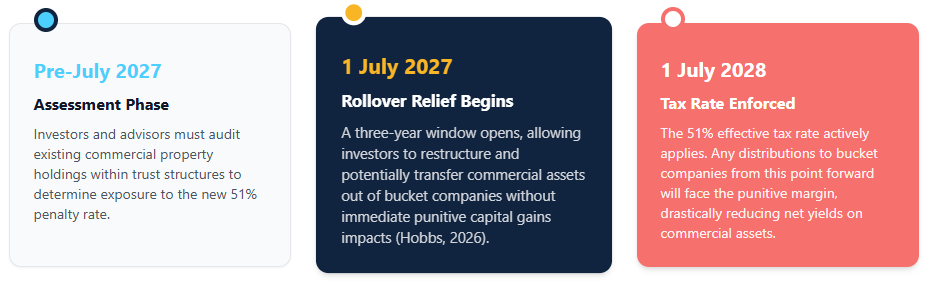
Faced with 63.39% taxation, commercial property syndicates and family offices have no choice but to abandon the trust structure. The natural migration is to operate directly through a standard Corporations Act entity (a Pty Ltd company), which pays a flat 25% or 30% rate on retained earnings.
-
Rollover Relief: The government has provided a three-year "rollover relief" window from July 1, 2027, to June 30, 2030, allowing trusts to restructure into companies without triggering federal CGT.
-
The ASIC Trap: However, migrating to a corporate structure is fraught with secondary consequences. Companies are subject to the surveillance of the Australian Securities and Investments Commission (ASIC), stringent director duties, strict Division 7A anti-avoidance loan provisions, and public reporting requirements. The opacity and flexibility historically afforded by family trust deeds will be eradicated. Furthermore, the federal CGT rollover relief does not bind state revenue authorities; restructuring a commercial property title from a trust to a company may trigger millions of dollars in prohibitive state stamp duty, trapping many investors.
Negative Gearing, The REIQ Critique, and "The Commercial Pivot"
While the 2026-2027 Budget aggressively dismantles private trust advantages, its approach to negative gearing introduces a massive policy asymmetry that deeply favours the commercial real estate sector.
The Ring-Fencing of Residential Negative Gearing
Negative gearing - the ability to deduct net rental losses against unrelated income, such as a primary salary - has been fundamentally altered for the residential sector.
-
Quarantining Losses: From July 1, 2027, investors who purchase an established residential property (after the May 12, 2026, budget night cutoff) will no longer be able to negatively gear those assets against their salary or business income.
-
Ring-Fencing Mechanism: Residential losses will be strictly "ring-fenced." They can only be deducted against other residential rental income or offset against future residential capital gains. If losses exceed residential income in a given year, they must be carried forward to future years.
-
New Build Exemption: The government has explicitly preserved full negative gearing benefits for investors who purchase "eligible new builds," hoping to drive capital into housing supply construction.
The REIQ Backlash: "No Substance"
The residential changes have been met with fierce resistance from industry bodies. The Real Estate Institute of Queensland (REIQ) issued a scathing media release asserting that there is "no substance" to the negative gearing changes.
-
Failure of Intergenerational Equity: The REIQ demanded that the Federal Government explain how restricting negative gearing would create genuine intergenerational equity. According to the REIQ, the budget offered "little insight into how this reform will materially help aspiring first homeowners or improve affordability".
-
The Grandfathering Distortion: Critics highlight that existing property owners are fully grandfathered; any property held before May 12, 2026, retains its negative gearing status indefinitely. This creates a severe market distortion. Existing owners are incentivised to hoard their grandfathered residential assets, thereby artificially constraining secondary-market supply and ultimately locking younger generations out of the property market entirely.
-
Construction Viability: Furthermore, pushing investors toward new builds ignores the reality of the construction sector. With building materials up 40% and borrowing costs elevated, many new residential projects remain financially unviable, meaning the promised surge in housing supply may never materialise despite the tax incentive.
The Commercial Pivot: A Preserved Tax Sanctuary
Amidst the chaos in the residential sector, commercial real estate emerges as the undisputed victor of the negative gearing debate.
-
Full Deductibility Maintained: The budget explicitly excludes commercial property (and asset classes such as shares) from the negative gearing restrictions. Commercial property investors retain the absolute right to offset net rental losses against their primary professional salaries or general business income.
-
The Strategic Pivot: This policy asymmetry is anticipated to trigger a broader strategic shift across the market. High-income earners seeking effective tax shelters are likely to move away from the now-restricted established residential sector, redirecting their private capital into commercial real estate to maintain full deductibility.
-
Commercial Appeal: Compared to residential housing, commercial assets offer significantly higher income yields, longer lease terms with "sticky tenants," and lease structures where the tenant typically covers all outgoings (insurance, maintenance, rates).
Comparative Deductibility Matrix
The table below outlines the stark tax advantages now heavily weighted toward commercial property investment.
| Property or Asset Type | Acquired Pre-May 12, 2026 | Acquired Post-May 12, 2026 | Negative Gearing Status (Post-July 2027) |
| Established Residential | Yes | N/A | Fully Grandfathered: Deductible against salary. |
| Established Residential | N/A | Yes | Ring-fenced: Deductible ONLY against residential income or capital gains. |
| New Build Residential | N/A | Yes | Fully Deductible against salary (to incentivise housing supply). |
| Commercial Real Estate | Yes or No | Yes or No | Fully Deductible against salary; Explicitly excluded from restrictions. |
Depreciation and Capital Allowances
Complementing the preservation of negative gearing, commercial real estate continues to offer the most lucrative tax depreciation frameworks in the Australian property landscape. The 2026-2027 Budget did not curtail these deductions, ensuring commercial assets remain highly tax-advantaged.
Division 43 and Division 40 Mechanics
Tax depreciation allows commercial landlords to claim significant non-cash deductions each year for the natural wear and tear of their buildings, profoundly improving after-tax cash flow.
-
Division 43 (Capital Works): This division allows commercial property owners to gradually write off the "bricks and mortar" structural integrity of the building. Eligible capital works are claimed at a steady rate of 2.5% per year over 40 years. For instance, a warehouse with a $1 million structural cost base generates a guaranteed $25,000 annual deduction.
-
Division 40 (Plant and Equipment): This covers the easily removable, specialised assets within a commercial building, such as HVAC mechanical ventilation, heavy lighting systems, fire safety systems, and roller door motors. These assets depreciate at highly accelerated rates based on their specific effective lifespan.
-
The Commercial Advantage: Unlike the residential sector, where recent legislation restricted investors from claiming depreciation on second-hand plant and equipment, commercial property investors can still claim substantial Division 40 depreciation on established, second-hand commercial buildings.
The $20,000 Instant Asset Write-Off
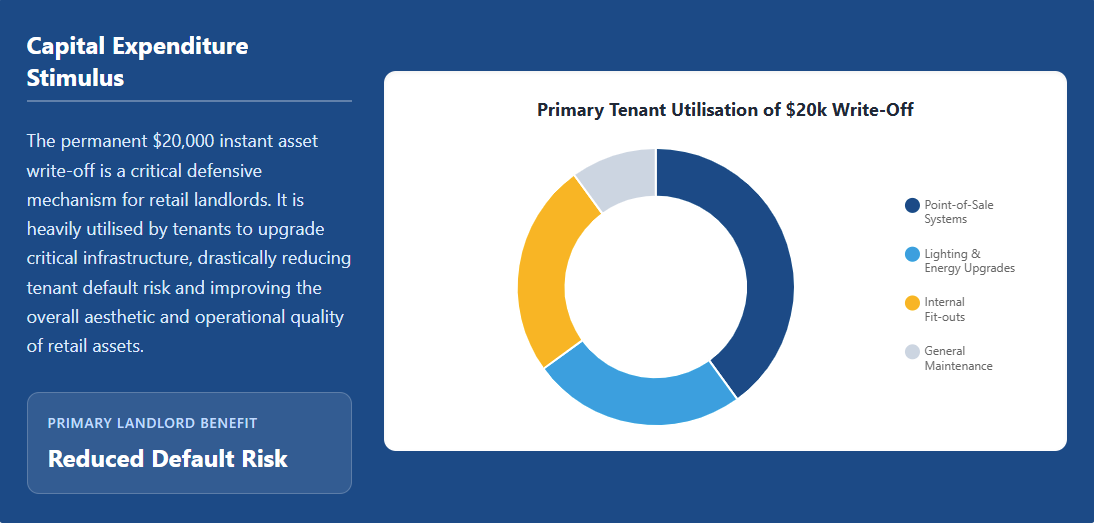
To further stimulate the commercial ecosystem, the Federal Government has permanently legislated the $20,000 instant asset write-off, effective July 1, 2026.
-
Eligibility: Businesses with an aggregated annual turnover of less than $10 million can immediately deduct the full cost of eligible depreciating assets costing less than $20,000.
-
Multiple Uses: The threshold applies on a per-asset basis, meaning businesses can write off multiple assets simultaneously, provided each falls under the $20,000 cap.
-
Impact on CRE: While aimed at small and medium enterprises (SMEs), this policy is a massive indirect boon for commercial landlords. It highly incentivises commercial retail and office tenants to upgrade their fit-outs, invest in new equipment, and refurbish their leased spaces. This capital expenditure by tenants improves the overall value of the landlord's asset and increases tenant retention by deeply integrating their operations into the physical space.
Sector-Specific Real Estate Impacts
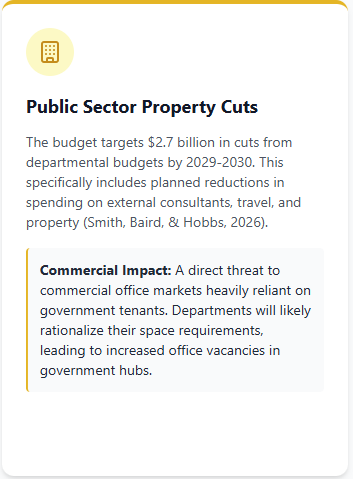
The sweeping macro fiscal changes and targeted tax policies of the 2026-2027 Budget do not fall uniformly across the commercial real estate spectrum. The differing dynamics of supply, consumer demand, and infrastructure funding will create distinct operational realities for office, industrial, and retail assets.
Office Sector: Supply Peaks and Flight to Quality
The Australian office market is currently characterised by high vacancy rates and evolving post-pandemic work patterns.
-
Vacancy Rates: According to the Property Council of Australia, the national office vacancy rate climbed to 15.9% in early 2026. This was led by a supply-driven surge, with non-CBD vacancy at 18.5% and CBD vacancy reaching 14.8%. The Property Council attributes this to a cyclical peak of projects that commenced three years prior.
-
Flight to Quality: The budget's emphasis on streamlining regulatory systems and secure access to data (backed by $198.1 million in funding) aligns with corporate demands for modern, technologically secure workspaces. Tenant demand is heavily concentrated on premium-grade, highly amenitsed buildings, pulling tenants away from secondary stock.
-
Stagnation of B-Grade Assets: Because the 30% CGT floor penalises the sale of commercial assets, owners of older B-grade and C-grade office buildings are highly likely to hold their assets rather than sell them at a discount. This will lead to a stagnation of capital improvement in the secondary office market, as owners lack the incentive to upgrade and lack the willingness to liquidate.
Industrial and Logistics: The Unrivalled Winner
Industrial and logistics real estate continues to moderate from its peak but remains the strongest fundamental sector in the CRE landscape, deeply supported by federal budget initiatives.
-
Infrastructure Corridors: The budget allocates $841.7 million to support regional community infrastructure and an additional $2 billion to target power, roads, and drains for new housing developments. These massive civil works will unlock new transport corridors and logistics nodes, ensuring sustained demand for warehousing and distribution centres.
-
Supply Chain Resilience: The $14.7 billion Strengthening Australia's Fuel Resilience Package guarantees the expansion of fuel reserves and localised infrastructure. By heavily investing in supply chain security, the government is indirectly subsidising the structural reliance on the industrial real estate sector, making it the most defensive asset class against geopolitical shocks.
-
Depreciation Benefits: Industrial warehouses generate massive Division 43 capital works deductions due to their large structural footprints, allowing investors to maximise cash-flow returns in a high-interest-rate environment.
Retail Sector: Buoyed by Targeted Stimulus
The retail property sector entered the budget cycle facing severe headwinds. High borrowing costs and inflation had driven consumer confidence to historic lows, with demand shifting heavily toward e-commerce. However, retail fundamentals remain unexpectedly resilient, supported by strategic government interventions.
-
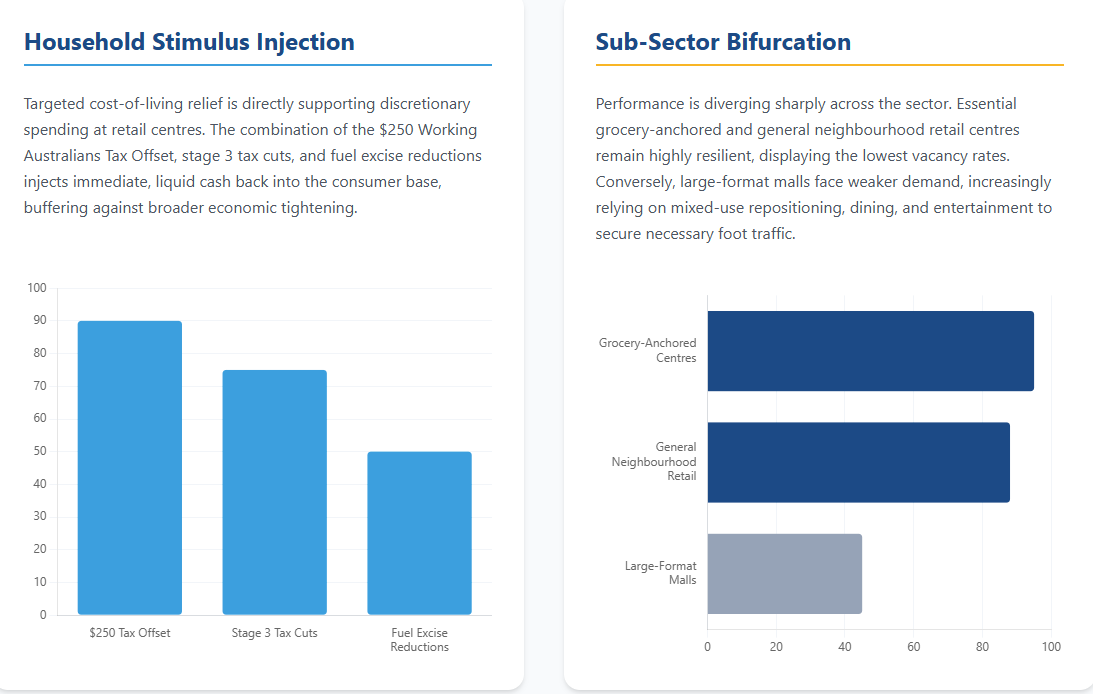
Household Stimulus: The introduction of the $250 Working Australians Tax Offset, combined with prior stage 3 tax cuts and fuel excise reductions, puts immediate, liquid cash back into the pockets of the consumer base. This targeted cost-of-living relief directly supports discretionary spending at retail centres.
-
Sub-Sector Bifurcation: General neighbourhood retail and essential grocery-anchored centres remain highly resilient, exhibiting the lowest vacancy rates across the sector. Conversely, large-format malls continue to face weaker demand and are increasingly reliant on mixed-use repositioning, integrating dining and entertainment to attract foot traffic.
-
The $20k Write-Off: As noted, the permanent $20,000 instant asset write-off is heavily utilised by retail tenants to upgrade point-of-sale systems, lighting, and fit-outs, drastically reducing tenant default risk for retail landlords.
The Institutional Advantage: MITs and Foreign Capital
A profound, and highly controversial, systemic outcome of the 2026-2027 Budget is the creation of a two-tiered tax system that aggressively favours institutional, widely-held, and foreign capital over domestic private investors.
The government has ring-fenced large-scale institutional investment vehicles from the punitive measures applied to the private market, fundamentally altering the competitive dynamics of commercial real estate acquisition.
Exemption from the 30% Trust Minimum Tax
While private family offices and syndicates operating through discretionary trusts are hit with a 30% minimum tax and the eradication of bucket company credits, the legislation explicitly excludes the institutional end of town.
-
Exempt Entities: "Fixed" trusts, "widely held trusts," special disability trusts, and complying superannuation funds are completely exempt from the 30% minimum trust tax.
-
Superannuation: Self-Managed Superannuation Funds (SMSFs) and large industry super funds retain their highly concessional status, paying a maximum of 15% operational tax and maintaining a 33.3% CGT discount.
The Managed Investment Trust (MIT) Arbitrage
The starkest inequity lies within the Managed Investment Trust (MIT) regime. MITs are the primary vehicle used by listed Real Estate Investment Trusts (REITs) and unlisted wholesale funds to pool capital from foreign pension funds and sovereign wealth entities to acquire prime Australian commercial real estate.
-
The 15% Withholding Sanctuary: Under current laws, foreign investors resident in recognised jurisdictions pay a highly concessional 15% final withholding tax on fund payments (including commercial rental income and capital gains) derived through an MIT.
-
Budget Clarifications: The 2026-2027 Budget did not abolish this concession. Instead, the government moved to strengthen it, announcing legislative amendments to clarify that trusts ultimately owned by a single widely-held foreign institutional investor (such as a foreign pension fund) can continue to qualify as an MIT and access the 15% withholding rate.
-
The Capital Gains Arbitrage: It remains unclear if the new 30% minimum CGT floor will apply to capital gains distributed by an MIT to a foreign resident, given the statutory 15% withholding framework. If exempt, a non-resident investor deriving capital gains from an Australian commercial property via an MIT will experience a vastly more favourable tax outcome than an Australian resident investing in the same asset.
The Corporatisation of Australian Real Estate
This tax asymmetry creates an insurmountable advantage for foreign and institutional capital. Because an international pension fund utilising an MIT faces a maximum tax burden of 15% (compared to the 51%-63% cascading trap facing a domestic private trust), institutional buyers can underwrite commercial property acquisitions at significantly lower gross yields.
The long-term implication is the accelerated corporatisation and institutionalization of prime Australian real estate. Private domestic syndicates and family offices will be systematically outbid for premium office towers, logistics parks, and retail centres by tax-advantaged institutional capital, relegating private investors to the secondary and sub-institutional commercial markets.
Entity Tax Advantage Matrix
The table below illustrates the severe disparity in taxation applied to different commercial property ownership structures post-2028.
| Ownership Entity Type | Operational Income Tax Liability | Capital Gains Tax Treatment | Is Negative Gearing Permitted? |
| Discretionary (Family) Trust | 30% Minimum Floor Tax (No corporate credits). | CPI Indexation + 30% Minimum Floor. | Yes (Commercial only). |
| Pty Ltd Company | 25% or 30% Flat Corporate Rate. | 25% or 30% Corporate Rate (Never eligible for discounts). | Yes (Commercial only). |
| Superannuation Fund (SMSF) | 15% Concessional Rate. | 33.3% Discount Preserved (Effectively 10% tax rate). | Yes (Commercial only). |
| Foreign Capital via MIT | 15% Concessional Withholding Tax. | 15% Withholding Tax (Pending final CGT floor application rules). | N/A (Assessed at fund level). |
Market Liquidity, Valuations, and "The Hold" Phenomenon
The culmination of the CGT overhaul and the imposition of minimum trust taxes will severely disrupt the foundational mechanics of the commercial property market: liquidity and valuation benchmarking.
The Destruction of Transaction Velocity
Commercial real estate relies heavily on regular transaction turnover to establish price discovery and benchmark valuations for the wider market. The replacement of the 50% CGT discount with a 30% minimum tax floor mathematically destroys the incentive for an investor to sell an asset.
-
By taxing the real capital gain at a mandated minimum of 30%, the after-tax realisation of a commercial asset sale is permanently suppressed.
-
Coupled with the incoming 30% tax on discretionary trusts, the financial penalty for liquidating a commercial property and attempting to redistribute the capital to family members becomes overwhelmingly prohibitive.
"The Hold" Phenomenon
Consequently, analysts and agents predict the onset of a severe "hold" phenomenon. Instead of selling properties to realise capital growth, commercial property owners will choose to retain their assets indefinitely. To access liquidity, investors will increasingly rely on refinancing their assets against capital growth, drawing equity via tax-free debt facilities rather than triggering a highly taxed CGT disposal event.
This behavioural shift will segment the commercial market into two distinct temporal phases:
-
The Pre-2027 Liquidation Rush: Between the budget's announcement in May 2026 and the legislative cutoff of June 30, 2027, the commercial market is expected to witness artificially elevated transaction volumes. Older investors, syndicates nearing the end of their operational lifecycle, and those heavily exposed to debt will race to sell assets and crystallise their capital gains under the legacy 50% discount rules before the door closes.
-
The Post-2027 Market Freeze: From July 1, 2027, onward, transaction volumes are predicted to plummet dramatically. This structural shift in holding behaviour will extend the period of subdued turnover indefinitely, even if underlying capital values remain stable.
Valuation and Lending Constraints
The downstream effects of reduced transaction velocity are severe.
-
Obscured Price Discovery: Lower transaction volumes critically obscure price discovery. Without frequent comparable sales, commercial valuers face massive difficulties in accurately assessing the true market value of office, retail, and industrial assets.
-
Lender Confidence: Commercial lending is inherently tied to accurate valuation. If banks and non-bank lenders lack confidence in the valuation metrics due to a frozen market, they will logically decrease Loan-to-Value Ratios (LVRs) and increase interest margins to mitigate risk. This tightening of credit availability will further suppress market activity, creating a self-fulfilling loop of illiquidity.
Conclusions and Strategic Outlook
The 2026-2027 Australian Federal Budget engineers a fundamentally altered reality for the commercial real estate sector. By heavily targeting private wealth vehicles while shielding institutional capital and preserving specific commercial tax shelters, the government has inadvertently (or perhaps deliberately) rewritten the rules of commercial property investment.
Based on the exhaustive analysis of the fiscal measures, the following strategic outlooks define the future of the market:
-
Urgent Restructuring is Mandatory: The era of the discretionary family trust operating via a bucket company is definitely over. Private commercial investors must urgently utilise the three-year rollover relief window (July 2027 to June 2030) to transition their portfolios into standard corporate structures or fixed trusts. However, investors must prepare for the intense regulatory scrutiny of ASIC and the potential hazard of state-level stamp duty liabilities.
-
The Commercial Asset Premium: The ring-fencing of residential negative gearing renders commercial real estate the ultimate sanctuary for high-income earners seeking tax-deductible investment losses. This "pivot" of private capital will likely compress yields in the lower-tier commercial market (sub-$3 million), as unsophisticated retail capital chases tax outcomes over underlying asset fundamentals.
-
A Two-Tiered Institutional Market: The preservation of the 15% MIT withholding tax for foreign pension funds cements a staggering competitive advantage for institutional capital. Domestic private syndicates, burdened by a 30% CGT floor and 30% trust taxes, will be systematically priced out of prime A-grade commercial assets.
-
The Liquidity Freeze: The 30% CGT floor destroys the incentive to sell. Investors must recalibrate their long-term underwriting to account for indefinite holding periods, focusing on sustainable rental yield and debt-equity refinancing rather than speculative capital growth exits.
Ultimately, the 2026-2027 Federal Budget transitions commercial real estate from a fluid, dynamic trading market into a highly corporatised, yield-focused, long-term holding environment dominated by institutional capital and tax-shielded corporate entities.
References
Hobbs, A. (2026, May 14). How Labor is killing family trusts - starting with the bucket company. The Australian Financial Review
https://www.afr.com/wealth/investing/how-labor-is-killing-family-trusts-starting-with-the-bucket-company-20260513-p5zw9r
Real Estate Institute of Queensland. (2026, May 13). No substance to negative gearing changes, says REIQ. https://www.reiq.com/resources/media-releases/no-substance-to-negative-gearing-changes-says-reiq
Smith, N., Baird, L., & Hobbs, A. (2026, May 12). Budget 2026 winners and losers. The Australian Financial Review. https://www.afr.com/politics/federal/budget-2026-winners-and-losers-20260507-p5zup6
For a complete list of weekly commercial transactions in Queensland, visit McGees Wrap Up | McGees Property Brisbane
Disclaimer: The information provided in this blog is for general informational purposes only and does not constitute legal, financial, or professional advice. While we strive for accuracy, we make no guarantees regarding the completeness or timeliness of the content. Always seek independent advice before making any financial or real estate decisions. We are not liable for any loss or damages arising from your reliance on the information provided.
Liability Limited by a Scheme approved under Professional Standards Legislation