
The commercial landscape of Aspley, situated approximately 13 kilometres north of the Brisbane Central Business District, represents a critical node in the Queensland capital’s northern growth corridor. As the primary retail and administrative gateway for the surrounding suburban catchments, Aspley serves as a high-density commercial hub characterised by a resilient workforce, significant infrastructure investment, and a specialised industry profile. The following analysis examines the underlying economic drivers, property asset performance, and the shifting regulatory environment that defines the Aspley commercial market, providing a strategic foundation for property owners considering the management, sale, or lease of their assets through McGees Property.
Macroeconomic Context and Workforce Dynamics
The economic viability of Aspley is anchored by its position as a major employment generator within the Brisbane North region. With a total land area of 6.3 km2, the Aspley Statistical Area Level 2 (SA2) supports a workforce of approximately 4,907 persons (Queensland Government Statistician's Office, 2025). This workforce is characterised by high levels of professionalisation and a distinct separation from the residential demographic, as evidenced by the fact that 82.7% of the individuals working in Aspley commute from other regions (Queensland Government Statistician's Office, 2025). This high rate of commuter inflow underscores Aspley’s role as a regional destination rather than a purely localised service centre, drawing labour predominantly from the Chermside SA3 (25.5%), The Hills District (12.5%), and Bald Hills, Everton Park (10.9%) (Queensland Government Statistician's Office, 2025).
The workforce composition reflects a mature commercial market with a strong lean toward white-collar occupations, which account for 78.1% of the total labour force (Queensland Government Statistician's Office, 2025). This dominance is particularly evident in the professional services, healthcare, and education sectors. However, the labour market also maintains a resilient blue-collar segment (20.8%), primarily concentrated in construction, manufacturing, and maintenance services, which provide essential support to the suburb's extensive retail and residential infrastructure (Queensland Government Statistician's Office, 2025).
Labour Productivity and Engagement
Workforce engagement in Aspley shows a unique distribution compared to the broader Brisbane Local Government Area (LGA). Full-time employment for the core 25-54 age bracket stands at 52.7%, significantly lower than the Brisbane LGA average of 69.5% (Queensland Government Statistician's Office, 2025). This suggests a higher prevalence of flexible or part-time work arrangements, likely driven by the retail and hospitality sectors which are the suburb’s primary industry subdivisions. The following table provides a detailed breakdown of the workforce by hours worked and age.
| Age Group | Full-Time (35+ hours) | Part-Time (1-34 hours) | Not Worked/Not Stated | Total Workers |
|---|---|---|---|---|
| 15-24 years | 278 (21.7%) | 856 (66.8%) | 125 (9.8%) | 1,281 |
| 25-54 years | 1,440 (52.7%) | 1,026 (37.5%) | 229 (8.4%) | 2,734 |
| 55 years + | 417 (46.8%) | 365 (41.0%) | 81 (9.1%) | 891 |
| Total | 2,158 (44.0%) | 2,247 (45.8%) | 435 (8.8%) | 4,907 |
The median personal income for workers in Aspley is reported at $46,332 per annum, which is lower than the Brisbane LGA median of $69,390 (Queensland Government Statistician's Office, 2025). This income disparity is largely reflective of the industry specialisation within the area. Retail trade and food services, which employ nearly 41% of the local workforce combined, typically operate on lower median wage structures compared to the finance or professional sectors dominant in the CBD (Queensland Government Statistician's Office, 2025). For property owners, this indicates a consumer base that is sensitive to inflationary pressures but also a business environment that is highly efficient in terms of labour costs.
Commuter Connectivity and Logistics
The transport infrastructure supporting Aspley’s commercial viability is heavily car-dependent, reflecting its role as a suburban hub. Approximately 68.3% of workers in Aspley commute via private vehicle, a figure substantially higher than the Brisbane LGA average of 52.6% (Queensland Government Statistician's Office, 2025). This reliance on road networks highlights the critical importance of Gympie Road, Robinson Road West, and Albany Creek Road as primary commercial arteries. The dominance of vehicle-based travel underpins the high valuation and demand for assets with significant on-grade parking and high visibility, such as drive-in shopping centres and standalone retail warehouses (Queensland Government Statistician's Office, 2025).
Aspley Central - Gympie Rd & Albany Creek Rd Intersection
Aspley Central Shopping Centre: 1368 Gympie Road, Aspley QLD 4034.
The high percentage of individuals working at home or not attending a physical workplace (24.8%) aligns with broader post-pandemic trends, yet the relative stickiness of physical retail and professional service occupations in Aspley ensures that physical floor space remains in high demand (Jaide Law, 2025; JLL, 2025). For owners, this reinforces the stability of local tenancies, as the business models of Aspley's top industries: food service, retailing, and medical care: require a physical presence and localised accessibility (Queensland Government Statistician's Office, 2025).
Industry Specialisation and Business Density
Aspley’s commercial strength is rooted in its extreme specialisation in retail trade and allied services. The suburb possesses a retail trade specialisation ratio of 3.56, meaning the industry is over three and a half times more concentrated in Aspley than in the broader Brisbane area (Queensland Government Statistician's Office, 2025). This concentration is further complemented by high specialisation in rental, hiring, and real estate services (ratio of 2.64) and accommodation and food services (ratio of 2.09) (Queensland Government Statistician's Office, 2025).
As of 30 June 2025, there are 1,051 registered businesses in the Aspley SA2. The distribution of these businesses reveals a landscape dominated by micro-enterprises and small businesses, yet supported by a tier of high-performing large-scale operations. Approximately 31.3% of businesses employ between 1 and 4 people, while 8.7% employ between 5 and 19 (Queensland Government Statistician's Office, 2025). Crucially, 1.5% of businesses in Aspley report a turnover exceeding $10 million per year, highlighting the presence of significant national tenants and high-volume commercial operators (Queensland Government Statistician's Office, 2025).
Registered Businesses by Industry Classification
The business counts by industry provide a clear picture of the diversity available to commercial property investors and owners. While Professional, Scientific, and Technical Services constitute the highest number of registered businesses (187 or 17.8%), the physical floor space and employment are heavily weighted toward Retail Trade and Construction (Queensland Government Statistician's Office, 2025).
| Industry | Business Count | Percentage of Total | Specialisation Ratio |
|---|---|---|---|
| Professional, Scientific & Technical | 187 | 17.8% | 0.99 |
| Construction | 156 | 14.8% | 1.18 |
| Rental, Hiring & Real Estate | 144 | 13.7% | 1.02 |
| Health Care & Social Assistance | 117 | 11.1% | 1.07 |
| Retail Trade | 87 | 8.3% | 1.48 |
| Transport, Postal & Warehousing | 66 | 6.3% | 0.75 |
| Financial & Insurance Services | 57 | 5.4% | 0.90 |
| Other Services | 52 | 4.9% | 1.20 |
| Total (all industries) | 1,051 | 100.0% | 1.00 |
The high specialisation in Construction (1.18) and Rental/Real Estate (1.02) suggests a suburb in a state of continuous renewal and high transactional activity. This environment creates a robust demand for office and light industrial space that can accommodate contractors and service providers supporting the northern suburbs' development. For property owners, this represents a diversified tenant pool ranging from sole-trader consultants to established trade enterprises.
Economic Resilience and Turnover Ranges
The financial stability of the Aspley business community is evidenced by the turnover data. Over 43% of businesses in the suburb generate between $200,000 and $5 million in annual turnover, a bracket that represents the backbone of the commercial leasing market (Queensland Government Statistician's Office, 2025). This segment typically occupies the 100sqm to 500sqm office and retail formats that are prevalent along Gympie Road (Queensland Government Statistician's Office, 2025).
The presence of 16 businesses with a turnover exceeding $10 million is particularly noteworthy for owners of larger assets (Queensland Government Statistician's Office, 2025). These businesses, often anchor retail tenants, medical providers, or regional distribution hubs, provide the long-term lease security sought by institutional and sophisticated private investors. The slightly higher concentration of mid-range turnover businesses ($200k to $5m) compared to the Brisbane average indicates a healthy, competitive SME sector that underpins suburban rental growth (Queensland Government Statistician's Office, 2025).
Asset Performance: Retail Property Analysis
Aspley is recognised as one of North Brisbane's premier retail destinations, centred around the Gympie Road arterial corridor. The retail sector in Aspley is characterised by a mix of large-format shopping centres, neighbourhood convenience strips, and standalone "drive-to-the-door" assets. The primary retail assets, such as the Aspley Hypermarket and Aspley Central, benefit from exposure to significant daily traffic volumes, estimated at over 75,000 vehicles (Blue Commercial, 2025).
Major Retail Nodes and Valuations
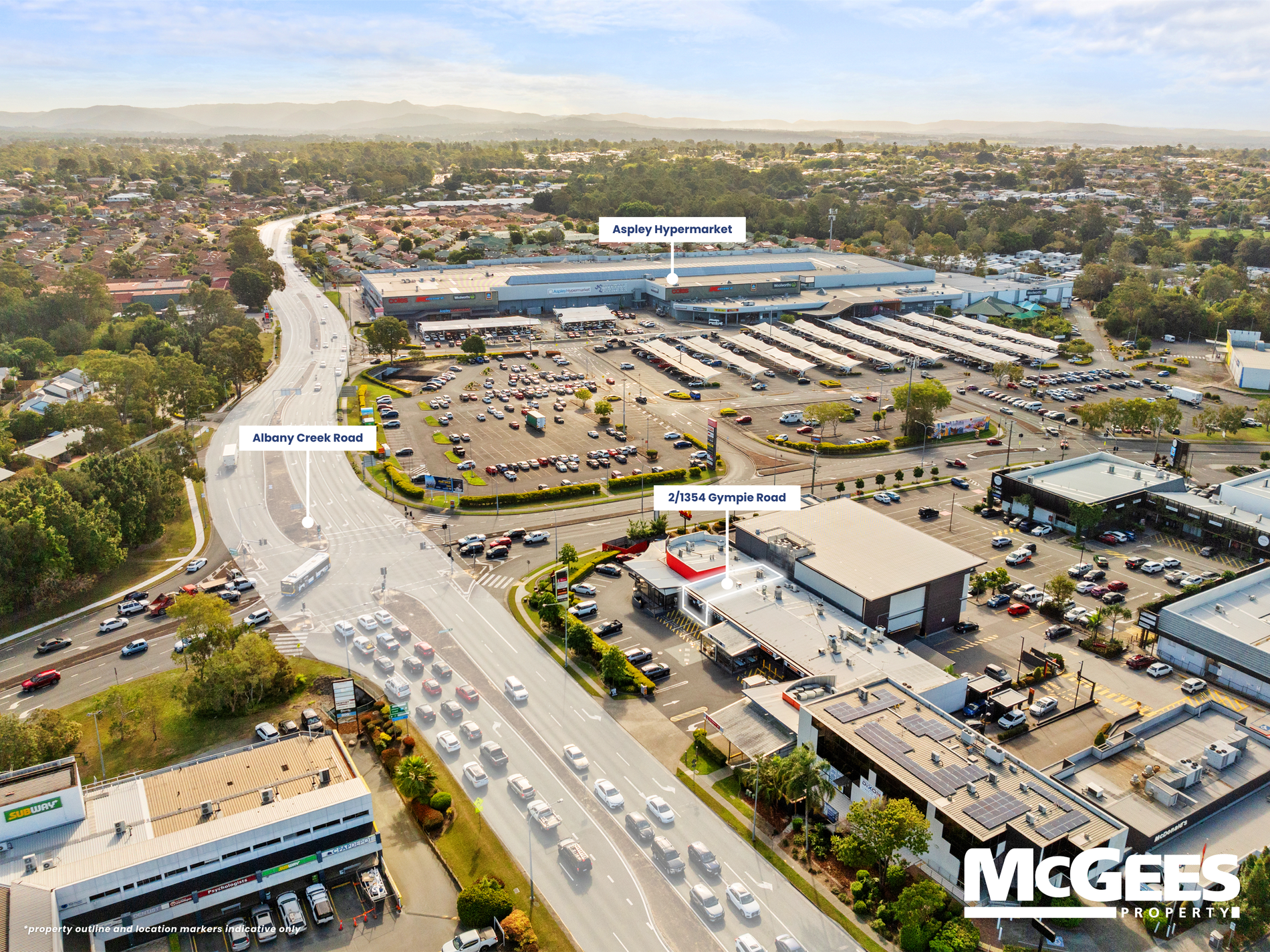
The valuation of retail assets in Aspley has shown significant resilience over the past two decades. Large-scale regional and sub-regional assets have historically commanded premium prices, reflecting the suburb's strategic importance. The Aspley Hypermarket site at 59 Albany Creek Road, encompassing over 125,400sqm of land, was transacted for $62.65 million as early as 2001 (Queensland Government Statistician's Office, 2025). More recent data indicates that neighbourhood-scale assets also maintain high value; the drive-in shopping centre at 605 Robinson Road West, covering nearly 2 hectares, sold for $32.25 million in 2015 (Queensland Government Statistician's Office, 2025).
Current retail market indicators for 2025 suggest a tightening of yields and a scarcity of listings. Across Brisbane, neighbourhood retail yields average 5.88%, while sub-regional assets sit at approximately 6.88% (CBRE, 2025b). In Aspley, the demand for non-discretionary retail remains particularly strong, with anchor tenants such as Woolworths, Coles, and Aldi driving consistent foot traffic (Blue Commercial, 2025; McGees Property Brisbane, 2025a).
Tenant Mix and Vacancy Trends
The tenant mix in Aspley is heavily weighted toward food and beverage services (12.5% of workers) and food retailing (12.3% of workers) (Queensland Government Statistician's Office, 2025). This focus on essential services provides a hedge against economic downturns, as non-discretionary spending remains stable. Established centres like Aspley Central (1370 Gympie Road) have recently undergone extensive renovations to meet modern customer expectations, featuring a mix of takeaway food, commercial services, and medical providers (Blue Commercial, 2025; Aspley Central, 2025).
Vacancy rates in the retail sector remain near record lows. Broader Brisbane data indicates a vacancy rate of just 0.9% for the retail-heavy middle-ring suburbs (Smart Business Plans, 2025). In Aspley, this translates to high competition for available tenancies. As of November 2025, only three tenancies remained available at Aspley Central following its major upgrade, highlighting the speed at which modernised space is absorbed by the market (Blue Commercial, 2025). High-profile tenants such as Westpac, Pizza Hut, Sushi Train, and Zambrero underpin the centre’s viability and attract high-income demographics from surrounding prestigious suburbs like Bridgeman Downs (Blue Commercial, 2025; McGees Property Brisbane, 2025a).
Asset Performance: Office and Professional Space
The office market in Aspley is primarily decentralised and suburban in nature, catering to professional services, medical practitioners, and government-related entities. Unlike the high-rise CBD market, Aspley’s office assets are often low-to-mid-rise buildings or integrated within mixed-use retail precincts.
Specialisation in Professional and Health Services
The business data reveals that Professional, Scientific, and Technical Services (17.8%) and Health Care and Social Assistance (11.1%) are the largest and fourth-largest business groups by count in Aspley (Queensland Government Statistician's Office, 2025). This creates a steady requirement for high-quality, accessible office suites. The specialisation ratio for Health Care and Social Assistance (1.07) and the high number of medical and allied health workers (6.5% of the local workforce) indicate that medical-specialised office space is a high-performing niche (Queensland Government Statistician's Office, 2025).
Specific office assets in the region demonstrate strong capital performance. 1311 Gympie Road, a professional office asset, was transacted for approximately $7.45 million in 2015, while 1346 Gympie Road commanded a $4.5 million sale price earlier in its history (Queensland Government Statistician's Office, 2025). Smaller professional suites, such as those at 607 Robinson Road West and 1356 Gympie Road, serve the high volume of local service providers, with 607 Robinson Road West selling for $2.4 million in late 2020 (Queensland Government Statistician's Office, 2025).
Shift in Occupier Demand and Future Yields
Post-pandemic trends have favoured suburban office locations like Aspley as businesses seek to reduce commute times for employees and leverage a more localised workforce. Brisbane-wide, prime office effective rental growth reached 7.1% year-on-year by early 2025 (CBRE, 2025c). In Aspley, the lack of new supply in the "Near City" and suburban markets has kept pressure on existing stock, with vacancy rates trending downward (KPMG, 2025a). For owners of secondary-grade office space, the current market presents a "flight to quality" opportunity, where strategic refurbishments can yield significantly higher rents from professional tenants seeking modern amenities without the premium of a city-centre address (KPMG, 2025a).
Office yields in Brisbane averaged 7.06% in early 2025, with expectations of compression as interest rates stabilise (CBRE, 2025c). In Aspley, the integrated nature of many office tenancies within retail hubs, such as the commercial zone at Aspley Central, provides an additional layer of yield security, as these assets benefit from the cross-pollination of retail foot traffic and medical service demand (Blue Commercial, 2025).
Asset Performance: Industrial and Specialist Land
While Aspley is not a primary heavy industrial precinct, it maintains a critical "light industry" and "specialised land use" corridor along Zillmere Road and parts of Gympie Road. These assets are vital for local logistics, service trades, and automotive-related businesses.
Industrial Valuations and Land Constraints
The industrial market in Brisbane’s North has seen some of the strongest rental growth in the city, with the 3,000 to 10,000 square metre segment recording 1.9% growth in Q2 2025 alone (Cushman & Wakefield, 2025). In Aspley, industrial-zoned land is finite, making existing assets highly valuable. Notable sales include the warehouse and bulk store at 80 Albany Creek Road for $46.84 million and the retail warehouse at 815 Zillmere Road for $41.2 million (Queensland Government Statistician's Office, 2025).
The specialisation in the construction industry (3.5% of workers but 14.8% of businesses) drives demand for small-to-medium industrial units that can serve as depots or workshops for contractors (Queensland Government Statistician's Office, 2025). Furthermore, the automotive sector remains a major land user, with several car sales yards and service stations situated along Gympie Road. For example, 1416 Gympie Road, a service station site, was involved in a multi-sale transaction valued at over $80.45 million in 2016 (Queensland Government Statistician's Office, 2025).
The transaction of 1289 Gympie Road for $4.85 million in 2021 highlights the value of high-exposure sales yards (Queensland Government Statistician's Office, 2025). Recently, this site has been the subject of development applications for redevelopment into a Hungry Jack’s and retail hub, illustrating the high-value transition occurring as traditional outdoor sales sites are converted into more intensive food and beverage uses (Your Neighbourhood, 2023).
Future Industrial Outlook and Zoning Changes
The industrial sector is transitioning toward "cleaner" industry and logistics. Brisbane City Council’s Major Amendment Package for industry mapping is shifting some General Industry C zones to General Industry B, facilitating more warehousing and logistics development (Brisbane City Council, 2025b). This is particularly relevant for the Zillmere Road corridor, where proximity to the Bruce Highway and Gateway Motorway enhances logistical efficiency (Department of Transport and Main Roads, 2025a).
As supply remains constrained and construction costs stay elevated, existing industrial assets in Aspley are expected to see continued capital appreciation. Current cap rates for industrial assets have remained stable at approximately 5.4%, with total returns reaching 6.4% in late 2025 (KPMG, 2025b). For owners, this stability provides a reliable income hedge, while the expansion of e-commerce continues to drive demand for last-mile delivery and storage facilities in the northern corridor (KPMG, 2025b).
Infrastructure and Development Pipelines
Aspley is currently at the centre of several transformative infrastructure projects aimed at improving connectivity and traffic flow throughout Brisbane’s northern suburbs. These projects are critical for commercial property owners as they directly influence property accessibility, tenant desirability, and long-term land values.
The Gympie Road Planning Programme and Bypass Tunnel
The Queensland Department of Transport and Main Roads is currently in the early planning stages for the Gympie Road Planning Programme (Department of Transport and Main Roads, 2025b). This initiative aims to improve transport options along the corridor from Herston to Carseldine, directly through the heart of Aspley. The programme focuses on easing congestion, improving network reliability, and preparing the region for the 2032 Olympic and Paralympic Games (Department of Transport and Main Roads, 2025b).
A significant component of this planning involves a review of the proposed Gympie Road Bypass tunnel, which officially transitioned to the Department on 1 July 2025 (Department of Transport and Main Roads, 2025b). For commercial owners on Gympie Road, a bypass tunnel could potentially remove through-traffic, allowing the surface corridor to be reimagined as a more pedestrian-friendly, high-density commercial boulevard. This would increase the "stop-and-shop" appeal of retail strips and could lead to higher rents for lifestyle-oriented tenancies.
Gateway Motorway to Bruce Highway Upgrade (G2BU)
Stage 1 of the Bruce Highway upgrade, covering the Gateway Motorway to Dohles Rocks Road, is scheduled for construction commencement in 2026 (Department of Transport and Main Roads, 2025a). This project will include a major upgrade at the Gateway Motorway/Bruce Highway/Gympie Arterial Road interchange, significantly improving the freight efficiency and traffic flow for businesses operating in North Brisbane (Department of Transport and Main Roads, 2025a).
The benefits for Aspley commercial property include: increased traffic flow and reduced congestion at the northern gateway, improved network efficiency for logistics and service-based businesses, better access to regional markets such as the Sunshine Coast and Moreton Bay, and enhanced active transport links supporting a broader workforce catchment (Department of Transport and Main Roads, 2025a, 2025b).
Aspley Village Precinct Project
Brisbane City Council’s Aspley Village Precinct Project represents a $5.9 million investment in the revitalisation of the Gympie Road shopping precinct (Aspley News, 2025). The project includes signalised pedestrian crossing upgrades, footpath enhancements for better accessibility, and extensive tree and groundcover planting to improve the visual amenity of the area (Aspley News, 2025). These improvements are specifically designed to support the viability of strip shopping along Gympie Road, making it more competitive against enclosed regional malls and providing a more attractive environment for boutique retail and dining tenants (Aspley News, 2025).
Regulatory and Legislative Shift: The 2025 Property Law Act
A significant challenge and opportunity for commercial property owners in 2025 is the commencement of the Property Law Act 2023 (Qld) on 1 August (Jaide Law, 2025; McTaggart Grant Lawyers, 2025). This legislation represents the most comprehensive overhaul of Queensland’s property law in decades and introduces new mandatory requirements that alter the landlord-tenant dynamic.
Mandatory Disclosure and Decision Windows
Under the new Act, landlords are subject to strict timelines for lease assignments and subleasing requests. A decision must be made within one month of receiving a request; failure to respond results in consent being "deemed to have been given" (Jaide Law, 2025; McTaggart Grant Lawyers, 2025). Furthermore, the Act explicitly states that consent for assignments must not be "unreasonably withheld," removing the ability for landlords to act with absolute discretion in many instances (Jaide Law, 2025; Ensure Legal, 2025).
Additionally, the Act introduces a mandatory Seller Disclosure Statement for all commercial property sales (Jaide Law, 2025). Failure to provide this statement before contracts are exchanged can give a buyer the right to terminate the contract at any time prior to settlement. For properties worth $10 million or more, the buyer can waive this requirement, but the default obligation remains a significant administrative hurdle for owners looking to divest (Jaide Law, 2025).
Lease Defaults and Automatic Releases
The process for handling lease breaches has also become more formalised. Landlords can no longer move immediately to termination for a breach, even for unpaid rent, without first serving a prescribed Form 7: Notice to Remedy Breach (McTaggart Grant Lawyers, 2025; Ensure Legal, 2025). This notice must describe the breach clearly and give the tenant a "reasonable opportunity" to fix it, a timeframe that must be assessed based on the complexity of the breach (McTaggart Grant Lawyers, 2025).
Perhaps the most critical change for long-term owners is the automatic release of original tenants and guarantors once a lease has been assigned twice (McTaggart Grant Lawyers, 2025; Ensure Legal, 2025). This prevents the "liability without end" scenario for tenants but requires landlords to be more rigorous in their initial vetting and to ensure that each subsequent assignee is of high financial standing (McTaggart Grant Lawyers, 2025; Ensure Legal, 2025).
Implications for Asset Management
These changes necessitate a professional approach to asset management. Owners who self-manage or use inexperienced residential-focused agents risk non-compliance, which can lead to unenforceable notices, loss of contract, or the inadvertent granting of lease assignments to unsuitable tenants. McGees Property has proactively integrated these legislative updates into its management workflows, ensuring that all notices, disclosures, and consent processes meet the new statutory standards (McGees Property Brisbane, 2025a; Ensure Legal, 2025).
The McGees Property Advantage in Aspley
View this post on Instagram
In a high-specialisation, low-vacancy market like Aspley, the quality of asset management and the strength of the sales and leasing strategy are the primary determinants of investment return. McGees Property Brisbane brings a 140-year legacy of commercial expertise to the northern suburbs, providing owners with a level of local insight and a specialised service suite that generalist agencies cannot match (McGees Property Queensland, 2025; Realcommercial, 2025).
Specialised Local Knowledge and Strategic Advisory
McGees agents are dedicated to specific geographic precincts, allowing them to track micro-trends in tenant demand and property performance (McGees Property Brisbane, 2025b). In North Brisbane, McGees is recognised as a trusted authority, regularly appointed as exclusive agents for prominent assets due to their transparent communication and data-driven approach (McGees Property Brisbane, 2025a).
The agency’s services extend beyond traditional sales and leasing to include investment consulting, rental assessments, tenant representation, and strategic planning adapted to suit the specific needs of the Aspley district neighbourhood plan (McGees Property Brisbane, 2025a, 2025c).
Proven Performance and Transactional Depth
Recently, McGees Property Brisbane has successfully managed 14 sales and 35 leasing transactions, demonstrating a high volume of market activity and a deep pool of active buyers and tenants (Realcommercial, 2025). Our ability to secure high-value transactions is evident in recent successes, such as the off-market sale of the freestanding facility at 39 Navigator Place, Hendra, for $5.4 million and the strata investment at 448 Boundary Street, Spring Hill, for $5.5 million (McGees Property Brisbane, 2025d, 2025e).
Comprehensive Asset Management for the 2026 Market
For commercial and retail owners in Aspley, McGees offers an integrated management division that works hand-in-glove with the sales and leasing teams. This "ownership focus" ensures that every decision aligns with the owner's long-term objectives. Key management benefits include enhanced tenant quality, preventative facility management, seamless lease administration, and financial clarity supported by detailed monthly reporting (McGees Property Brisbane, 2025a, 2025c).
McGees has been managing multiple commercial and retail property assets in Aspley.
Strategic Synthesis and Future Outlook
The commercial environment in Aspley is evolving into a sophisticated, highly connected regional hub. Navigating this transition, while mitigating the risks of a new legislative framework, requires a partner with deep local roots and an uncompromising commitment to professional standards. McGees Property Brisbane provides the strategic guidance and operational excellence necessary to turn these market conditions into enduring financial success (McGees Property Brisbane, 2025b, 2025c).
We can maximise your return
With Aspley’s retail sector performing at 3.56 times the Brisbane average and vacancy rates sitting at record lows, your property should be performing at its absolute peak.
Navigating the 2025 commercial landscape requires more than just a generalist approach—it requires the specialised micro-precinct knowledge and 140-year heritage of McGees Property Brisbane. Whether you are looking to secure a high-quality tenant, achieve a premium sale price, or transition to a management team that proactively handles the complexities of the Property Law Act 2023, we have the proven track record to deliver.
Send us an email agency.admin@bne.mcgees.com.au or call 07 3231 9777