Category: <span>Back to Basic</span>

The Smart Approach to Purchase of Commercial Property Investment

April 5, 2025

Understanding Commercial Real Estate

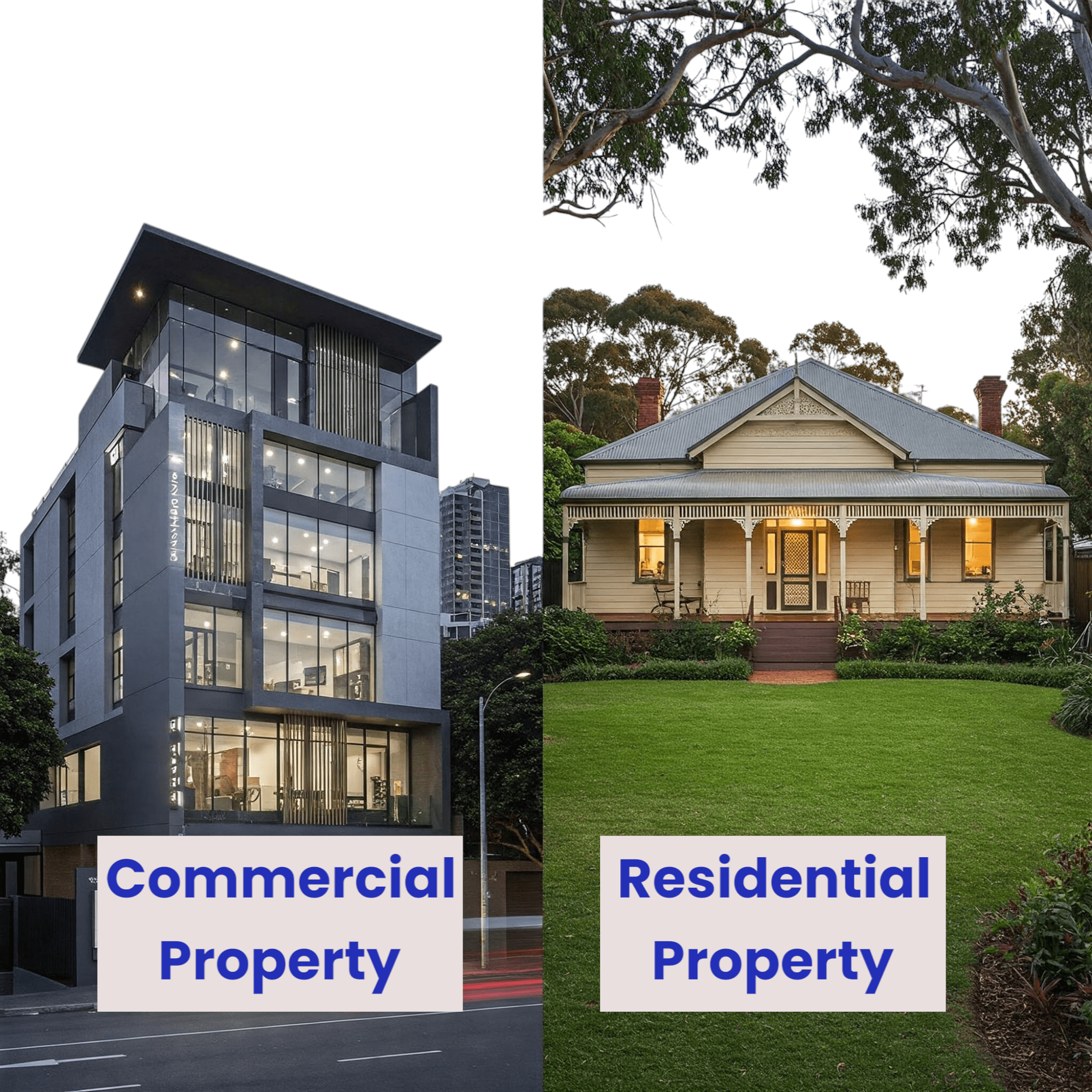
The purchase of commercial property is a vastly different commercial proposition from buying a home. Where residential property is usually driven by emotional or lifestyle choices, commercial real estate is all about business, returns, and long-term growth.

Commercial properties include office buildings, retail spaces, industrial warehouses, and even service stations. Each asset class brings its own risks, tenant types, and income potential. Unlike residential tenants, who tend to come and go, commercial tenants often sign lengthy lease terms, creating more predictable cash flow for investors.

Commercial vs Residential Property

Commercial Property Residential Property
Types Office buildings, retail spaces, warehouses Houses, apartments, condos
Typical Tenants Businesses, corporations Individuals, families
Lease Length Long-term (3–10+ years) Short-term (6–12 months)
Income Stability More predictable Can be less predictable
Management Needs More complex, especially in leased Simpler, almost same lease every time
Risk Profile Higher cost, steadier income Lower cost, more turnover
Operating Hours Usually business hours 24/7 occupancy
Regulation Business zoning, codes Tenant protection laws

A well-selected commercial investment property can balance out a residential property portfolio, providing diversification and access to stronger commercial yields.

An example of this is a property in New Farm, Queensland.
Both cost around $2,000,000. The residential property, 4 bedrooms 2 bathrooms, has a net income of $34,000 annually.
The commercial property 2 retail spaces, 1 office space, with a net income of $127,501 annually

The net income of the commercial property is 3.75 times better than the residential one.

What is Commercial Property Investing?

Commercial property investing involves purchasing a property with the intention of generating a profit through rental income, capital growth, or a combination of both. It is a popular investment strategy among individuals, businesses, and institutions looking to diversify their portfolios and achieve long-term financial goals. Commercial property investing can take many forms, including office buildings, retail spaces, industrial facilities, and more. With the right approach, commercial property investing can provide a stable source of income, tax benefits, and potential for long-term capital growth.

Benefits of Commercial Property Investing

One of the biggest drawcards of commercial property investment is the return. Commercial properties tend to offer significantly higher yields than residential ones, with better potential for capital growth over time.

Lease structures in commercial premises also favor the landlord. Outgoings like repair costs, insurance, and sometimes even goods and services tax (GST) can be passed on to tenants—something rarely possible in residential deals.

Another major perk? If managed right, a commercial property investment can be paid off in ten years or less, setting investors up for strong passive income. For those using self-managed super funds or discretionary trusts, the tax savings can be significant—capital gains tax, for example, may be reduced under certain structures.

Structuring Your Commercial Property Purchase

Choosing the right ownership structure can have a major impact on your financial outcome. Whether it’s through a company, a family trust, or a self-managed super fund, each structure offers unique benefits and tax implications.

A company might access lower corporate tax rates of 25–30%, while discretionary trusts allow income distribution among lower-taxed beneficiaries. Meanwhile, SMSFs are taxed at just 15%—making them a compelling option for long-term commercial investment.

You should always seek advice from an accountant or lawyer to ensure your buying entity is right for your goals and situation.

Comparison of Ownership Structures in Australia

Below is a comparison of Companies, Family Trusts, and Self-Managed Super Funds (SMSFs) with referenced sources.

Aspect Company Discretionary (Family) Trust SMSF
Tax Rate 25% for base rate entities, 30% otherwise.
ATO
Income taxed at beneficiaries’ marginal rates.
ATO
Income taxed at 15% in accumulation phase.
ATO
Income Distribution Profits retained or paid as dividends taxed at shareholders’ marginal rates. Trustee distributes income to beneficiaries.
ATO
Retirement income may be tax-free over age 60.
ATO
Asset Protection Limited liability protects shareholders’ assets. Assets held in trust are generally protected.
ATO
Fund assets protected from creditors.
ATO
Regulatory Requirements Must comply with ASIC and ATO reporting. Governed by trust deed; lighter reporting.
Source
Strict ATO compliance and annual audits.
ATO

Company Tax Rates
Companies in Australia are generally taxed at either 25% or 30%, depending on their size and business type.

  • If the company qualifies as a base rate entity (less than $50 million turnover and mostly active income), it pays 25%.

  • Larger or passive-income-heavy companies pay 30%.

You can confirm these rates directly with the ATO here:
https://www.ato.gov.au/Rates/Company-tax/

Discretionary Trusts
A discretionary trust doesn’t pay tax itself. Instead, the trustee chooses how to distribute the trust income to beneficiaries each year. Those individuals then pay tax at their own marginal rates. This setup can lower overall tax if income is distributed to people on lower tax brackets.

The ATO’s guide on how discretionary trusts are taxed is here:
Type of trust | Australian Taxation Office

Self-Managed Super Funds (SMSFs)
SMSFs are popular for long-term investments like property because of their concessional tax rates.

  • Income is taxed at 15%.

  • If the SMSF sells an asset held for over 12 months, it usually pays only 10% tax on the capital gain.

More details from the ATO:
How SMSFs are taxed | Australian Taxation Office

Minimising Capital Gains Tax

Capital gains tax (CGT) is a significant consideration for commercial property investors. CGT is levied on the profit made from the sale of a commercial property, and it can be a substantial expense. However, there are strategies to minimise CGT, such as:

  • Holding the property for at least 12 months to qualify for the 50% CGT discount

  • Using a self-managed super fund (SMSF) to purchase the property, which can provide tax benefits and CGT relief

  • Implementing a tax-effective ownership structure, such as a trust or company, to reduce CGT liability

  • Consider a CGT rollover or deferral, which can allow investors to delay paying CGT until a later date

It is essential to consult with a tax professional or financial advisor to determine the best strategy for minimising CGT on a commercial property investment.

Financing Your Commercial Property Investment

Unlike residential mortgages, commercial property loans typically require more money upfront—usually a 20–30% deposit. This is one of the reasons many see the purchase of commercial property as having higher barriers to entry.

However, the trade-off is often worth it. Commercial loans tend to deliver better cash flow and in many cases, greater capital growth. Rates and terms can vary depending on the lender, the business premises, and the tenant’s situation.

It’s crucial to check how the loan will impact your business activity statement and whether you’ll need to pay GST on the purchase price (though the margin scheme can sometimes apply). Getting pre-approval before you purchase commercial property will also help with negotiations.

Commercial Property Loans and Interest Rates

Commercial property loans are used to finance the purchase of a commercial property. These loans typically have different interest rates and terms compared to residential property loans. Commercial property loans can be secured by a variety of lenders, including banks, credit unions, and private lenders. Interest rates for commercial property loans can vary depending on factors such as the loan amount, loan term, and borrower’s creditworthiness.

Some common types of commercial property loans include:

  • Fixed-rate loans, which offer a fixed interest rate for a set period

  • Variable-rate loans, which offer a variable interest rate that can change over time

  • Interest-only loans, which allow borrowers to pay only the interest on the loan for a set period

  • Line of credit loans, which provide borrowers with access to a revolving line of credit

It is essential to shop around and compare interest rates and loan terms from different lenders to find the best option for a commercial property investment.
Due Diligence and Research

Before you buy commercial property, it is essential to do your homework. That means going beyond the brochure and diving into the due diligence process.

Searches like title search, rates and water, company checks, and even contaminated land registers are standard. You will also want to review existing leases, check for arrears reports, and ensure the contract correctly identifies all key terms, including market rent, tenant obligations, and whether you are buying premises subject to any conditions.

Always ensure leases are disclosed, and that you have a clear understanding of the settlement date, any additional stamp duty, or whether you’re liable for the next business activity statement period.

Market Trends and Outlook

The commercial property market is subject to various trends and outlooks that can impact investment decisions. Some current trends include:

  • Increased demand for industrial and logistics properties, driven by the growth of e-commerce and online retail

  • Growing interest in sustainable and environmentally friendly commercial properties

  • The shift towards flexible and co-working office spaces, driven by changes in workforce demographics and preferences

  • Increased focus on technology and innovation in commercial property development and management

It is essential to stay informed about market trends and outlooks to make informed investment decisions and maximise returns on a commercial property investment.

Finding and Acquiring Commercial Property

In the commercial market, location is everything. You want solid transport networks, retail amenities, and access that makes it easy for tenants to attract customers.

Look for tenanted buildings with a strong tenancy mix, low vacancy rates, and up-to-date lease terms. If there are vacant shops, understand their commercial viability—can they be leased quickly, or do they present a risk?

It also helps to work with a commercial sales agent or leasing specialist who knows the local commercial property market and can spot good deals and reliable potential tenants. Let McGees Property help you.

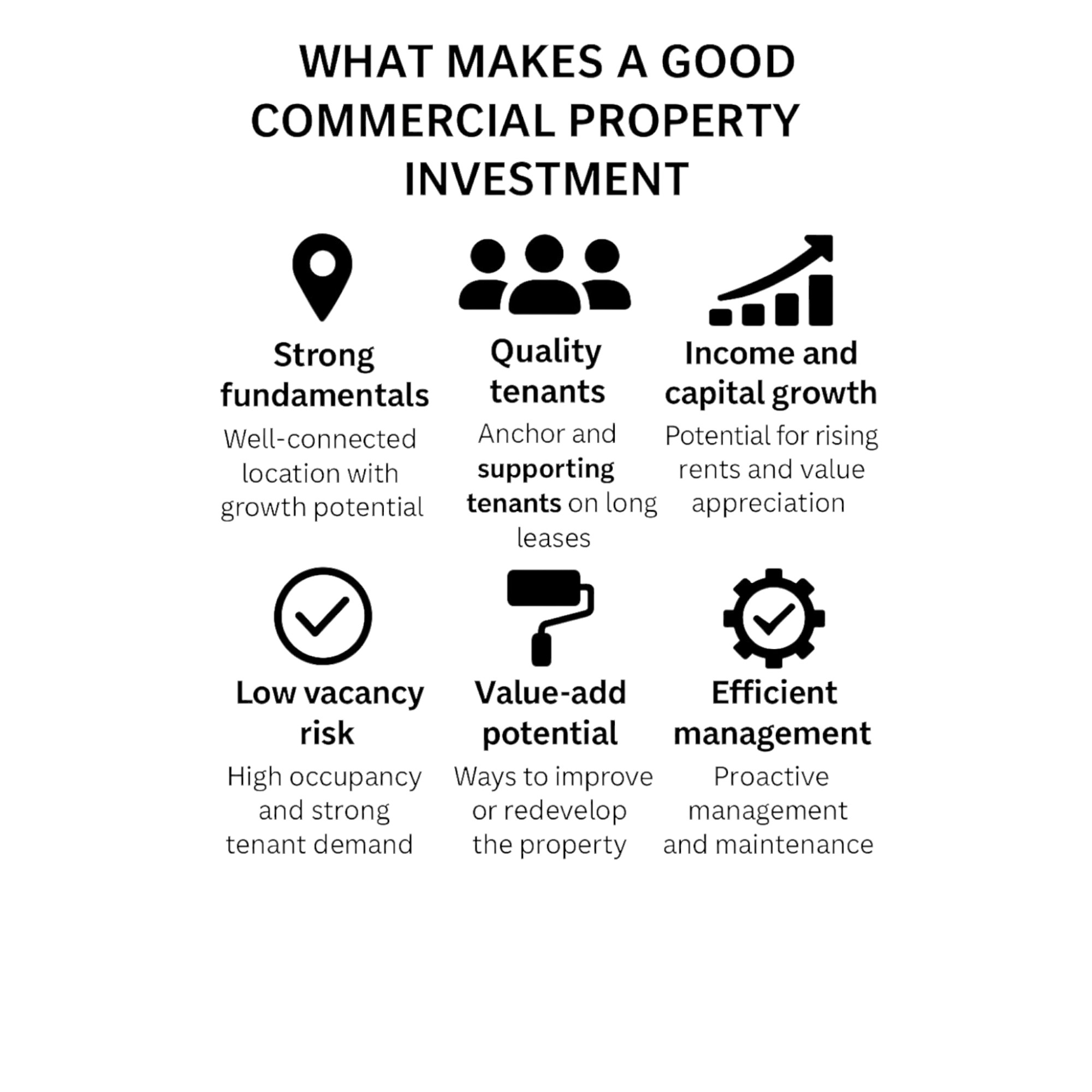
What Makes a Good Commercial Investment?

A good commercial investment property typically has a combination of the following characteristics:

Location with Economic Fundamentals

A property located in a well-connected area with strong population or business growth, and close proximity to infrastructure, services, and complementary businesses, tends to attract consistent tenant demand and long-term value.

High-Quality and Diversified Tenant Mix

A good commercial investment includes reliable tenants who are financially stable, operate with a sound business model, and understand their profit and loss. Ideally, There is a mix of main and smaller tenants, each with long leases that end at different times. This helps keep income steady and reduces the risk of having the whole building empty at once. This provides a stable cash flow, reduces vacancy risk, and enhances the property’s resilience during market fluctuations.

Potential for Income and Capital Growth

Properties with built-in rental escalations, potential for market rent increases, or located in areas undergoing gentrification or infrastructure upgrades offer the opportunity for both improved rental income and long-term capital appreciation.

Low Vacancy Risk and Strong Market Demand

Assets located in areas with high occupancy levels and limited supply of comparable properties are more likely to retain tenants, attract new ones quickly, and maintain steady income even in softer markets.

Opportunities to Add Value

Properties that offer potential for refurbishment, lease restructuring, improved management, or future redevelopment can unlock additional value, increasing both income and the asset’s market worth.

Sustainable Operating Costs and Regulatory Compliance

A building with efficient outgoings and full compliance with zoning, fire safety, building regulations, and environmental standards is more attractive to tenants and helps preserve long-term investment value.

Strong Property Management

Proactive and professional property management ensures tenants are supported, lease obligations are met, maintenance is up to date, and rental income is collected on time—all of which contribute to investment performance and asset preservation.

It is essential to conduct thorough research and due diligence to identify a good commercial investment property that meets these criteria and aligns with investment goals and risk tolerance.

Adding Value to Your Commercial Investment

Adding value to your commercial investment doesn’t always mean a major renovation. Strategic moves like buying under market value, subdividing spaces, or adding features like storage or parking can boost your asset’s appeal.

Extending the lease term, upgrading fit-outs, or negotiating better terms during a lease review can also increase the value of your investment property. A more secure income stream means a higher valuation down the line—and better terms if you ever sell.

Investing in Commercial Property in Australia

The Australian commercial property market is worth over $11 trillion and continues to be a key part of many investor portfolios. However, like all investments, timing and strategy matter.

Some commercial property types—like office spaces—are more sensitive to economic shifts, while others, such as industrial or retail space, tend to be more stable. Choosing a recession-proof asset and assessing its long-term demand is critical.

Investors should also keep an eye on interest rates, broader market trends, and legislative changes impacting stamp duty, capital gains tax, and the way GST is generally imposed.

Final thought

Purchasing a commercial property is not something to take lightly. It is a major commitment and one with many moving parts—from lease reviews and ownership structures to commercial property loans and tax planning.

Always have a seller’s lawyer review the sale contract, and make sure you understand your rights and obligations before signing. The right investment journey starts with smart planning, good advice, and a clear understanding of the commercial proposition in front of you.

With the right team, the right property, and the right plan, investing in commercial real estate can be a great investment—one that provides strong returns, consistent cash flow, and long-term growth.

Contact Gavin Moore today to help you purchase your commercial real estate today.

For a complete list of weekly commercial transactions in Queensland, visit McGees Wrap Up | McGees Property Brisbane

Disclaimer: The information provided in this blog is for general informational purposes only and does not constitute legal, financial, or professional advice. While we strive for accuracy, we make no guarantees regarding the completeness or timeliness of the content. Always seek independent advice before making any financial or real estate decisions. We are not liable for any loss or damages arising from your reliance on the information provided.

Liability Limited by a Scheme approved under Professional Standards Legislation

Latest News

McGees Wrap Up 23 October 2026

October 23, 2026

McGees Wrap Up 23 October 2026

Queensland Commercial Property Weekly Wrap-Up Week Ending 23 October 2026 South East Queensland commercial property is accelerating as the 2032 Olympic deadline forces developers and investors to lock in projects before resource bottlenecks intensify. Population growth continues to fuel exceptional…

October 23, 2026 McGees Wrap Up
McGees Wrap Up 16 October 2026

October 16, 2026

McGees Wrap Up 16 October 2026

Market Overview Queensland commercial property is drawing intense local and cross-border capital as investors race to secure assets ahead of long-term infrastructure delivery (Bleby, 2026; Lenaghan, 2026). The Brisbane central business district office sector has reached Australia's tightest vacancy rate…

October 16, 2026 McGees Wrap Up
McGees Wrap Up 9 October 2026

October 9, 2026

McGees Wrap Up 9 October 2026

Market Overview South East Queensland commercial property continues to experience fierce capital competition driven by severe supply constraints and infrastructure connectivity. While broader macroeconomic headwinds such as falling building approvals and rising retail operational costs challenge feasibility, developers and investors…

October 9, 2026 McGees Wrap Up

October 1, 2026

McGees Wrap Up 2 October 2026

Rising sovereign bond yields and tight consumer budgets are testing commercial property valuations across Queensland, but capital continues to find a home where tenant demand and infrastructure investment remain clear. Australian ten-year government bond yields have climbed past 5.3 per…

October 1, 2026 McGees Wrap Up
View all

Over 45 years of national property excellence.

Contact our experienced team today.

First Name(Required)
Last Name(Required)

Commercial Property Investment Terms Explained

April 4, 2025

1. Asset

Definition: An asset is something valuable that you own and that can make you money in the future.
Example: A rental property in Brisbane is an asset because it can generate rental income and may increase in value over time.

2. Capital Gain

Definition: This is the profit you make when you sell an investment for more than what you paid for it.
Example: You bought shares in Telstra for $1,000 and sold them later for $1,500. The $500 profit is your capital gain.

3. Capital Gains Tax (CGT)

Definition: This is the tax you pay on your capital gains.
Example: If you made a $500 profit from selling those Telstra shares, a portion of that gain may be taxed when you lodge your income tax return in Australia.

4. Dividend

Definition: A dividend is money paid by a company to its shareholders, usually from its profits.
Example: You own shares in the Commonwealth Bank, and every six months they pay you a dividend of $2 per share.

5. Franked Dividend

Definition: This is a dividend where the company has already paid tax on the profit. The franking credit can reduce the tax you pay.
Example: You receive a $70 dividend that is 100% franked. You may get a tax credit for the tax the company already paid on that profit.

6. Managed Fund

Definition: A managed fund pools money from many investors, and a professional manager invests it in a mix of assets like shares, property, or bonds.
Example: You invest $5,000 in a managed fund that includes Australian shares, global shares, and property trusts.

7. Exchange-Traded Fund (ETF)

Definition: An ETF is similar to a managed fund but is traded on the stock exchange like a share.
Example: You buy an ETF that tracks the top 200 companies on the ASX (Australian Securities Exchange). The value goes up and down depending on those companies’ performance.

8. Superannuation (Super)

Definition: Superannuation is money saved for your retirement. Employers must pay at least 11% of your wages into your super fund.
Example: You earn $80,000 per year, and your employer contributes $8,800 into your superannuation account annually.

9. Negative Gearing

Definition: This happens when the cost of owning an investment (like a rental property) is more than the income it earns. The loss may reduce your taxable income.
Example: Your rental property costs $25,000 per year to maintain, but it only earns $20,000 in rent. You can claim the $5,000 loss to reduce your income tax.

10. Positive Gearing

Definition: When your investment earns more than it costs to own, it is positively geared.
Example: You receive $30,000 in rent from a property, but the total expenses (mortgage, maintenance, etc.) are only $20,000. You keep the $10,000 profit.

11. Portfolio

Definition: A portfolio is a collection of all your investments.
Example: Your portfolio might include shares in BHP, a Brisbane apartment, an ETF, and a term deposit.

12. Diversification

Definition: This means spreading your investments across different assets to reduce risk.
Example: Instead of putting all your money into one company’s shares, you invest in shares, property, and a managed fund.

13. Return on Investment (ROI)

Definition: ROI is a measure of how much money you earn compared to how much you invested.
Example: If you invest $10,000 in shares and earn $1,000 profit, your ROI is 10%.

14. Shares (or Stocks)

Definition: Shares represent ownership in a company. If you own shares, you own a part of that company.
Example: If you own 100 shares in Woolworths, you are one of the owners of the company and may receive dividends.

15. Bond

Definition: A bond is a loan you give to a company or government. In return, they pay you interest over time and return your money at the end.
Example: You buy a $10,000 government bond paying 4% per year. You receive $400 every year until the bond matures.

16. Risk Profile

Definition: Your risk profile is how much risk you are comfortable with when investing.
Example: If you are young and can handle ups and downs, you might be a high-risk investor. If you are retired, you may prefer lower-risk options like term deposits.

17. Liquidity

Definition: Liquidity is how quickly you can access your money from an investment.
Example: Shares are usually liquid because you can sell them on the ASX quickly. Property is less liquid because it takes time to sell.

18. Blue Chip Stocks

Definition: These are shares in large, reliable, and financially strong companies with a history of steady performance.
Example: Companies like CSL, BHP, or Westpac are often considered blue-chip stocks in Australia.

19. Property Trust (REIT – Real Estate Investment Trust)

Definition: This is a type of fund that owns income-producing property. Investors earn a share of the rental income.
Example: You invest in a listed property trust that owns shopping centres and earns rental income from tenants like Coles and JB Hi-Fi.

20. Leverage

Definition: Leverage means borrowing money to invest, aiming to increase returns.
Example: You use a loan to buy an investment property worth $800,000. If the value rises to $900,000, your gain is much higher compared to only investing with your own money.

21. Gross Rental Income

Definition: This is the total income received from a commercial tenant before any expenses are taken out.
Example: A tenant pays you $60,000 per year in rent for your warehouse. That full $60,000 is your gross rental income.

22. Net Rental Income

Definition: This is the income you receive after expenses like rates, maintenance, and management fees have been deducted.
Example: From the $60,000 annual rent, you pay $5,000 in council rates and $2,000 in management fees. Your net income is $53,000.

23. Net Lettable Area (NLA)

Definition: This is the usable area of a commercial space that you can lease out to tenants.
Example: An office has 1,000 square metres of floor space, but 100 square metres are common areas like toilets and lifts. The NLA is 900 square metres.

24. Outgoings

Definition: These are the running costs of the property, often passed on to the tenant.
Example: Rates, insurance, water, cleaning of shared areas, and land tax can be classified as outgoings. A commercial tenant usually pays these on top of the rent.

25. Face Rent vs Effective Rent

Face Rent: The advertised rent without any incentives or discounts.
Effective Rent: The actual rent after incentives (such as rent-free periods) are factored in.
Example: You sign a lease at $500 per square metre per year (face rent), but offer six months rent-free in a five-year lease. The effective rent is lower when averaged over five years.

26. Capitalisation Rate (Cap Rate)

Definition: A rate used to estimate the value of an income-producing property. It is calculated as net income divided by property value.
Example: A building earning $100,000 in net rent per year with a cap rate of 5% is worth $2,000,000 ($100,000 ÷ 0.05).

27. Yield

Definition: Yield is the return you earn from a property, expressed as a percentage of the purchase price.
Example: You buy a small shop for $800,000 and it earns $56,000 net rent per year. Yield = 7% ($56,000 ÷ $800,000).

28. Lease Term

Definition: The length of time the tenant agrees to rent the property.
Example: A 5 + 5 year lease means five years initially, with the option to renew for another five.

29. CPI Increase (Consumer Price Index)

Definition: A lease clause where the rent increases in line with inflation, based on the CPI published by the ABS.
Example: If CPI rises by 3%, then rent increases by 3% that year.

30. Market Rent Review

Definition: This is when the rent is reviewed and adjusted to reflect current market conditions.
Example: Every five years, the lease allows the rent to be reviewed. If similar properties in the area are charging more, the rent may increase to match.

31. Fixed Annual Increase

Definition: A lease clause where rent increases by a fixed percentage each year.
Example: Rent increases by 4% each year, regardless of inflation or market conditions.

32. Make Good Clause

Definition: A condition in a commercial lease where the tenant must return the property to its original condition at the end of the lease.
Example: A café tenant must remove all fittings and repaint the walls before vacating the shop.

33. Vacancy Rate

Definition: The percentage of all available commercial properties that are unoccupied. It is used to understand demand and market health.
Example: If 3 out of 100 shops in a suburb are empty, the vacancy rate is 3%.

34. Incentives

Definition: Benefits given to attract tenants, such as rent-free periods or fit-out contributions.
Example: You offer three months’ free rent to a new tenant who signs a five-year lease.

35. Tenant Covenant

Definition: This refers to the financial strength and reliability of a tenant. A strong covenant means a tenant is likely to pay rent on time and stay for the full lease term.
Example: A government agency or national supermarket chain is usually considered a strong tenant covenant.

36. Strata Title

Definition: This means you own a commercial unit (such as an office suite or a shop) within a larger complex, and share responsibility for common areas.
Example: You buy a 100 square metre office in a mixed-use building with shared lifts and bathrooms. You pay strata fees for maintenance of these shared areas.

37. Freehold vs Leasehold

Freehold: You own the land and building outright.
Leasehold: You lease the land from another party (like the government) for a set time.
Example: Many petrol stations in Australia operate on leasehold land, while a standalone retail shop may be freehold.

38. Heads of Agreement (HOA)

Definition: A preliminary document that outlines the main terms of a commercial lease before the formal lease is signed.
Example: You and a tenant agree on rent, lease term, and fit-out period. These are written in an HOA before the lawyer prepares the final lease.

39. Gross Lease vs Net Lease

Gross Lease: The landlord pays all or most outgoings.
Net Lease: The tenant pays rent plus all outgoings.
Example: In a gross lease, you charge $70,000 per year and pay rates yourself. In a net lease, the tenant pays $60,000 plus all outgoings.

40. Due Diligence

Definition: The process of checking everything before buying a commercial property — leases, zoning, maintenance issues, tenant history, etc.
Example: Before buying an office building, you check that the tenant is paying rent on time and that there are no structural problems with the building.

41. Depreciation

Definition: A tax deduction you can claim over time for wear and tear on the building and assets.
Example: You buy a commercial property with a new air-conditioning system. You can claim depreciation each year on that system through a quantity surveyor’s report.

42. WALE (Weighted Average Lease Expiry)

Definition: WALE tells you the average time left until leases expire across all tenancies in a building, weighted by how much income each tenant contributes. A longer WALE usually means more stability.
Example:
You own a retail centre with three tenants:

  • Tenant A pays $50,000 and has 2 years left

  • Tenant B pays $30,000 and has 1 year left

  • Tenant C pays $20,000 and has 0.5 years left

WALE = (50k×2 + 30k×1 + 20k×0.5) ÷ ($100,000 total rent) = 1.15 years

In Plain Language:
It means that, on average, the tenants in this property have just over one year left on their leases. This is based on how much rent they pay. A WALE of 1.15 years suggests that most leases are short-term or coming up for renewal soon.

Why it matters:

  • A short WALE (like 1.15 years) means there could be more leasing risk because tenants might leave soon.

  • A long WALE (for example, 5 years) usually means more income security.

43. Gearing

Given: Gearing: 50%
Definition: Gearing refers to how much of the investment is funded by borrowed money (debt) compared to how much is funded by investor money (equity). It is usually expressed as a percentage.

In Plain Language:
With 50% gearing, half of the purchase price of the property is funded by a loan, and the other half is funded by investor contributions.

Why it matters:

  • Higher gearing means more borrowing, which can increase returns if the property performs well, but also adds risk if interest rates rise or the value falls.

  • Lower gearing means less risk but also lower potential return.

Example:
You buy a property for $10 million:

  • Loan: $5 million (50%)

  • Investor equity: $5 million (50%)
    That is 50% gearing.

44. Investment Term

Definition: This is the planned period during which your money will remain invested in the property before it is sold or the investment is wound up.

In Plain Language:
For example, you are committing your money to this investment for 5 years. During this time, the property will be managed, rented out, and may grow in value. After 5 years, the property is usually sold, and profits are shared.

Why it matters:

  • You should not expect to access your money during this time.

  • It gives time for the property to stabilise and grow in value.

Example:
You invest $100,000 in a commercial property syndicate with a 5-year term. After 5 years, the property is sold and your share of the profit (capital gain) is returned, along with any income earned along the way.

45. Targeted Cash Return

Given: 10%+ per annum cash return at 90% occupancy
Definition: This is the annual income you are expected to receive from your investment — paid to you as cash — not including any capital growth from the sale of the property.

In Plain Language:
If the building stays at least 90% leased, you should receive 10% or more every year in cash, based on how much you invested.

Why it matters:

  • This is your income return, separate from any profit made when the property is eventually sold.

  • It depends on occupancy. If more space becomes vacant, the return could drop.

Example:
You invest $100,000 into the property.
If the cash return is 10%, you will receive $10,000 per year, likely paid quarterly or monthly.
This return assumes the property stays at least 90% leased.

47. Form 6

Form 6 is a standard contract used in Queensland under the Property Occupations Act 2014. It is required when appointing a real estate agent to manage, lease, or sell a property on your behalf. It sets out the scope of the agent’s authority, their commission, and the duration of their appointment.

Example:
If you are the owner of a commercial office building and want to engage a property agent to lease it, you must sign a Form 6. The form will detail the leasing fees, how long the agent will act for you, and what they are allowed to do (e.g. negotiate rent, sign leases, collect rent).

47. Title Office (also known as Land Titles Office)

Explanation:
The Title Office is the government body that keeps official records of who owns land and property. In Queensland, this is handled by the Queensland Titles Registry. When you buy or sell a property, the transaction must be registered with the Titles Office to make the change in ownership official.

Example:
After buying a retail shop, your solicitor lodges paperwork with the Titles Office to transfer the title from the seller to your name. Once registered, you officially become the owner in the eyes of the law.

48. Building Classification

  • Under the Building Code of Australia, every building is given a classification based on its intended use (e.g. commercial, industrial, or residential).

  • Each classification comes with specific construction and safety standards.
    Example:
    An office building is typically classified as Class 5, while a storage warehouse might be Class 7b.

49. Zoning

  • Zoning rules are set by local councils to determine what type of activity can occur on a piece of land.

  • Common zones include residential, commercial, industrial, and mixed-use.
    Example:
    A property zoned as “Centre Zone” may allow for uses like shops, restaurants, and office spaces, but not heavy industry.

50. Survey Plan

  • A survey plan is a legal document showing the exact boundaries, shape, and size of a piece of land.

  • It can also show easements, encroachments, and access points.
    Example:
    Before buying a vacant commercial block, your solicitor checks the survey plan to confirm that the fence does not cross over into neighbouring land.

51. Option to Renew

  • This is a clause in a lease that gives the tenant the right to extend their lease for another term, usually under the same or slightly revised terms.

  • It provides security to tenants and can also help investors keep reliable tenants longer.
    Example:
    A retail lease is signed for five years with an option to renew for another five years. If the tenant exercises the option, the lease continues for a total of ten years.

52. Encumbrance

  • An encumbrance is a legal burden or interest registered on the title of a property. It can include easements, mortgages, covenants, or restrictions.

  • It is important to identify any encumbrances before purchasing a property, as they can affect how the land is used or developed.
    Example:
    A telecommunications company has a right to access a strip of land on your property where cables are laid. This right is recorded as an encumbrance on the title.

53. Exclusive Agency

  • This is a type of agreement where only one agent is appointed to sell or lease a property during a specific period.

  • The agent is entitled to a commission if the property is sold or leased, even if the owner finds the buyer or tenant themselves.
    Example:
    You appoint one agent to lease your office space under an exclusive agency for 90 days. If you find a tenant during that time, the agent still gets paid.

54. Gross Building Area (GBA)

  • This refers to the total floor area of a building, including all internal and external walls.

  • It is commonly used in industrial and warehouse property measurements.
    Example:
    A warehouse has a Gross Building Area of 1,200 square metres, which includes all usable floor space and wall thickness.

55. Landlord Disclosure Statement

  • A document that a landlord must give a potential commercial or retail tenant before signing a lease.

  • It outlines key details such as lease terms, outgoings, rent reviews, and known risks.
    Example:
    Before a café signs a lease in your retail complex, you must give them a Landlord Disclosure Statement showing all the financial commitments and conditions.

56. Tenant Mix

  • This refers to the combination of tenants in a shopping centre or multi-tenant property. A well-balanced tenant mix can improve foot traffic and tenant success.
    Example:
    A small retail centre has a supermarket, pharmacy, bakery, and hair salon. This tenant mix serves daily needs and encourages cross-shopping.

57. Property Condition Report (PCR)

  • A written report that documents the condition of the property at the start of a lease.

  • It protects both landlord and tenant by providing a reference in case of disputes at the end of the lease.
    Example:
    Before handing over the keys to a tenant, you prepare a Property Condition Report showing photos of the clean walls, floors, and lighting fixtures.

58. Rental Bond (Security Bond)

  • A sum of money paid by the tenant at the beginning of the lease as security against unpaid rent or property damage.

  • In commercial leases, the bond is usually 3 to 6 months’ worth of rent and may be held as a bank guarantee or cash deposit.
    Example:
    A tenant leasing your industrial shed pays a rental bond equal to four months’ rent. If they leave damage behind, you can claim against the bond.

59. Make Good Obligation

  • A legal obligation in a lease requiring the tenant to return the property in its original condition when they vacate.

  • This may include repainting, removing partitions, or repairing damages.
    Example:
    At lease end, your office tenant must remove the desks and partitions they installed and repaint the walls as part of their make good obligation.

60. Retail Shop Lease Act (Queensland)

  • A law that protects tenants of retail premises in Queensland. It includes rules about disclosure, minimum lease terms, rent reviews, and dispute resolution.
    Example:
    If you lease a shop in a shopping centre in Queensland, your lease is governed by the Retail Shop Lease Act, and you must follow its requirements, such as giving the disclosure statement at least seven days before lease signing.

61. Permitted Use

  • This defines what the tenant is legally allowed to use the premises for, as outlined in the lease agreement.

  • It must align with the zoning and council approvals.
    Example:
    A lease says the tenant may use the space for a bakery. If they later want to run a café, they need landlord consent and council approval.

62. Fit-Out Period (Rent-Free Fit-Out Period)

  • A rent-free period given at the beginning of the lease to allow the tenant to fit out the premises without paying rent.
    Example:
    Your new tenant signs a 5-year lease for a fashion store. You offer them a 2-month rent-free fit-out period so they can install shelves, lighting, and displays before opening.

To be continue

For a complete list of weekly commercial transactions in Queensland, visit McGees Wrap Up | McGees Property Brisbane

Disclaimer: The information provided in this blog is for general informational purposes only and does not constitute legal, financial, or professional advice. While we strive for accuracy, we make no guarantees regarding the completeness or timeliness of the content. Always seek independent advice before making any financial or real estate decisions. We are not liable for any loss or damages arising from your reliance on the information provided.

Liability Limited by a Scheme approved under Professional Standards Legislation

Latest News

McGees Wrap Up 23 October 2026

October 23, 2026

McGees Wrap Up 23 October 2026

Queensland Commercial Property Weekly Wrap-Up Week Ending 23 October 2026 South East Queensland commercial property is accelerating as the 2032 Olympic deadline forces developers and investors to lock in projects before resource bottlenecks intensify. Population growth continues to fuel exceptional…

October 23, 2026 McGees Wrap Up
McGees Wrap Up 16 October 2026

October 16, 2026

McGees Wrap Up 16 October 2026

Market Overview Queensland commercial property is drawing intense local and cross-border capital as investors race to secure assets ahead of long-term infrastructure delivery (Bleby, 2026; Lenaghan, 2026). The Brisbane central business district office sector has reached Australia's tightest vacancy rate…

October 16, 2026 McGees Wrap Up
McGees Wrap Up 9 October 2026

October 9, 2026

McGees Wrap Up 9 October 2026

Market Overview South East Queensland commercial property continues to experience fierce capital competition driven by severe supply constraints and infrastructure connectivity. While broader macroeconomic headwinds such as falling building approvals and rising retail operational costs challenge feasibility, developers and investors…

October 9, 2026 McGees Wrap Up

October 1, 2026

McGees Wrap Up 2 October 2026

Rising sovereign bond yields and tight consumer budgets are testing commercial property valuations across Queensland, but capital continues to find a home where tenant demand and infrastructure investment remain clear. Australian ten-year government bond yields have climbed past 5.3 per…

October 1, 2026 McGees Wrap Up
View all

Over 45 years of national property excellence.

Contact our experienced team today.

First Name(Required)
Last Name(Required)

Understanding the Make Good Provision: Essential Insights for Tenants

March 21, 2025

Table of Contents:[hide]

What is a Make-Good Clause?

A “make good” clause is a standard part of most commercial leases. It sets out what condition the tenant must leave the property in at the end of the lease.

In simple terms, it usually means returning the space to its original state—minus normal wear and tear. The goal is to avoid disputes and make turnover smoother for both landlord and tenant.

Understanding this clause clearly is key to avoiding unnecessary conflict when your lease ends.

Types of Make-Good Obligations

1. Basic Make Good
Just remove your belongings and leave the place clean and tidy.

2. Extended Make Good
This includes a deep clean, repainting, and carpet cleaning to restore the space more closely to its original condition.

3. Full Make Good
You’ll be expected to strip out all fixtures, furniture, and finishes—restoring the space to a “warm shell” or original base build. This often includes ceiling tiles, lighting, and mechanical services.

Full make-good costs vary but are typically in the range of $200–$300 per square metre (source). Managing this process yourself can save money but comes with risk, especially if settling in cash with the landlord.

Negotiating the Clause

  • Always review the make good clause before signing a lease.

  • If anything is unclear, ask for clarification or negotiate adjustments.

  • Landlords should ensure the clause is specific, fair, and enforceable.

  • A well-drafted clause protects both parties and minimises future issues.

Understanding Your Obligations

Your make good responsibilities usually involve returning the property to its original state when your lease ends. This can include:

  • Repairing damage

  • Removing fit-outs

  • Cleaning or repainting

It’s different from a “redecoration clause”, which usually relates to regular upkeep during the lease—like repainting or replacing worn carpet.

Managing Make Good Responsibly

  • Make sure your office fit-out aligns with your make good obligations.

  • Do a condition report when you move in to document existing damage.

  • Fix any damage as it happens to avoid a bigger bill later.

  • Keeping the property well-maintained throughout your lease will make the end-of-lease process smoother.

Alternatives to Make Good

In some cases, tenants and landlords agree to a cash settlement instead of physical reinstatement. This can work well—especially if:

  • The landlord wants to refit the space anyway

  • You want a faster exit

  • Both parties want certainty on costs

That said, negotiate the amount carefully, and get legal advice before accepting or proposing a cash alternative.

Are These Clauses Enforceable?

Yes—but with limits.

  • If a tenant doesn’t meet make good obligations, the landlord may claim damages based on how the property’s value was affected.

  • If repairs aren’t done, landlords may also seek to recover the cost of the work directly.

However, what’s enforceable depends on the specific wording of the lease. That’s why clarity from day one is important.

Lease Transfers & Make Good

If you’re taking over someone else’s lease (assignment of lease), your make good duties often relate to the condition of the space when the original lease was signed—not when you moved in.

That’s why it’s essential to:

  • Get photos or records of the property’s original state

  • Understand what work might be required when your lease ends

This helps avoid surprises later.

Handling Make-Good Disputes

If issues arise at the end of your lease, here’s how to approach them:

  1. Review the lease clause to understand what’s actually required.

  2. Talk to the other party and try to reach agreement.

  3. Seek legal advice—especially if the lease terms are complex.

  4. Consider mediation through the Queensland Small Business Commissioner if needed (for claims up to $750,000).

  5. If unresolved, you can escalate the matter to QCAT for retail lease disputes.

Final Word

Make good clauses can feel complex, but they are a normal part of commercial leasing. The key is to understand your obligations up front, manage the property responsibly, and be proactive when your lease is ending.

Tenants should always review this clause carefully before signing, and landlords should make sure it’s clear and fair. When managed well, the make good process protects both parties—and avoids stress when it’s time to move on.

If you own property in Brisbane, the Gold Coast or Sunshine Coast and need expert support with tenant management and lease compliance, reach out to the team at McGees Property—we are here to take care of it for you.

Get in touch with Brad Sheppard for expert support in leasing, managing, and protecting your commercial asset. With the experience to navigate make good provisions and ensure compliance, Brad can take the hassle off your hands.

For a complete list of weekly commercial transactions in Queensland, visit McGees Wrap Up | McGees Property Brisbane

Disclaimer: The information provided in this blog is for general informational purposes only and does not constitute legal, financial, or professional advice. While we strive for accuracy, we make no guarantees regarding the completeness or timeliness of the content. Always seek independent advice before making any financial or real estate decisions. We are not liable for any loss or damages arising from your reliance on the information provided.

Liability Limited by a Scheme approved under Professional Standards Legislation

Latest News

McGees Wrap Up 23 October 2026

October 23, 2026

McGees Wrap Up 23 October 2026

Queensland Commercial Property Weekly Wrap-Up Week Ending 23 October 2026 South East Queensland commercial property is accelerating as the 2032 Olympic deadline forces developers and investors to lock in projects before resource bottlenecks intensify. Population growth continues to fuel exceptional…

October 23, 2026 McGees Wrap Up
McGees Wrap Up 16 October 2026

October 16, 2026

McGees Wrap Up 16 October 2026

Market Overview Queensland commercial property is drawing intense local and cross-border capital as investors race to secure assets ahead of long-term infrastructure delivery (Bleby, 2026; Lenaghan, 2026). The Brisbane central business district office sector has reached Australia's tightest vacancy rate…

October 16, 2026 McGees Wrap Up
McGees Wrap Up 9 October 2026

October 9, 2026

McGees Wrap Up 9 October 2026

Market Overview South East Queensland commercial property continues to experience fierce capital competition driven by severe supply constraints and infrastructure connectivity. While broader macroeconomic headwinds such as falling building approvals and rising retail operational costs challenge feasibility, developers and investors…

October 9, 2026 McGees Wrap Up

October 1, 2026

McGees Wrap Up 2 October 2026

Rising sovereign bond yields and tight consumer budgets are testing commercial property valuations across Queensland, but capital continues to find a home where tenant demand and infrastructure investment remain clear. Australian ten-year government bond yields have climbed past 5.3 per…

October 1, 2026 McGees Wrap Up
View all

Over 45 years of national property excellence.

Contact our experienced team today.

First Name(Required)
Last Name(Required)

Make Good Obligations: A Quick Guide for Tenants and Landlords

February 17, 2025

Make Good

Time and time again we experience conflict with tenants at the end of a lease over the terms and conditions of the Make Good obligations.

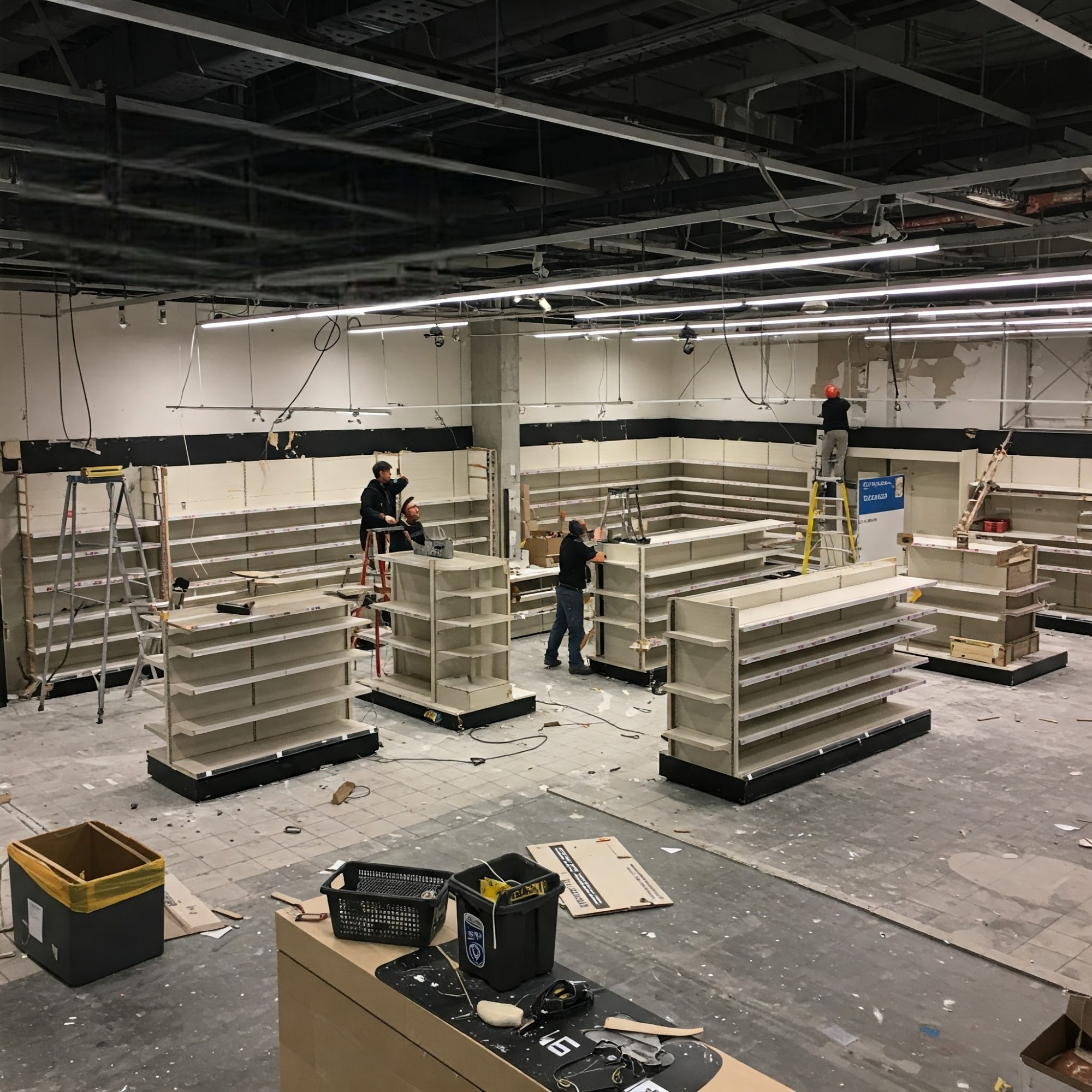
Requiring a tenant to make good commercial premises at the end of a lease term is a reasonable expectation of the landlord. The makegood can take many forms from a simple clean to a full removal of all fixtures and fittings and return to base build configuration. The details of the obligations will be documented in the lease and it is up to the tenant to make sure they understand what is expected at the end of the lease.

This topic remains the leading point of contention with tenants as most do not pay enough attention to establishing a clear understanding of what is expected. Given the make good is completed at the end of the lease, if the cost has not been budgeted it can lead to an unwelcome surprise. Often we are confronted with a scenario where the tenant is totally unaware there is an obligation until we bring it to their attention.

The best time for a tenant to establish an understanding of this topic is at the start of lease negotiations. A clear understanding of the Landlords expectations can help in the negotiation process and may also establish how the tenant treats the premises during the lease term. Seeking leniency at the end of the lease term is too late, especially if it is in poor condition.

A clear and detailed Entry Condition Report (ECR) with photos is a must for every tenant and landlord. It is impossible to argue with a photo and the ECR provides the best evidence of tenancy condition for both parties at the start of the lease.

Establishing a clear understanding of the wording in the lease is also important. For instance, a tenant may have moved into premises that had been fitted out by an earlier occupant. Given that scenario the tenant may think that anything to do with the existing fitout does not apply to them. However, some leases carry a condition that the make good applies to any fittings that are in place, even if installed by a previous tenant. This example is a simple case of a few words making a big difference to a tenants cost when exiting the premises.

Tenants should always seek legal advice in this matter as understanding the obligation at lease end will save a lot of time and angst when it is least welcomed.

For a complete list of weekly commercial transactions in Queensland, visit McGees Wrap Up | McGees Property Brisbane

Disclaimer: The information provided in this blog is for general informational purposes only and does not constitute legal, financial, or professional advice. While we strive for accuracy, we make no guarantees regarding the completeness or timeliness of the content. Always seek independent advice before making any financial or real estate decisions. We are not liable for any loss or damages arising from your reliance on the information provided.

Liability Limited by a Scheme approved under Professional Standards Legislation
Latest News

McGees Wrap Up 23 October 2026

October 23, 2026

McGees Wrap Up 23 October 2026

Queensland Commercial Property Weekly Wrap-Up Week Ending 23 October 2026 South East Queensland commercial property is accelerating as the 2032 Olympic deadline forces developers and investors to lock in projects before resource bottlenecks intensify. Population growth continues to fuel exceptional…

October 23, 2026 McGees Wrap Up
McGees Wrap Up 16 October 2026

October 16, 2026

McGees Wrap Up 16 October 2026

Market Overview Queensland commercial property is drawing intense local and cross-border capital as investors race to secure assets ahead of long-term infrastructure delivery (Bleby, 2026; Lenaghan, 2026). The Brisbane central business district office sector has reached Australia's tightest vacancy rate…

October 16, 2026 McGees Wrap Up
McGees Wrap Up 9 October 2026

October 9, 2026

McGees Wrap Up 9 October 2026

Market Overview South East Queensland commercial property continues to experience fierce capital competition driven by severe supply constraints and infrastructure connectivity. While broader macroeconomic headwinds such as falling building approvals and rising retail operational costs challenge feasibility, developers and investors…

October 9, 2026 McGees Wrap Up

October 1, 2026

McGees Wrap Up 2 October 2026

Rising sovereign bond yields and tight consumer budgets are testing commercial property valuations across Queensland, but capital continues to find a home where tenant demand and infrastructure investment remain clear. Australian ten-year government bond yields have climbed past 5.3 per…

October 1, 2026 McGees Wrap Up
View all

Over 45 years of national property excellence.

Contact our experienced team today.

First Name(Required)
Last Name(Required)

Understanding Gross Lease: Outgoings in Commercial Leases Including Net, and Semi-Gross Leases

December 16, 2024

Table of Contents:[hide]

Understanding Lease Structures: Gross, Net, and Semi-Gross Leases Explained

Leasing commercial property isn’t just about securing a tenant—it’s about choosing the right lease structure to suit the asset, the landlord’s objectives, and the tenant’s needs. One of the key factors in any lease is how outgoings—the running costs of the property—are handled.

Outgoings typically include things like council rates, insurance, repairs and maintenance, property management fees, and cleaning of common areas. The way these expenses are recovered defines the lease structure and can significantly impact both cash flow and tenant satisfaction.

What Are Outgoings in Commercial Leases?

Outgoings (or operating expenses) are the day-to-day costs of owning and managing a commercial property. These may include:

  • Council rates
  • Building insurance
  • Routine repairs and maintenance
  • Property management fees
  • Cleaning and upkeep of shared spaces

Understanding how these costs are passed on to the tenant—or absorbed by the landlord—is essential to setting up a lease that works for both parties.

The Three Main Types of Commercial Leases

1. Net Lease

In a net lease, tenants pay base rent plus a separate charge for outgoings. These costs are usually estimated in advance and reconciled annually.

Landlord advantages:

  • Protects net income by isolating rent from rising operational costs
  • Shields the landlord from cost increases in council rates, insurance, or maintenance

Tenant advantages:

  • Full transparency into the property’s running costs
  • Often includes input into how money is spent (e.g. maintenance standards)

2. Gross Lease

A gross lease is more straightforward for tenants. All operating costs are bundled into the rent. The tenant pays a single, fixed amount—and the landlord handles the rest.

Tenant benefits:

  • Simpler budgeting with no surprise charges
  • Landlord absorbs any increases in outgoings, keeping tenant costs predictable

Landlord considerations:

  • More predictable rental income
  • Must budget carefully, as rising costs reduce the landlord’s net return

3. Semi-Gross Lease

A semi-gross lease blends elements of both. Typically, tenants pay base rent plus increases in outgoings above a base year. This structure is more complex but offers a balanced approach.

Best suited for:

  • Larger commercial buildings or portfolios
  • Experienced landlords who can manage detailed budgets and financial models

Key benefits:

  • Gives landlords more control over cost recovery
  • Offers tenants some predictability, especially early in the lease

Comparing Gross, Net, and Semi-Gross Leases

Feature Gross Lease Net Lease Semi-Gross Lease
Outgoings Included in rent Paid separately by tenant Shared responsibility
Cost Predictability High for tenant High for landlord Balanced
Transparency Lower High Moderate
Admin Effort Simplified for tenant Simplified for landlord More complex

Choosing the Right Lease Structure

There’s no one-size-fits-all answer. The best lease structure depends on the asset, the market, and what both landlord and tenant are looking to achieve.

  • Net leases: Ideal for maintaining control over income and costs.
  • Gross leases: Best for tenants who want simplicity and cost certainty.
  • Semi-gross leases: Offer flexibility and balance for larger, more complex properties.

A better understanding of how these leases work can lead to better outcomes for everyone involved. Misunderstandings around outgoings are a common source of disputes—but they don’t have to be.

Need Advice on Lease Structures or Outgoings?

Whether you’re a landlord or a tenant, having the right lease agreement in place is critical to the success of any commercial property.

If you have questions about lease types, outgoings, or how to structure agreements that protect your interests, reach out today.

Contact Brad Sheppard
bsheppard@bne.mcgees.com.au

For a complete list of weekly commercial transactions in Queensland, visit McGees Wrap Up | McGees Property Brisbane

Disclaimer: The information provided in this blog is for general informational purposes only and does not constitute legal, financial, or professional advice. While we strive for accuracy, we make no guarantees regarding the completeness or timeliness of the content. Always seek independent advice before making any financial or real estate decisions. We are not liable for any loss or damages arising from your reliance on the information provided.

Liability Limited by a Scheme approved under Professional Standards Legislation

Latest News

McGees Wrap Up 23 October 2026

October 23, 2026

McGees Wrap Up 23 October 2026

Queensland Commercial Property Weekly Wrap-Up Week Ending 23 October 2026 South East Queensland commercial property is accelerating as the 2032 Olympic deadline forces developers and investors to lock in projects before resource bottlenecks intensify. Population growth continues to fuel exceptional…

October 23, 2026 McGees Wrap Up
McGees Wrap Up 16 October 2026

October 16, 2026

McGees Wrap Up 16 October 2026

Market Overview Queensland commercial property is drawing intense local and cross-border capital as investors race to secure assets ahead of long-term infrastructure delivery (Bleby, 2026; Lenaghan, 2026). The Brisbane central business district office sector has reached Australia's tightest vacancy rate…

October 16, 2026 McGees Wrap Up
McGees Wrap Up 9 October 2026

October 9, 2026

McGees Wrap Up 9 October 2026

Market Overview South East Queensland commercial property continues to experience fierce capital competition driven by severe supply constraints and infrastructure connectivity. While broader macroeconomic headwinds such as falling building approvals and rising retail operational costs challenge feasibility, developers and investors…

October 9, 2026 McGees Wrap Up

October 1, 2026

McGees Wrap Up 2 October 2026

Rising sovereign bond yields and tight consumer budgets are testing commercial property valuations across Queensland, but capital continues to find a home where tenant demand and infrastructure investment remain clear. Australian ten-year government bond yields have climbed past 5.3 per…

October 1, 2026 McGees Wrap Up
View all

Over 45 years of national property excellence.

Contact our experienced team today.

First Name(Required)
Last Name(Required)

Understanding the Essentials of a Commercial Tenancy Agreement QLD

December 8, 2024

A commercial lease agreement is a written and legally binding contract between a landlord and a tenant that outlines the terms and conditions of a commercial tenancy. It is a crucial document that protects the interests of both parties and ensures a smooth and successful business relationship. This article will provide an overview of commercial lease agreements, their key elements, and the importance of registering a commercial lease in QLD.

What is a Commercial Lease Agreement?

A commercial lease agreement is a written contract between a landlord and a tenant that grants the tenant the right to use a commercial property for a specified period. The agreement outlines the terms and conditions of the tenancy, including the rent, lease duration, renewal options, and the responsibilities of both parties. A commercial lease agreement is a legally binding contract with significant financial and legal implications for both parties.

Key Elements of a Commercial Lease

A commercial lease agreement typically includes the following key elements:

  • Rent and Payment Terms: The agreement outlines the rent amount when to pay rent, payment frequency, and any additional rent or fees. This ensures both parties are clear on their financial obligations.

  • Lease Duration and Renewal Options: The agreement specifies the length of the lease and any options for renewal or termination. This provides stability and clarity for both the landlord and tenant.

  • Security Deposits and Guarantees: The agreement outlines the security deposit amount and any guarantees required by the landlord. This protects the landlord against potential damages or unpaid rent.

  • Use of the Property and Any Restrictions: The agreement specifies the permitted use of the property and any restrictions or limitations. This ensures the property is used appropriately and in line with zoning laws.

  • Maintenance and Repairs: The agreement outlines both parties’ responsibilities for maintaining and repairing the property. This helps prevent disputes over property upkeep.

  • Termination and Breach of Contract Provisions: The agreement specifies the circumstances under which the lease can be terminated and the consequences of breaching the contract. This provides a clear framework for resolving disputes.

Types of Commercial Properties

Commercial properties are diverse and can be categorized based on their use, location, and characteristics. Understanding these categories can help businesses choose the right property for their needs.

  • Retail Properties: Retail properties include shopping centers, strip malls, and standalone retail stores. These properties are designed to attract consumers and provide spaces for businesses to sell goods and services. They are typically located in high-traffic areas to maximize visibility and foot traffic.

  • Restaurant and Bar Properties: These commercial properties are designed for food and beverage service, often featuring kitchen equipment, seating areas, and compliance with health and safety regulations. They are typically located in areas with high foot traffic to attract customers (usually, this will be covered under Retail Shop Lease Act 1994)

  • Office Buildings: These multi-story buildings are designed for office use and are often located in central business districts. They provide spaces for businesses to conduct their daily operations, host meetings, and house employees. Office buildings can range from small, single-tenant spaces to large skyscrapers with multiple tenants.

  • Industrial Properties: Industrial properties are often located in industrial parks or near transportation hubs. They are used for manufacturing, warehousing, and distribution and are designed to accommodate heavy machinery, large storage areas, and logistical operations.

  • Warehouse Properties: Warehouses specialise in storage and distribution, featuring high ceilings, loading docks, and ample parking. They are essential for businesses that require large spaces to store inventory and manage shipping and receiving operations.

  • Hotel and Motel Properties: Designed for short-term lodging, hotel and motel properties often feature amenities such as pools, fitness centers, and restaurants. They cater to travellers and tourists, providing comfortable accommodations and various services.

  • Medical Office Properties: These properties are designed for healthcare services, featuring exam rooms, medical equipment, and waiting areas. They are often located near hospitals or in medical districts to provide easy access for patients.

Understanding the different types of commercial properties can help businesses make informed decisions when selecting a property that meets their specific needs.

Benefits of a Written Lease Agreement

A written lease agreement is essential for both landlords and tenants in a commercial property transaction. Here are some key benefits of having a written lease agreement:

  • Clarity and Specificity: A written lease agreement clearly outlines the terms and conditions of the lease, reducing the risk of misunderstandings and disputes. It specifies the rent amount, payment terms, lease duration, and responsibilities of both parties involved.

  • Protection of Rights: A written lease agreement protects the rights of both parties. For landlords, it ensures the right to receive rent and maintain control over the property. For tenants, it guarantees the right to use the property as specified in the agreement.

  • Flexibility: A written lease agreement can be tailored to meet the specific needs of the parties involved. It can include options for renewal, termination, and assignment, providing flexibility for both landlords and tenants to adapt to changing circumstances.

  • Compliance with Laws and Regulations: A written lease agreement helps ensure compliance with relevant laws and regulations, such as those related to rent control, zoning, and environmental issues. This compliance is crucial for avoiding legal issues and maintaining a good business relationship.

  • Dispute Resolution: A written lease agreement provides a clear framework for resolving disputes. It can include provisions for mediation, arbitration, or other dispute resolution methods, reducing the risk of costly and time-consuming litigation.

  • Tax Benefits: A written lease agreement can provide tax benefits for both landlords and tenants. Landlords can deduct expenses related to the property, such as maintenance and repairs, while tenants can deduct rent and operating expenses.

Having a written lease agreement allows landlords and tenants to enjoy these benefits, ensuring a smooth and successful commercial tenancy.

Lease Duration and Renewal Options

The lease duration and renewal options are critical components of a commercial lease agreement. The lease duration can vary from a few months to several years, and the agreement should specify the lease length and any options for renewal or termination. Renewal options may include the right to renew the lease for a specified period, the right to terminate the lease, or the right to negotiate a new lease. These options provide flexibility and security for both parties, allowing them to plan for the future and adapt to changing circumstances. In Queensland, a long term lease, typically longer than three years, requires registration to ensure legal protection for lessees and can offer benefits such as signing incentives and concessions from landlords for established businesses.

Registering a Commercial Lease in QLD

In QLD, it is not mandatory to register a commercial lease, but it is highly recommended. Registering a commercial lease provides the tenant with a legal and indefeasible interest in the leased premises and certain statutory protections. The registration process involves lodging the lease agreement with the QLD Titles Registry, and the tenant must ensure that the lease is registered within the required timeframe to avoid any potential issues. This registration can offer peace of mind and legal security, ensuring that the tenant’s rights are protected throughout the lease.

A net lease, a prevalent type of commercial lease agreement, is one where the tenant not only pays a base rent but also covers additional expenses related to the property. Understanding the type of lease, such as a net lease, is crucial as it may impact the registration process and the associated costs.

Understanding Different Commercial Lease Types in Queensland

Commercial leases are vital for businesses operating in non-residential spaces, including various types of commercial properties. Whether you’re running a retail shop, leasing an office, or securing a long-term warehouse space, the type of lease agreement you choose impacts your rights, obligations, and protections. It is crucial to have a solicitor involved in the commercial property lease process due to the complexity of commercial property law and the financial risks involved. Additionally, documenting the date of the last rent increase in commercial lease agreements is important to ensure transparency and protect tenant rights.

In Queensland, three primary types of commercial leases are commonly used:

  1. Retail Leases for retail businesses operating in shopping centres or similar premises.

  2. Commercial Tenancy Agreements (CTA) are short-term leases (less than 3 years).

  3. Commercial Lease Agreements that are lawyer-drafted, registered, and designed for long-term or complex arrangements.

This blog explores these lease types, their features, and when they’re most suitable.

Different types of commercial lease agreement

1. Retail Lease

Retail leases are governed by the Retail Shop Leases Act 1994 (QLD) and are designed specifically for businesses operating in retail spaces, such as shopping centers or strip malls. These leases provide strong statutory protections for tenants.

Key Features:

  • Disclosure Statement: Landlords must provide a detailed disclosure statement at least 7 days before the lease is signed. This statement includes critical information about rent, outgoings, and obligations.

  • Minimum Lease Term: Typically 5 years unless waived by the tenant.

  • Tenant Protections: Includes limits on recoverable outgoings and mandatory lease renew or transfer rights.

Ideal For:

Retail businesses such as shops, cafes, and other operations in designated retail premises.

2. Commercial Tenancy Agreement (CTA)

A Commercial Tenancy Agreement is a standardized lease template, commonly used for short-term arrangements of less than 3 years. These agreements are typically provided by REIQ-accredited agents or follow guidelines by the Queensland Law Society (QLS).

Key Features:

  • Simplified Terms: Focused on essential clauses, such as rent, duration, and maintenance responsibilities.

  • No Registration Requirement: Leases under 3 years need not be registered with the Titles Registry under the Land Title Act 1994 (QLD).

  • Lower Complexity: Ideal for straightforward leasing arrangements.

Ideal For:

Small to medium businesses leasing office spaces, warehouses, or industrial properties for short durations.

Downsides of a Commercial Tenancy Agreement (CTA)

A Commercial Tenancy Agreement (CTA) is a simple, low-cost lease option designed for small spaces and short rental periods (you can buy the hard copy here) However, it comes with some risks and limitations that tenants should be aware of. Here are the main issues:

1. Not Registered on the Property Title

  • The Problem: CTAs cannot be officially recorded on the property title, meaning your lease might not be protected if the landlord decides to sell the building.

  • What This Means: A new owner may not have to follow the terms of your lease, which could leave you scrambling to find a new space or renegotiate from a weaker position.

2. Vague and Incomplete Terms

  • The Problem: CTAs leave out many details that a regular lease would include, such as:

    • Who pays for outgoings (like rates and maintenance costs).

    • Who is responsible for insurance.

    • Who handles repairs and upkeep, like fixing the air-conditioning.

    • What you are required to do to restore the space (known as “make good”) when you leave.

  • What This Means: Without these details, there is room for misunderstanding and arguments, which can lead to unexpected expenses or disputes.

3. Not Ideal for Long-Term or Complex Situations

  • The Problem: CTAs are meant for short-term leases (less than three years), and they do not offer the stability or protection that long-term tenants or businesses with complicated needs might require.

  • What This Means: If you plan to sell your business in the future or want to guarantee your ability to stay in the space for a long time, a CTA might not give you the security you need.

4. Uncertainty About “Make Good” Costs

  • The Problem: CTAs are often unclear about what is expected when it is time to vacate. For example, you might need to restore the premises to its original condition, but the requirements may not be spelled out.

  • What This Means: You could end up paying much more than expected to meet the landlord’s demands, which can be a heavy burden when you are already facing moving expenses.

5. Room for Disagreements

  • The Problem: Because CTAs are so basic, they do not always cover every scenario clearly. This can lead to arguments about what each party is responsible for.

  • What This Means: Sorting out these disagreements can take time, cost money, and cause headaches for your business.

6. Insurance and Risk Gaps

  • The Problem: CTAs often do not explain who is responsible for insurance. This might leave you exposed to risks like property damage, flooding, or accidents.

  • What This Means: If insurance responsibilities are not clearly outlined, you might end up underinsured or stuck with bills that you were not expecting.

Bottom Line: When Does a CTA Work?

CTAs can be a good choice for:

  • Small businesses in small spaces.

  • Short rental terms (less than three years).

  • Tenants who are aware of the risks and ready to manage the uncertainties.

How to Reduce the Risks

If you are considering a CTA, here are some tips to protect yourself:

  • Get Legal Advice: Have a solicitor review the agreement and suggest any necessary changes or additions.

  • Negotiate Key Points: Try to add clauses that cover things like what happens if the property is sold, who handles insurance, and what “make good” means.

  • Be Proactive: Plan ahead for potential disruptions and do not assume everything will go smoothly.

With proper planning and awareness, a CTA can work for certain situations, but it is important to understand its limitations and not leave things to chance.

3. Commercial Lease Agreement (Lawyer-Drafted, Registered)

A Commercial Lease Agreement is the most comprehensive option for long-term or complex commercial arrangements. Lawyers draft these agreements to address unique needs and are often used for high-value leases exceeding 3 years.

Key Features:

  • Customizable Clauses: Tailored to specific business and property needs, including bespoke rent reviews, sublease rights, and dispute resolution methods.

  • Registration Requirement: Required for leases exceeding 3 years to ensure enforceability under the Land Title Act 1994 (QLD).

  • Legal Complexity: Addresses operational risks, specialized facilities, and intricate landlord-tenant obligations.

Ideal For:

Businesses that require long-term stability or operate in specialized facilities, such as factories, large offices, or logistics hubs.

Comparison of Commercial Lease Types

Aspect

Retail Lease

Commercial Tenancy Agreement (CTA)

Commercial Lease Agreement (Lawyer-Drafted, Registered)

Purpose

For retail spaces such as shops, cafes, or other retail outlets.

For short-term commercial tenancies, typically less than 3 years.

For high-value, long-term, or complex commercial arrangements.

Governing Legislation

Retail Shop Leases Act 1994 (QLD)

Property Law Act 1974 (QLD)

Property Law Act 1974 (QLD) with bespoke legal provisions.

Registration Requirement

Required for leases exceeding 3 years under the Land Title Act 1994 (QLD).

Not required for leases under 3 years.

Mandatory for leases exceeding 3 years under the Land Title Act 1994 (QLD).

Tenant Protections

Strong protections under retail lease law (e.g., disclosure statement, limits on outgoings).

Limited statutory protections; terms depend on the template and negotiation.

Protections are negotiated and included in bespoke terms.

Customization

Moderate customization to comply with retail lease laws.

Minimal customisation, as templates are standardized.

Highly customizable; clauses tailored to tenant and landlord needs.

Typical Duration

There is no minimum term for a lease. Usually 3-7 years

Up to 3 years, often fixed-term leases.

More than 3 years; often long-term leases (5–10+ years).

Legal Complexity

Governed by prescriptive retail lease legislation.

Simpler, with standardized clauses that are easy to implement.

High complexity due to tailored clauses and potential for bespoke conditions.

Drafting Source

REIQ or Queensland Law Society (QLS) templates.

REIQ or Queensland Law Society (QLS) templates.

Lawyer-drafted, addressing specific business and property requirements.

Ideal For

Retail businesses in shopping centres or precincts.

Small to medium businesses need straightforward lease terms.

Businesses with specialised premises, high-value leases, or complex requirements.

Understanding the differences between these lease types is essential to selecting the right agreement for your business. Retail leases provide statutory protections tailored to retail tenants, while Commercial Tenancy Agreements (CTA) are ideal for straightforward, short-term arrangements. For long-term, high-value, or complex leases, a Commercial Lease Agreement drafted by a lawyer offers the most comprehensive and flexible solution.

Regardless of the lease type, ensure compliance with Queensland’s property laws and consult legal experts to tailor agreements to your business needs. For more information, refer to the Retail Shop Leases Act 1994 (QLD) (https://www.legislation.qld.gov.au/view/html/inforce/current/act-1994-062) or the Property Law Act 1974 (QLD) (https://www.legislation.qld.gov.au/view/html/inforce/current/act-1974-076).

For a complete list of weekly commercial transactions in Queensland, visit McGees Wrap Up | McGees Property Brisbane

Disclaimer: The information provided in this blog is for general informational purposes only and does not constitute legal, financial, or professional advice. While we strive for accuracy, we make no guarantees regarding the completeness or timeliness of the content. Always seek independent advice before making any financial or real estate decisions. We are not liable for any loss or damages arising from your reliance on the information provided.

Liability Limited by a Scheme approved under Professional Standards Legislation
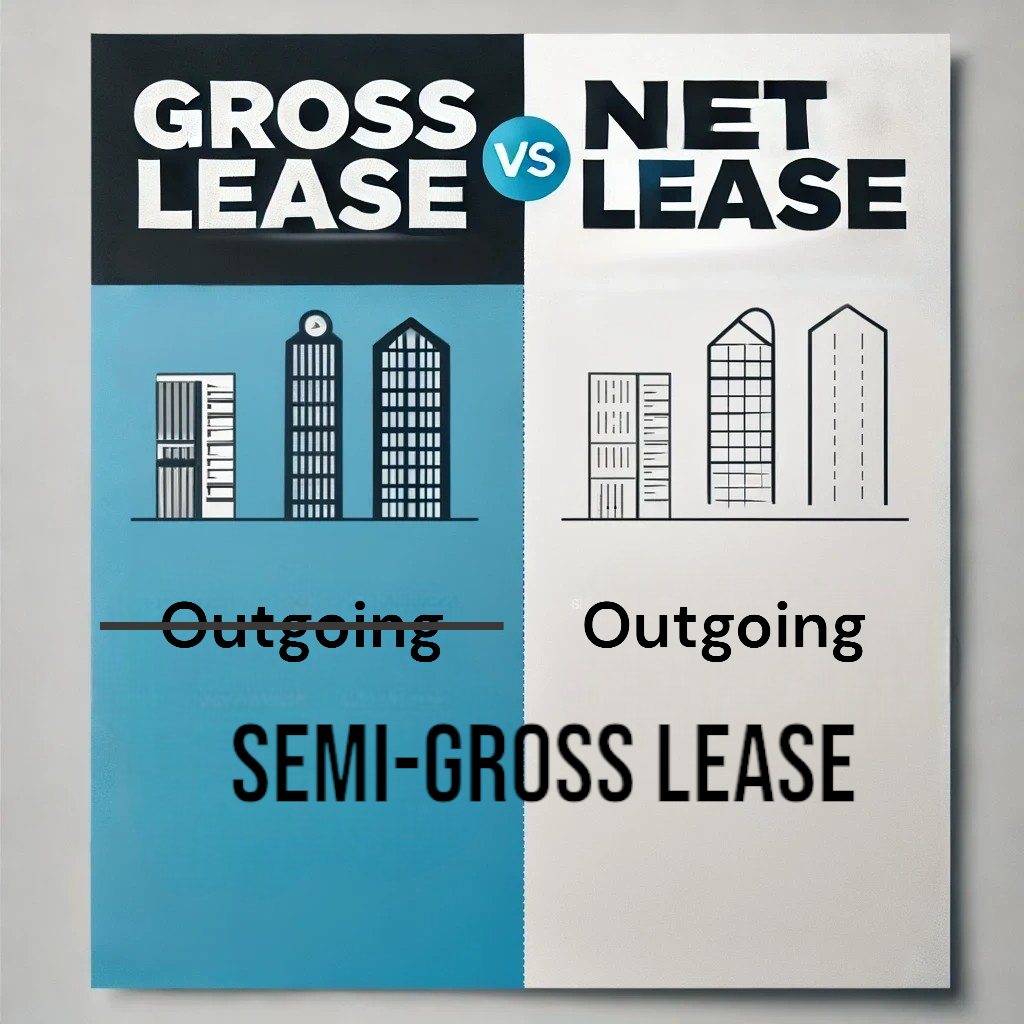
Latest News

McGees Wrap Up 23 October 2026

October 23, 2026

McGees Wrap Up 23 October 2026

Queensland Commercial Property Weekly Wrap-Up Week Ending 23 October 2026 South East Queensland commercial property is accelerating as the 2032 Olympic deadline forces developers and investors to lock in projects before resource bottlenecks intensify. Population growth continues to fuel exceptional…

October 23, 2026 McGees Wrap Up
McGees Wrap Up 16 October 2026

October 16, 2026

McGees Wrap Up 16 October 2026

Market Overview Queensland commercial property is drawing intense local and cross-border capital as investors race to secure assets ahead of long-term infrastructure delivery (Bleby, 2026; Lenaghan, 2026). The Brisbane central business district office sector has reached Australia's tightest vacancy rate…

October 16, 2026 McGees Wrap Up
McGees Wrap Up 9 October 2026

October 9, 2026

McGees Wrap Up 9 October 2026

Market Overview South East Queensland commercial property continues to experience fierce capital competition driven by severe supply constraints and infrastructure connectivity. While broader macroeconomic headwinds such as falling building approvals and rising retail operational costs challenge feasibility, developers and investors…

October 9, 2026 McGees Wrap Up

October 1, 2026

McGees Wrap Up 2 October 2026

Rising sovereign bond yields and tight consumer budgets are testing commercial property valuations across Queensland, but capital continues to find a home where tenant demand and infrastructure investment remain clear. Australian ten-year government bond yields have climbed past 5.3 per…

October 1, 2026 McGees Wrap Up
View all

Over 45 years of national property excellence.

Contact our experienced team today.

First Name(Required)
Last Name(Required)

A Comprehensive Guide to the Retail Shop Tenancy Agreement in Queensland

August 28, 2024

Table of Contents:[hide]

Understanding the Retail Shop Tenancy Agreement in Queensland

Leasing a retail shop in Queensland has specific legal requirements, particularly for three years or less of short-term leases. The Retail Shop Tenancy Agreement, Fourth Edition, is a standardised form adopted by The Real Estate Institute of Queensland Limited for such leases. This article will provide a detailed overview of this agreement, including its key components, important considerations, and the circumstances in which it is appropriate to use this document.

What is the Retail Shop Tenancy Agreement?

The Retail Shop Tenancy Agreement is a legally binding contract used for leasing retail shops in Queensland for a term of up to three years, including any options to renew. It is designed to comply with the Retail Shop Leases Act 1994 (Qld), which governs the leasing of retail premises in the state.

Key Features of the Retail Shop Tenancy Agreement

  1. Applicable Term: The agreement is only suitable for leases with a term, including options, of three years or less. If the term exceeds three years, a different lease form must be used.

  1. Retail Shop Compliance: The premises must be classified as a “retail shop” under the Retail Shop Leases Act 1994 (Qld), typically premises used predominantly for selling goods or providing services.

  1. Non-Registrability: This agreement should not be used if either party requires the lease to be registered under the Land Titles Act 1994 (Qld).

  1. Major Lessee Exclusion: The agreement is not suitable for tenants classified as “major lessees” under the Retail Shop Leases Act 1994 (Qld), generally referring to tenants occupying a large portion of a shopping centre.

Warning: When Not to Use the Retail Shop Tenancy Agreement

It is crucial to note that this agreement should not be used in the following situations:

  • Residential Tenancies: This agreement is not intended for residential properties.

  • Non-Retail Premises: If the premises do not qualify as a “retail shop” under the Act, this agreement is not applicable.

  • Lease Term Exceeds Three Years: If the total lease term, including any renewal options, exceeds three years.

  • Requirement for Registration: If either party requires the lease to be registered under the Land Titles Act 1994 (Qld).

  • Major Lessee: If the tenant is a “major lessee” as defined in the Act.

Components of the Retail Shop Tenancy Agreement

The Retail Shop Tenancy Agreement comprises four main parts, which should be compiled into a single, cohesive document:

  1. Reference Schedule: This section includes essential details about the lease, such as the names of the parties (landlord and tenant), the term of the lease, and the rent amount. It is crucial to insert the full legal entity names and, if applicable, the name of any trust involved.

  1. Special Conditions: Any modifications or additional terms that deviate from the standard conditions must be inserted here. These are necessary when the standard terms need to be adjusted to suit the specific circumstances of the lease.

  1. Standard Conditions: These are the default terms of the lease, covering general obligations and rights of both the landlord and tenant. This section forms the bulk of the agreement, including provisions on rent payment, maintenance responsibilities, and other standard lease terms.

  1. Plan of Premises: An annexure that includes a detailed plan of the premises being leased. This is mandatory unless the premises comprise the entire land or a complete lot in a Community Title Scheme.

Steps to Completing the Retail Shop Tenancy Agreement

When preparing a Retail Shop Tenancy Agreement, follow these steps to ensure compliance with Queensland law:

1. Complete the Reference Schedule: Fill in all required details, ensuring that full legal names are used. If a trust is involved, specify it correctly to avoid any legal complications later.

2. Insert Special Conditions: If any special conditions apply, insert them in the designated section or attach them as Annexure B. Ensure that these conditions do not violate legal regulations or the standard terms of the lease. It is advisable to seek legal advice when drafting or inserting special conditions.

3. Review and Finalise Standard Conditions: Carefully review the standard conditions for completeness and accuracy, ensuring they align with the specific needs and intentions of both the landlord and the tenant.

4. Attach the Plan of Premises: Include a clear and accurate plan of the premises as an annexure to the agreement. This is mandatory unless the premises comprise the entire land or a complete lot in a Community Title Scheme.

5. Prepare and Exchange Disclosure Statements:

Lessor Disclosure Statement: The landlord must provide the tenant with a completed and signed Lessor Disclosure Statement at least seven days before the tenant enters into the agreement. Failure to do so allows the tenant to terminate the lease within six months of entering into the agreement.

Lessee Disclosure Statement: The tenant must provide the landlord with a Lessee Disclosure Statement, along with the Legal and Financial Advice Reports, as required under Sections 22A and 22D of the Act.

Legal Advice Report: The Legal Advice Report is mandatory for prospective lessees or assignees who lease less than five retail establishments in Australia as of the date of the report. This report must be completed by an Australian lawyer. It serves to confirm that the lessee or assignee has received independent legal advice on the terms and conditions of the lease.

Financial Advice Report: The Financial Advice Report is also required for prospective lessees or assignees who lease less than five retail establishments in Australia as of the date of the report. This report must be completed by a qualified accountant in accordance with Australian Auditing Standard AUS 904 (Engagement to Perform Agreed-Upon Procedures). The report ensures that the lessee or assignee has received independent financial advice regarding the lease.

6. Execution of the Agreement: Ensure that all parties, including any guarantors, sign the agreement. Each signature must be witnessed by an independent adult witness to validate the agreement legally.

7. Delivery of Certified Copy: After the agreement has been signed, the landlord, their agent, or solicitor must provide the tenant with a certified copy of the fully signed agreement within 30 days of execution. This ensures that both parties have a legally enforceable document for their records.

Pros and Cons of the Retail Shop Tenancy Agreement

Pros:

  • Cost-Effective: This agreement is simpler and less costly to prepare compared to more complex lease agreements.

  • Quick Setup: Designed for short-term leases, it can be prepared and finalised more quickly, making it ideal for retail businesses with immediate needs.

  • State Compliance: The agreement is specifically tailored to comply with Queensland’s retail leasing laws, ensuring both parties are protected under state regulations.

Cons:

  • Limited Term: The agreement is only suitable for leases of up to three years, making it less appropriate for long-term leasing arrangements.

  • Non-Registrability: The agreement cannot be registered with the Titles Office, which may reduce its enforceability if the property is sold during the lease term.

  • Not Suitable for Complex Tenancies: For larger or more complex retail tenancies, a more detailed lease agreement might be necessary to adequately cover all aspects of the tenancy.

Retail Shop Leases Act 1994 (Qld): Application and Scope

The Retail Shop Leases Act 1994 (Qld) (RSLA) governs all retail shop leases in Queensland. Understanding when the RSLA applies is crucial because it dictates the type of lease that can be offered, the costs and outgoings chargeable to the tenant, critical timeframes, and mandatory disclosure obligations.

What Constitutes a ‘Retail Shop’?

Under Sections 5B and 5C of the RSLA, a retail shop is defined as premises that are either:

  • Situated in a retail shopping centre, or

  • Used wholly or predominantly for carrying on a retail business.

What is a Retail Shopping Centre?

Section 5D of the RSLA defines a retail shopping centre as a cluster of premises with the following characteristics:

  • Five or more premises used predominantly for retail businesses.

  • All premises either:

  • Are owned by one person, or

  • Have one lessor or head lessor, or

  • Comprise lots within a single community titles scheme under the Body Corporate and Community Management Act 1997.

  • The premises are in:

  • One building, or

  • Two or more adjoining buildings, or buildings separated by common areas, other owned areas, or a road.

  • The cluster is promoted or regarded as a shopping centre, mall, court, or arcade.

Exclusions from the RSLA

Section 5A of the RSLA specifies several exclusions where the Act does not apply, meaning a retail shop lease does not cover:

  • Premises with a floor area over 1,000 m².

  • Premises within the South Bank corporation area under a perpetual lease or a lease of 100 years or more.

  • Premises used by a lessee as the lessor’s employee or agent.

  • Premises in theme parks, amusement parks, flea markets, or temporary stalls at events like agricultural shows.

  • Premises in a retail shopping centre used for non-retail purposes if the retail area is 25% or less of the total lettable area of the level or building.

Impact on Retail Shop Tenancy Agreements

Given these definitions and exclusions, it is crucial for landlords and tenants to determine whether the RSLA applies before entering into a Retail Shop Tenancy Agreement. If the RSLA does apply, certain obligations and restrictions are imposed that do not exist in other types of commercial leases. These include:

  • Mandatory Disclosure Statements: Both lessors and lessees must provide and exchange specific disclosure statements before the lease is finalised (Section 22A and Section 22D of the Retail Shop Leases Act 1994 (Qld)

  • Regulated Costs and Outgoings: The RSLA limits what costs and outgoings can be charged to the tenant.

  • Time Frames and Renewal Processes: The Act outlines specific timeframes for actions such as lease renewal notifications and provision of disclosure statements.

Key Takeaways

For landlords and tenants dealing with retail premises in Queensland, understanding the scope and application of the Retail Shop Leases Act 1994 (Qld) is essential. This determines not only the type of lease agreement that can be offered but also the rights, responsibilities, and protections that come with it. Failing to correctly apply the RSLA could result in legal complications, including the possibility of the tenant terminating the lease if proper procedures and disclosures are not followed.

Landlords should ensure that they are using the correct lease forms and that they fully understand the obligations imposed by the RSLA, particularly regarding disclosure requirements, permissible charges, and compliance with the Act’s provisions.

If you are uncertain whether your premises qualify as a retail shop under the RSLA, or if you need assistance with preparing a Retail Shop Tenancy Agreement, it is highly recommended to seek legal advice to ensure full compliance with the law

Retail Shop Leases Act 1994 (Qld)

  • Section 5 – What constitutes a retail shop? This section defines what premises are considered a “retail shop,” which is critical to determining whether the Retail Shop Leases Act applies. The premises must be situated in a retail shopping centre or used wholly or predominantly for retail business purposes.

  • Section 5D – What constitutes a retail shopping centre: This defines a retail shopping centre and the conditions under which the Act applies to premises within such centres.

  • Section 5A – Exclusions from the Act: This section outlines scenarios where the Act does not apply, such as premises with a floor area over 1,000 m² or premises within the South Bank corporation area under a perpetual lease or a lease of 100 years or more.

  • Sections 22A and 22D – Disclosure Statements: These sections mandate that both the lessor and lessee must provide specific disclosure statements before finalising a lease. This is crucial for ensuring both parties are fully informed before entering a Retail Shop Tenancy Agreement.

  • Section 22 – Regulation of lease terms: This section provides details on the regulation of lease terms, including the requirement that the lease must be in writing and must comply with the disclosure requirements.

Land Titles Act 1994 (Qld)

  • Section 66 – Leases for more than three years must be registered: This section specifies that leases exceeding three years, including any options to renew, must be registered under the Land Titles Act. This supports the article’s statement that the Retail Shop Tenancy Agreement should not be used for leases requiring registration.

Useful Links:

  • Land Titles Act 1994 (Qld) – Here you can access the full text of the Land Titles Act 1994, including the provisions on lease registration.

For a complete list of weekly commercial transactions in Queensland, visit McGees Wrap Up | McGees Property Brisbane

Disclaimer: The information provided in this blog is for general informational purposes only and does not constitute legal, financial, or professional advice. While we strive for accuracy, we make no guarantees regarding the completeness or timeliness of the content. Always seek independent advice before making any financial or real estate decisions. We are not liable for any loss or damages arising from your reliance on the information provided.

Liability Limited by a Scheme approved under Professional Standards Legislation
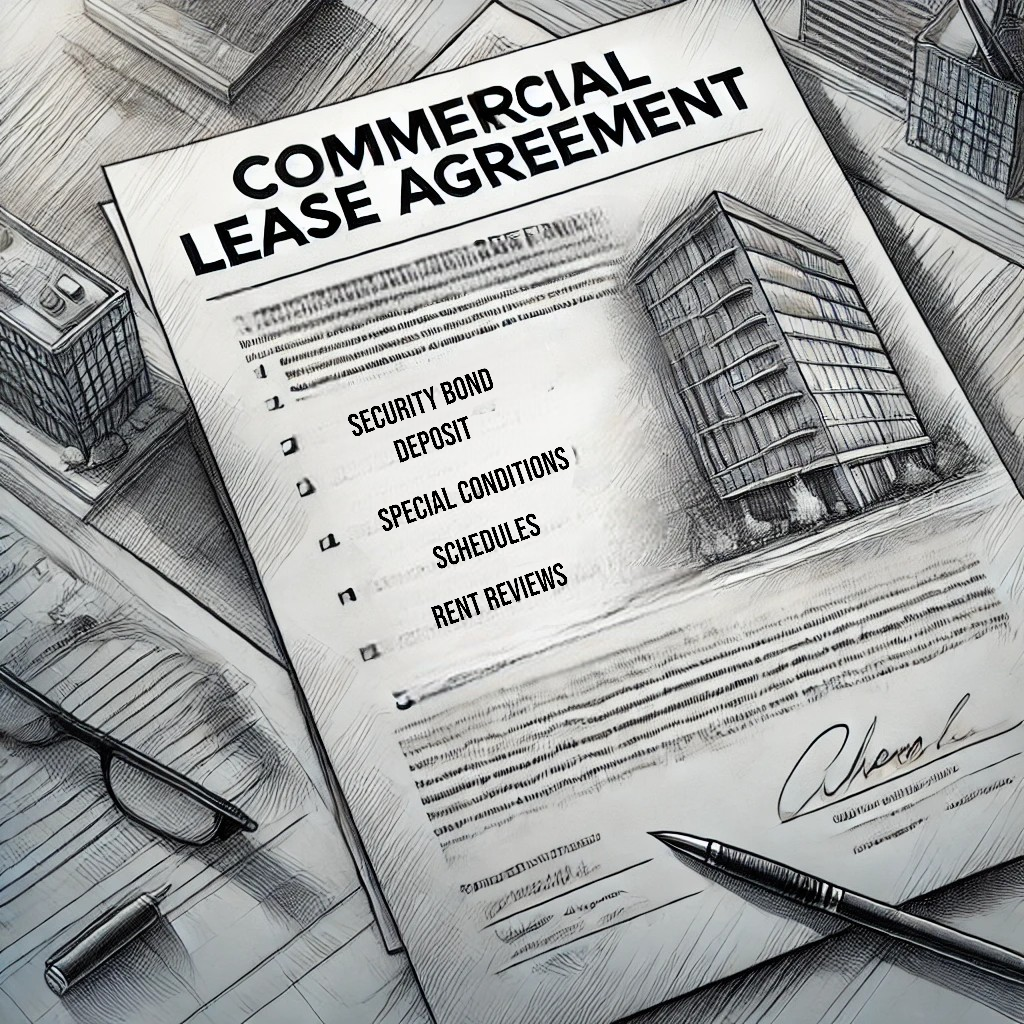
Latest News

McGees Wrap Up 23 October 2026

October 23, 2026

McGees Wrap Up 23 October 2026

Queensland Commercial Property Weekly Wrap-Up Week Ending 23 October 2026 South East Queensland commercial property is accelerating as the 2032 Olympic deadline forces developers and investors to lock in projects before resource bottlenecks intensify. Population growth continues to fuel exceptional…

October 23, 2026 McGees Wrap Up
McGees Wrap Up 16 October 2026

October 16, 2026

McGees Wrap Up 16 October 2026

Market Overview Queensland commercial property is drawing intense local and cross-border capital as investors race to secure assets ahead of long-term infrastructure delivery (Bleby, 2026; Lenaghan, 2026). The Brisbane central business district office sector has reached Australia's tightest vacancy rate…

October 16, 2026 McGees Wrap Up
McGees Wrap Up 9 October 2026

October 9, 2026

McGees Wrap Up 9 October 2026

Market Overview South East Queensland commercial property continues to experience fierce capital competition driven by severe supply constraints and infrastructure connectivity. While broader macroeconomic headwinds such as falling building approvals and rising retail operational costs challenge feasibility, developers and investors…

October 9, 2026 McGees Wrap Up

October 1, 2026

McGees Wrap Up 2 October 2026

Rising sovereign bond yields and tight consumer budgets are testing commercial property valuations across Queensland, but capital continues to find a home where tenant demand and infrastructure investment remain clear. Australian ten-year government bond yields have climbed past 5.3 per…

October 1, 2026 McGees Wrap Up
View all

Over 45 years of national property excellence.

Contact our experienced team today.

First Name(Required)
Last Name(Required)

How to Maximise Your ROI on Commercial Properties

August 7, 2024

Table of Contents:[hide]

Investing in commercial properties can be a lucrative endeavor, but achieving a strong return on investment (ROI) requires careful planning, strategic management, and a deep understanding of the market. Whether you’re an experienced investor or new to the world of commercial real estate, this guide will provide you with essential tips and insights to maximize your ROI. We’ll also highlight the benefits of working with an experienced commercial property manager, the importance of structuring leases correctly, and explain concepts like the Variable Outgoing Washup that benefit both landlords and tenants.

1. Understanding ROI in Commercial Properties

Return on Investment (ROI) in commercial real estate is a key metric that investors use to gauge the profitability of their properties. ROI is typically calculated by dividing the net profit from the property by the total investment cost, expressed as a percentage. Achieving a high ROI requires not just high rental income, but also efficient management of costs, minimization of vacancies, and strategic enhancements to the property value.

2. The Benefits of Hiring an Experienced Commercial Property Manager

Managing a commercial property involves a wide range of responsibilities, from maintenance and tenant relations to financial reporting and regulatory compliance. An experienced commercial property manager can significantly enhance your ROI by:

  • Optimizing Rental Income: A skilled manager knows how to set competitive rent prices, negotiate leases effectively, and reduce vacancies by attracting and retaining quality tenants.
  • Cost Management: They oversee day-to-day expenses, manage maintenance efficiently, and ensure that repairs are done promptly and cost-effectively, which helps in controlling operating costs.
  • Legal and Regulatory Compliance: Experienced managers stay updated on local laws and regulations, ensuring that your property complies with all legal requirements, reducing the risk of costly fines or legal issues.
  • Tenant Relations: Good property managers build strong relationships with tenants, which leads to higher tenant satisfaction, lower turnover, and a stable income stream.

Working with professionals like McGees Property Brisbane provides you with access to experienced commercial property managers who can help you navigate these complexities and maximize your returns.

3. The Importance of a Proper Lease Structure

The lease structure is one of the most critical factors in determining the long-term profitability of a commercial property. Key considerations include:

  • Lease Duration: Long-term leases can provide stability and reduce the risk of vacancy, while shorter leases offer flexibility to adjust rents in line with market conditions.
  • Rent Review: Including escalation clauses that increase rent periodically, based on inflation (CPI), fixed percentage or market rates, can protect your income against rising costs and inflation.
  • Tenant Incentive: Providing incentives such as fit-out contributions can attract high-quality tenants who are willing to pay premium rents, enhancing your property’s value.
  • Renewal Options: Offering renewal options within the lease can help retain good tenants, providing a steady income stream and reducing vacancy risks.

A well-structured lease not only secures a reliable income but also makes the property more attractive to potential buyers or investors should you decide to sell.

In Australia, the concepts of Gross and Net leases are similar to those in other jurisdictions, but with some differences in terms of how they are applied under Australian law.

Gross Lease (Fully Gross Lease)

Under Australian law, a Gross Lease is an agreement where the tenant pays a fixed amount of rent, and the landlord covers all the outgoings associated with the property. These outgoings typically include council rates, water rates, land tax, insurance, and maintenance costs. The tenant’s financial obligation is limited to the agreed rent, making it easier for them to budget. Gross leases are more common in multi-tenanted buildings where the landlord retains control over the building’s operating expenses.

Net Lease

A Net Lease in Australia means that the tenant is responsible for paying not only the base rent but also a portion or all of the outgoings related to the property which depending on the lease.

Net Lettable Area (NLA) is a key concept in Australian commercial real estate, particularly in office and retail leasing. It refers to the amount of floor space that can be rented out to a tenant. NLA is crucial for determining the rent and understanding the tenant’s rights and obligations regarding the space.

Understanding Net Lettable Area (NLA)

  • Definition: Net Lettable Area is the area within a building that is exclusively used by the tenant and for which rent is charged. This excludes areas such as common corridors, stairwells, toilets, lift lobbies, and mechanical plant rooms, which are not included in the rentable space.

  • Calculation: NLA is typically calculated according to guidelines set out by the Property Council of Australia (PCA) or other relevant local standards. These guidelines ensure consistency in how space is measured across different properties, making it easier for tenants and landlords to compare different properties.

    • In an Office Building: NLA would include the space within the office that can be used for desks, meeting rooms, and storage. It excludes shared areas like hallways, lobbies, or bathrooms.

    • In a Retail Setting: NLA would include the sales floor area, back-of-house storage, and any other area used exclusively by the tenant for their business operations. Again, it excludes common areas such as food courts or shopping centre walkways.

Importance of NLA

  • Rent Calculation: Rent is often calculated on a per square metre basis, so a precise understanding of NLA is essential for both landlords and tenants to determine the correct rent. A higher NLA means a higher rental income for the landlord, while tenants need to ensure they are paying for the actual usable space.

  • Lease Agreements: Lease agreements will specify the NLA, and any disputes about space, rent, or shared costs are often based on this measurement. It is essential to ensure that the NLA is accurately measured and agreed upon by both parties before signing the lease.

  • Outgoings: In some leases, outgoings (such as maintenance, utilities, and insurance) are apportioned based on the NLA, making it an important factor in determining the total cost of occupying the space.

4. Understanding the Variable Outgoing Washup

The Variable Outgoing Washup is a crucial concept in commercial leases that benefits both landlords and tenants. This term refers to the process of reconciling estimated and actual outgoings (operational expenses such as utilities, maintenance, insurance, etc.) at the end of each financial year.

  • For Landlords: The washup ensures that all operational costs are recovered from tenants, thereby protecting the landlord’s profit margins. If the actual costs exceed the estimated outgoings charged to tenants, the landlord can recover the difference through the washup process.
  • For Tenants: The washup process provides transparency and accountability, ensuring tenants are only paying their fair share of the actual costs incurred. If the actual outgoings are less than the estimated charges, tenants are typically entitled to a refund or credit.

The correct execution of the Variable Outgoing Washup is vital. If handled improperly, it can lead to disputes, financial loss, or strained landlord-tenant relationships. Partnering with an experienced property management team, like those at McGees Property Brisbane, ensures that this process is managed efficiently and fairly.

In commercial real estate, precision and attention to detail can make a significant difference in your ROI. Key areas where getting it right is crucial include:

  • Accurate Valuation: Regular property valuations ensure you have a clear understanding of your property’s worth, enabling informed decisions regarding leasing, refinancing, or selling.
  • Lease Administration: Proper management of leases, including the accurate recording of rent payments, lease renewals, and escalation clauses, is essential for financial stability.
  • Maintenance and Upgrades: Timely maintenance and strategic upgrades not only preserve the property’s value but can also increase its appeal, allowing for higher rents and reduced vacancies.
  • Market Analysis: Continuous market research helps in adjusting rent prices according to market trends and identifying opportunities for property improvements or repositioning.

By focusing on these critical areas, you can avoid common pitfalls and enhance the long-term profitability of your investment.

5. Additional Tips for Maximizing ROI

Here are some additional strategies that can help you maximize the ROI on your commercial properties:

  • Diversify Your Tenant Mix: A diverse tenant mix reduces the risk associated with any single industry or tenant type. For example, combining retail, office, and service tenants can create a more resilient income stream.
  • Utilize Technology: Invest in property management software to streamline operations, from rent collection to maintenance scheduling. These tools can improve efficiency, reduce costs, and enhance tenant satisfaction.
  • Regularly Review Expenses: Periodically review all operating expenses and seek opportunities to reduce costs without compromising the quality of services. For example, energy efficiency upgrades can lower utility costs and appeal to environmentally conscious tenants.
  • Plan for Capital Expenditures: Set aside funds for future capital expenditures, such as roof replacements or HVAC upgrades, to avoid financial strain when these expenses inevitably arise.
  • Exit Strategy: Always have an exit strategy in place, whether it’s selling the property at a peak market time, refinancing to access equity, or executing a 1031 exchange to defer capital gains taxes.

6. Tax Planning for a Sustainable Commercial Property in Brisbane

1. Capital Works Deduction (Division 43):

  • Capital works deductions allow property owners to claim a deduction on the construction costs of their commercial property. This includes expenses related to renovations, extensions, or structural improvements.
  • Application: Suppose you own a commercial building in Brisbane and decide to upgrade it with energy-efficient features such as solar panels, better insulation, or water-saving fixtures. The construction costs associated with these improvements can be claimed as a capital works deduction, typically at a rate of 2.5% per annum over 40 years.
  • Benefit: This deduction reduces your taxable income, lowering the tax payable amount.

2. Immediate Asset Write-Off (Temporary Full Expensing):

  • As part of COVID-19 economic stimulus measures, the Australian government introduced temporary full expensing, allowing businesses to immediately write off the full cost of eligible assets.
  • Application: If your commercial property in Brisbane undergoes a sustainable upgrade, such as installing new energy-efficient HVAC systems or LED lighting, the entire cost of these assets can be written off immediately in the year of installation, provided they are installed by the cut-off date specified by the ATO.
  • Benefit: This immediate deduction helps reduce your taxable income in the year the assets are installed, improving your cash flow and return on investment.

3. Government Incentives for Sustainable Development:

  • The Brisbane City Council and Queensland Government offer various incentives for sustainable developments, including rebates, grants, and reduced development fees for projects that enhance energy efficiency or environmental sustainability.
  • Application: If your commercial property in Brisbane meets certain criteria for sustainability, such as achieving a Green Star rating or incorporating renewable energy sources, you may be eligible for financial incentives. For example, a grant might be available to offset the cost of installing solar panels, or a rebate might be offered for water-saving technologies.
  • Benefit: These incentives directly reduce the cost of sustainable upgrades, further improving the return on investment by lowering both capital outlay and ongoing operational costs.

4. Depreciation of Plant and Equipment (Division 40):

  • Description: Plant and equipment assets within a commercial property, such as solar panels, energy-efficient appliances, and other sustainable fixtures, can be depreciated over time.
  • Application: After upgrading your Brisbane commercial property with energy-efficient equipment, you can claim depreciation deductions on these assets over their useful life, which is typically shorter than the 40-year period for capital works deductions.
  • Benefit: Depreciation deductions reduce taxable income each year, spreading the tax benefit over the useful life of the assets and improving the property’s long-term profitability.

8. Contact McGees Property Brisbane to maximise your return

Partnering with a trusted and experienced property management team is essential to truly maximize your ROI. McGees Property Brisbane offers a full range of services, including valuation, property management, and agency services. Their team of professionals is equipped to provide real-time insights and personalized strategies tailored to your specific investment goals.

Maximizing the ROI on your commercial properties requires expertise, strategic planning, and meticulous management. Whether you need help with lease structuring, property valuation, or day-to-day management, McGees Property Brisbane is here to assist. Our team of experienced valuers, property managers, and agency professionals can provide the guidance and support you need to maximise your investments.
View our team here

Contact McGees Property Brisbane today to learn how we can help you achieve your commercial property investment goals.

For a complete list of weekly commercial transactions in Queensland, visit McGees Wrap Up | McGees Property Brisbane

Disclaimer: The information provided in this blog is for general informational purposes only and does not constitute legal, financial, or professional advice. While we strive for accuracy, we make no guarantees regarding the completeness or timeliness of the content. Always seek independent advice before making any financial or real estate decisions. We are not liable for any loss or damages arising from your reliance on the information provided.

Liability Limited by a Scheme approved under Professional Standards Legislation
Latest News

McGees Wrap Up 23 October 2026

October 23, 2026

McGees Wrap Up 23 October 2026

Queensland Commercial Property Weekly Wrap-Up Week Ending 23 October 2026 South East Queensland commercial property is accelerating as the 2032 Olympic deadline forces developers and investors to lock in projects before resource bottlenecks intensify. Population growth continues to fuel exceptional…

October 23, 2026 McGees Wrap Up
McGees Wrap Up 16 October 2026

October 16, 2026

McGees Wrap Up 16 October 2026

Market Overview Queensland commercial property is drawing intense local and cross-border capital as investors race to secure assets ahead of long-term infrastructure delivery (Bleby, 2026; Lenaghan, 2026). The Brisbane central business district office sector has reached Australia's tightest vacancy rate…

October 16, 2026 McGees Wrap Up
McGees Wrap Up 9 October 2026

October 9, 2026

McGees Wrap Up 9 October 2026

Market Overview South East Queensland commercial property continues to experience fierce capital competition driven by severe supply constraints and infrastructure connectivity. While broader macroeconomic headwinds such as falling building approvals and rising retail operational costs challenge feasibility, developers and investors…

October 9, 2026 McGees Wrap Up

October 1, 2026

McGees Wrap Up 2 October 2026

Rising sovereign bond yields and tight consumer budgets are testing commercial property valuations across Queensland, but capital continues to find a home where tenant demand and infrastructure investment remain clear. Australian ten-year government bond yields have climbed past 5.3 per…

October 1, 2026 McGees Wrap Up
View all

Over 45 years of national property excellence.

Contact our experienced team today.

First Name(Required)
Last Name(Required)

Bank Guarantee vs Cash Bond

April 1, 2024

We are often asked by tenants, and owners, what is the difference between a Bank Guarantee and a Cash Bond? Putting it simply either is used by a lessee (tenant) to provide security to a lessor (landlord) to perform a lease.

A Bank Guarantee is a written undertaking from a bank or financial institution to pay either the full amount of the security or part thereof should the lessee be in default of the lease. It is usually the lessee’s bank that would provide the undertaking. The party to which it is made out to, referred to as The Favouree, would present the written document to the bank for payment when wanting to make a claim. The period for which the guarantee is provided can be unlimited or have an end date. If it is the latter, no earlier than 3 months after the end of a lease would be appropriate in most circumstances. That period of time allows for all end of lease matters to be finalised.

A Cash Bond is simply that, an amount of cash that the lessee provides to the lessor as security for performance of the lease. There is no strict amount although we see the calculation typically ranging from 3 to 6 months rent + outgoings if applicable, + GST. The funds would typically be held by the lessors managing agent in its trust account, although the lessor is also entitled to hold the funds unless stipulated otherwise in the lease.

What type of security is best?

It really depends on the situation. Some lessors prefer a cash bond for its simplicity and ease of transacting. Others, however, prefer the added security a Bank Guarantee provides.

Whilst claiming a bank guarantee can be cumbersome, it is basically as good as cash. The bank providing the undertaking cannot refuse to exchange it for cash when presented by The Favouree. One example of when it may be presented, for instance, would be where a lessee is in arrears or has been placed into liquidation.

With regards to the latter, typically what happens when a company is placed into liquidation or receivership and premises have been leased is as follows:

  • The Liquidator or receiver would write to the lessor or its managing agent and disclaim the lease. In other words, all bets are off.
  • Depending on the situation, the Liquidator or receiver may keep the lease on foot if there is a chance that the company could be sold.
  • The Liquidator or receiver would seek access to the premises to asses if there are any assets that could be sold.
  • The Liquidator or receiver would review the type of security that has been provided for the performance of the lease. If it is a bank guarantee, the lessor is usually entitled to retain the guarantee and keep the proceeds once claimed. If a cash bond is in place, it would typically be treated as a preferential payment to the lessor which must be returned to the liquidator.

For this last reason alone, our view is that a Bank Guarantee is the best form of security a lessor can have from the lessee.

Written by: Brad Sheppard, Managing Director .

Bank Guarantee for Lease vs. Cash Bonds in Commercial Lease Agreements

When securing a commercial lease for a commercial property, both landlords and tenants must decide between using a bank guarantee for the lease or providing cash bonds. Each method has its own implications, costs, and benefits, affecting financial security, cash flow, and risk management.

What Is a Bank Guarantee for Lease?

A bank guarantee for lease is a commitment from a financial institution to cover unpaid rent or damages in the event the tenant fails to meet their contractual obligations under the lease agreement. It acts as a commercial lease bond, ensuring the landlord receives a guaranteed payment.

Benefits of Bank Guarantees

  • Business Banking Team Support: Banks assess the tenant’s financial situation and only issue guarantees to credible parties.

  • Guaranteed Payment: If the tenant breaches the lease, the landlord receives payment through the bank, reducing financial risk.

  • Flexibility in Cash Flow: Unlike cash bonds, the tenant doesn’t need to provide a large upfront sum, preserving liquidity.

Drawbacks of Bank Guarantees

  • Ongoing Fees: Banks charge maintenance fees for the guarantee, impacting the tenant’s budget.

  • Expiry Date Issues: If the guarantee expires before the end of the lease, the landlord may lose protection.

  • Collateral Requirements: Some banks may require collateral, increasing the financial burden on the tenant.

Cash Bonds in Commercial Lease Agreements

A cash bond involves the tenant paying a cash deposit to the landlord or property manager as a security deposit. The bond can be accessed if the tenant breaches the lease, such as by failing to pay rent or causing property damage.

Advantages of Cash Bonds

  • Immediate Access to Funds: If the tenant defaults, the landlord can access the bond directly without waiting for a bank process.

  • Interest Earned: Depending on the agreement, the cash bond may earn interest, potentially benefiting the tenant.

  • No Expiry Dates: Cash bonds remain intact until the lease concludes, avoiding renewal issues.

Disadvantages of Cash Bonds

  • Upfront Cash Requirement: Tenants must provide a lump sum, impacting cash flow.

  • Potential Disputes: Disagreements may arise over how much of the bond should be returned at the end of the lease.

  • Risk of Mismanagement: If the property manager mishandles the bond, the tenant may face difficulties in recovery.

Personal Guarantees: An Alternative Approach

In some lease agreements, landlords may also request personal guarantees from tenants. This means that the tenant is personally responsible for the lease obligations, providing additional security.

  • For Landlords: Personal guarantees offer a safety net if the tenant defaults.

  • For Tenants: It increases personal financial risk but may reduce the need for a large cash bond or bank guarantee.

Key Differences Between Bank Guarantees and Cash Bonds

  • Payment Structure: A bank guarantee involves a third-party financial institution, while a cash bond is a direct payment to the landlord.

  • Cost Implications: Bank guarantees involve ongoing fees, while cash bonds require a one-time payment.

  • Financial Flexibility: Bank guarantees preserve tenant cash flow, while cash bonds tie up funds for the duration of the lease.

Choosing the Right Option

  • For Landlords: Consider the tenant’s financial stability, the length of the lease, and the potential for non-payment.

  • For Tenants: Assess the financial impact of providing a cash bond versus paying ongoing bank fees.

Bottom Line

Choosing between a bank guarantee for lease and cash bonds in a commercial lease agreement depends on financial circumstances, risk tolerance, and the specifics of the lease. Landlords seeking immediate security may prefer cash bonds, while tenants looking to maintain cash flow may lean towards bank guarantees. Understanding the terms, including ongoing fees, personal guarantees, and potential expiry dates, is essential in making an informed decision.

For a complete list of weekly commercial transactions in Queensland, visit McGees Wrap Up | McGees Property Brisbane

Disclaimer: The information provided in this blog is for general informational purposes only and does not constitute legal, financial, or professional advice. While we strive for accuracy, we make no guarantees regarding the completeness or timeliness of the content. Always seek independent advice before making any financial or real estate decisions. We are not liable for any loss or damages arising from your reliance on the information provided.

Liability Limited by a Scheme approved under Professional Standards Legislation

Latest News

McGees Wrap Up 23 October 2026

October 23, 2026

McGees Wrap Up 23 October 2026

Queensland Commercial Property Weekly Wrap-Up Week Ending 23 October 2026 South East Queensland commercial property is accelerating as the 2032 Olympic deadline forces developers and investors to lock in projects before resource bottlenecks intensify. Population growth continues to fuel exceptional…

October 23, 2026 McGees Wrap Up
McGees Wrap Up 16 October 2026

October 16, 2026

McGees Wrap Up 16 October 2026

Market Overview Queensland commercial property is drawing intense local and cross-border capital as investors race to secure assets ahead of long-term infrastructure delivery (Bleby, 2026; Lenaghan, 2026). The Brisbane central business district office sector has reached Australia's tightest vacancy rate…

October 16, 2026 McGees Wrap Up
McGees Wrap Up 9 October 2026

October 9, 2026

McGees Wrap Up 9 October 2026

Market Overview South East Queensland commercial property continues to experience fierce capital competition driven by severe supply constraints and infrastructure connectivity. While broader macroeconomic headwinds such as falling building approvals and rising retail operational costs challenge feasibility, developers and investors…

October 9, 2026 McGees Wrap Up

October 1, 2026

McGees Wrap Up 2 October 2026

Rising sovereign bond yields and tight consumer budgets are testing commercial property valuations across Queensland, but capital continues to find a home where tenant demand and infrastructure investment remain clear. Australian ten-year government bond yields have climbed past 5.3 per…

October 1, 2026 McGees Wrap Up
View all

Over 45 years of national property excellence.

Contact our experienced team today.

First Name(Required)
Last Name(Required)

5 TAX TIPS FOR PROPERTY INVESTORS TO GET AHEAD THIS FINANCIAL YEAR

August 18, 2023

As we navigate the new fiscal year, property investors need to stay savvy with their tax strategies to maximise returns and minimise liabilities. With the right planning and advice, you can leverage tax to your advantage.

Here are five essential tax tips for property investors.

1. Engage a Good Accountant

A skilled accountant specialising in property investment is indispensable for navigating the complexities of property-related tax obligations. They can assist you in optimizing tax deductions, managing capital gains tax (CGT), and preparing depreciation schedules. With their expertise, you’ll avoid common tax pitfalls and ensure that you’re taking full advantage of the available tax benefits. They can also provide tailored advice on how to structure your investments for tax efficiency, helping you to legally minimize your taxable income.

2. Leverage Depreciation Benefits

Depreciation is one of the most effective tools for property investors to reduce taxable income. It allows you to claim deductions for the decline in value of your investment property’s structure and its fixtures over time. By having a detailed depreciation schedule prepared by a qualified quantity surveyor, you can ensure that you accurately claim these deductions. This can significantly reduce your annual tax bill, enhancing the overall return on your investment. Remember, even older properties may have depreciable assets, so it’s worth investigating whether your property qualifies.

3. Maximise Deductible Expenses

One of the key strategies for reducing your taxable income as a property investor is to maximize your deductible expenses. Common deductions include mortgage interest, property management fees, maintenance and repair costs, insurance premiums, and council rates. Other less obvious deductible expenses can include travel expenses for property inspections and legal fees related to lease agreements. To ensure you don’t miss out on any potential deductions, it’s crucial to maintain meticulous records of all your property-related expenses throughout the year. This not only helps with your tax return but also provides a clear financial picture of your investment’s performance.

4. Consider Capital Gains Tax (CGT) Strategies

Capital Gains Tax (CGT) can significantly impact the profitability of your property investment when you decide to sell. To minimize CGT, consider strategies such as holding the property for more than 12 months to qualify for a 50% discount on the gain, using capital losses to offset gains, and timing the sale of the property in a low-income year to reduce the tax payable. Understanding the intricacies of CGT and planning your sale accordingly can save you a substantial amount in taxes. Additionally, reinvesting the proceeds into another qualifying property or using roll-over relief options can defer the tax liability, helping you to continue growing your portfolio with minimized tax exposure.

5. Employ a Quality Property Manager

A quality property manager is a crucial partner in ensuring your investment property generates consistent income and remains in optimal condition. At McGees Property Brisbane, we understand that effective property management extends far beyond simply collecting rent—it’s about delivering comprehensive, tailored services that enhance your investment’s value, streamline operations, and maximize returns.

Here’s an in-depth look at how employing a professional property manager, particularly from McGees Property Brisbane, can significantly benefit your investment:

A. Comprehensive Property Management Services

1. Rent Collection and Tenant Management: Our property management services include rigorous tenant screening processes to ensure that only reliable and responsible tenants occupy your property. We handle all aspects of rent collection, lease renewals, and tenant communications. Maintaining a professional relationship with tenants ensures that rental payments are made on time and that any issues are addressed promptly, reducing the risk of vacancies and ensuring a steady cash flow.

2. Maintenance and Repairs: Property maintenance is essential to preserving the value of your investment. We coordinate and oversee all necessary repairs and maintenance, using our network of trusted contractors to ensure high-quality work at competitive prices. Regular inspections and preventive maintenance help prevent costly repairs, ensuring your property remains in excellent condition.

3. Legal Compliance and Risk Management: Navigating the legal landscape of property ownership can be complex. Our team stays up-to-date with all relevant laws and regulations, ensuring your property fully complies with local, state, and federal requirements. This includes managing landlord-tenant laws, safety regulations, and property licensing, thus mitigating risks associated with property ownership.

4. Financial Reporting and Transparency: We provide comprehensive monthly reports detailing all income and expenses, giving you a clear and transparent view of your property’s financial performance. These reports include rent collection summaries, maintenance costs, and any other property-related expenses. Additionally, our end-of-month financial reports consolidate this information, making it easier for you to track your investment’s profitability and make informed decisions.

5. Strategic Annual Budgeting: Financial planning is crucial for long-term success in property investment. Our team assists with annual budgeting, helping you forecast potential income and expenses. This proactive approach allows you to plan for future expenditures, such as major repairs or upgrades, and ensures you’re prepared for any financial contingencies.

6. Business Activity Statement (BAS) Reporting: For property owners operating under a business structure, our services include meticulous preparation and submission of BAS reports. This ensures that your GST obligations are met accurately and on time, avoiding any potential penalties and maintaining smooth financial operations. Please have your accountant verify the reports before submitting.

B. The Advantages of Commercial Property Management

Partnering with a professional commercial property manager like McGees Property Brisbane can be especially beneficial if you own commercial properties, whether it is Retail, Office, Industrial or mixed-used. Here’s why:

1. Expert Market Knowledge: The commercial property market is dynamic, with factors like economic conditions, zoning laws, and tenant demand constantly shifting. Our team at McGees Property Brisbane has extensive knowledge of the local commercial real estate market, allowing us to provide informed advice on setting competitive rental rates, identifying growth opportunities, and ensuring your property remains attractive to potential tenants.

2. Optimizing Tenant Mix: A successful commercial property often hinges on having the right mix of tenants. We strategically manage tenant placements to ensure a balanced mix that maximizes foot traffic and revenue for all tenants, particularly in retail or mixed-use developments. This careful selection process helps maintain a vibrant and profitable commercial environment, ultimately boosting the value of your investment.

3. Lease Negotiation and Administration: Commercial leases are often complex, involving multiple stakeholders and intricate terms. Our experienced property managers handle all aspects of lease negotiation and administration, ensuring favourable terms that protect your interests while meeting your tenants’ needs. We manage lease renewals, rent reviews, and lease terms compliance, ensuring all lease agreement aspects are upheld.

4. Facility Management and Operations: Besides managing the property, we offer comprehensive facility management services. This includes overseeing the day-to-day operations of the property, such as security, cleaning, landscaping, and utilities management. Our goal is to ensure that the property is always in optimal condition, providing a safe and welcoming environment for tenants and visitors alike. Efficient facility management not only preserves the property’s value but also enhances tenant satisfaction and retention.

5. Maximizing Return on Investment (ROI): We focus on maximizing your ROI by leveraging our expertise in property and facility management. We do this through strategic planning, cost-effective maintenance, and ensuring your property is operating at peak efficiency. Our proactive approach helps identify opportunities for cost savings and revenue generation, ensuring your investment continues to grow in value.

6. Customizable Service Packages: We understand that every commercial property has unique needs. Whether you own a single office building, a retail center, or a portfolio of mixed-use properties, our services are fully customizable to meet your specific requirements. From basic property management to full-scale facility management, we tailor our offerings to ensure that you receive the support you need to achieve your investment goals.

C. Why Choose McGees Property Brisbane?

At McGees Property Brisbane, we pride ourselves on delivering a level of service that goes beyond traditional property management. Here’s what sets us apart:

  • Experience and Expertise: With decades of experience in the Brisbane property market, we bring unparalleled knowledge and expertise to the management of your property. Our team is comprised of industry professionals who are dedicated to maximizing the value of your investment.

  • Personalized Service: We believe in building strong relationships with our clients. Our approach is personalized, ensuring that we understand your unique investment goals and work closely with you to achieve them.

  • Proactive Management: We don’t just manage your property; we actively look for ways to enhance its value. From regular property inspections to strategic financial planning, our proactive approach ensures that your investment is always performing at its best.

  • Comprehensive Reporting: Transparency is key to successful property management. Our detailed financial reports provide you with a clear understanding of your property’s performance, making it easy to track income, expenses, and overall profitability.

  • Integrated Services: In addition to property management, we offer a full range of real estate services, including sales, leasing, and valuation. This integrated approach means we can support you at every stage of your investment journey.

By choosing McGees Property Brisbane, you’re not just hiring a property manager; you’re gaining a partner who is committed to the long-term success of your investment. Whether you own residential or commercial properties, our team provides the expertise, service, and dedication needed to maximize your returns and ensure your peace of mind.

For a complete list of weekly commercial transactions in Queensland, visit McGees Wrap Up | McGees Property Brisbane

Disclaimer: The information provided in this blog is for general informational purposes only and does not constitute legal, financial, or professional advice. While we strive for accuracy, we make no guarantees regarding the completeness or timeliness of the content. Always seek independent advice before making any financial or real estate decisions. We are not liable for any loss or damages arising from your reliance on the information provided.

Liability Limited by a Scheme approved under Professional Standards Legislation

Latest News

McGees Wrap Up 23 October 2026

October 23, 2026

McGees Wrap Up 23 October 2026

Queensland Commercial Property Weekly Wrap-Up Week Ending 23 October 2026 South East Queensland commercial property is accelerating as the 2032 Olympic deadline forces developers and investors to lock in projects before resource bottlenecks intensify. Population growth continues to fuel exceptional…

October 23, 2026 McGees Wrap Up
McGees Wrap Up 16 October 2026

October 16, 2026

McGees Wrap Up 16 October 2026

Market Overview Queensland commercial property is drawing intense local and cross-border capital as investors race to secure assets ahead of long-term infrastructure delivery (Bleby, 2026; Lenaghan, 2026). The Brisbane central business district office sector has reached Australia's tightest vacancy rate…

October 16, 2026 McGees Wrap Up
McGees Wrap Up 9 October 2026

October 9, 2026

McGees Wrap Up 9 October 2026

Market Overview South East Queensland commercial property continues to experience fierce capital competition driven by severe supply constraints and infrastructure connectivity. While broader macroeconomic headwinds such as falling building approvals and rising retail operational costs challenge feasibility, developers and investors…

October 9, 2026 McGees Wrap Up

October 1, 2026

McGees Wrap Up 2 October 2026

Rising sovereign bond yields and tight consumer budgets are testing commercial property valuations across Queensland, but capital continues to find a home where tenant demand and infrastructure investment remain clear. Australian ten-year government bond yields have climbed past 5.3 per…

October 1, 2026 McGees Wrap Up
View all

Over 45 years of national property excellence.

Contact our experienced team today.

First Name(Required)
Last Name(Required)