
See how proactive Facility Management resolved a Brisbane CBD lift emergency in 48 minutes and used independent technical audits to prevent major motor failure.
Part 1: 48 Minutes from Emergency Alert to Back in Service
When a lift exhibits unusual movement, standard building emergency protocols are strict: occupants must never use the faulty car, and untrained staff must never attempt a mechanical intervention. The facility management team must act as the immediate bridge between the hazard and a licensed specialist.
Here is the exact, documented timeline of how our reactive Facility Management protocol unfolded:
- 3:47 pm: The urgent fault is logged and escalated immediately.
- 5:10 pm: A specialist lift technician is formally dispatched.
- 5:30 pm: The technician arrives onsite, isolates the system, and diagnoses a failure in the controller microprocessor unit.
- 6:18 pm: The faulty component is replaced, safety checks are cleared, and the lift is returned to full passenger service.
From the moment the technician stepped through the front doors to the moment the lift doors opened safely for tenants, just 48 minutes had elapsed.
Part 2: What We Found When We Audited the Maintenance Contractor
Fast emergency response keeps tenants happy, but proactive Facility Management uncovers the hidden issues that maintenance contractors miss.
Many commercial landlords pay thousands of dollars every year for comprehensive monthly lift maintenance, assuming their contractors are attending site and ticking every box. We do not make assumptions. Instead, we engage independent third-party vertical transportation consultants to conduct visual technical audits of our clients’ machinery.
During an independent audit of this exact three-lift bank, the consultant’s inspection revealed critical findings that would have otherwise gone completely unnoticed by the building owner:
| Audit Finding | The Hidden Risk to the Building Owner | Our Facility Management Action |
|---|---|---|
| Missed Monthly Servicing | The contractor had missed scheduled monthly maintenance visits for several months despite an active service contract. | Formally put the contractor on notice that missed visits are unacceptable and subject to contractual penalties. |
| Commutator Arcing & Bearing Wear | A DC gearless lift motor showed commutator arcing (requiring specialised stoning) alongside a suspected failing top-of-car sheave bearing. | Flagged for immediate rectification to prevent catastrophic motor burnout and unbudgeted capital replacement. |
| High Door Fault Call-Back Rate | Call-back data analysis showed one specific lift accounted for the majority of door-related faults, alongside out-of-adjustment car door gaps. | Mandated intensive door maintenance and gap realignment to restore passenger reliability. |
| Safety Handrail Compliance | Top-of-car handrails required modification to meet current Work Health and Safety (WHS) access standards. | Scheduled high-priority safety upgrades to shield the owner from WHS liability. |
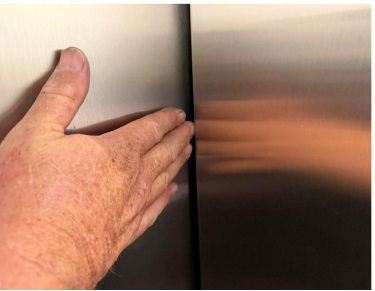
Adjust Lift Car Door gaps
Source: supplied by our contractor
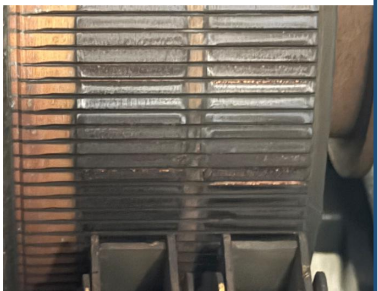
Clean and stone lift motor commutator
Source: independent technical audit
-
Heavy Carbon Build-up and Arcing: Instead of a clean, uniform copper surface, the bars are covered in dark black carbon deposits and show signs of commutator arcing (electrical sparking). You can see bright copper streaks where the surface is worn unevenly.
-
Grooving and Roughness: Over time, electrical arcing and friction create tiny pits, grooves, and high spots on the copper bars, causing the carbon brushes to bounce and spark even more.
What “Clean/Stone Commutator” means:
-
Cleaning: Removing the accumulated carbon dust and grease from between the copper slots so electricity does not short-circuit across the bars.
-
Stoning: A technician holds a special non-conductive abrasive stone (a commutator stone, also called a brush seater or collector grindstone) against the spinning copper cylinder to grind away the pit marks, burn spots, and grooves. This restores a smooth, perfectly round surface so the brushes make clean electrical contact again.
Why it matters: Because stoning requires taking the lift out of service for an extended period, contractors often put it off. If left unaddressed, the sparking will severely damage the copper bars and burn out the motor, turning a routine maintenance task into a massive capital replacement bill for the building owner.
Yet, despite the immediate risk to the lift motor, getting the maintenance provider to actually schedule the work was another battle entirely.
Part 3: No Excuses and Hard Deadlines
Finding a defect on an audit report is useless if the contractor stalls on the close-out.
When we tracked these findings on our Corrective Action Grid, the lift vendor attempted to delay the works, citing internal staffing shortages and a retiring technician. In commercial property management, excuses do not protect your asset lifecycle.
Rather than letting the issue drift, our senior leadership stepped in directly. We issued a hard Close of Business Friday deadline to the vendor’s senior account manager and regional service manager, demanding a replacement technician be assigned immediately and a firm date locked in for the commutator stoning.
The result? The vendor escalated the priority internally, committed to completing the commutator works, and scheduled the remaining mechanical and compliance items – all verified by our independent lift consultant.
Part 4: Planning Four Years Ahead for Obsolete Parts
True Facility Management does not stop at today’s repairs. It looks years down the road to protect your capital expenditure budget.
During our technical audit, discussions with the Original Equipment Manufacturer (OEM) revealed a major future risk: manufacturer support for the building’s landing door equipment had been discontinued, with spare parts only guaranteed for roughly four more years.
Instead of letting the building owner be blindsided by an emergency upgrade bill in four years’ time, we integrated this lifecycle data directly into the property’s long-term asset strategy – recommending that the landing door replacement be packaged into the next maintenance contract tender process.
The True Cost of Passive Property Management
A commercial lift system is one of the most expensive mechanical assets in any building. When it is managed passively, you pay three times: once for missed maintenance visits, a second time when neglected components fail prematurely, and a third time when obsolete parts force an unbudgeted capital emergency.
Effective Facility Management protects your bottom line by combining:
- Immediate crisis escalation that measures downtime in minutes, not days.
- Independent technical auditing that catches missed contractor visits and hidden mechanical wear.
- Executive-level vendor management that enforces strict close-out deadlines.
- Long-term lifecycle forecasting that prepares your capital budget years before parts become obsolete.
Is Your Building Actually Being Managed – Or Just Monitored?
If your current property manager simply forwards contractor emails without auditing service logs, inspecting machinery, or forecasting equipment lifecycles, hidden liabilities are quietly eating into your asset value.
Book a confidential Facility Management Asset Review with our Brisbane team today. We will inspect your current maintenance schedules, review your contractor close-out records, and show you exactly where proactive Facility Management can reduce your risk, extend your equipment lifespan, and protect your capital budget.
Call us today on 07 3231 9777 to see how we can help you today.
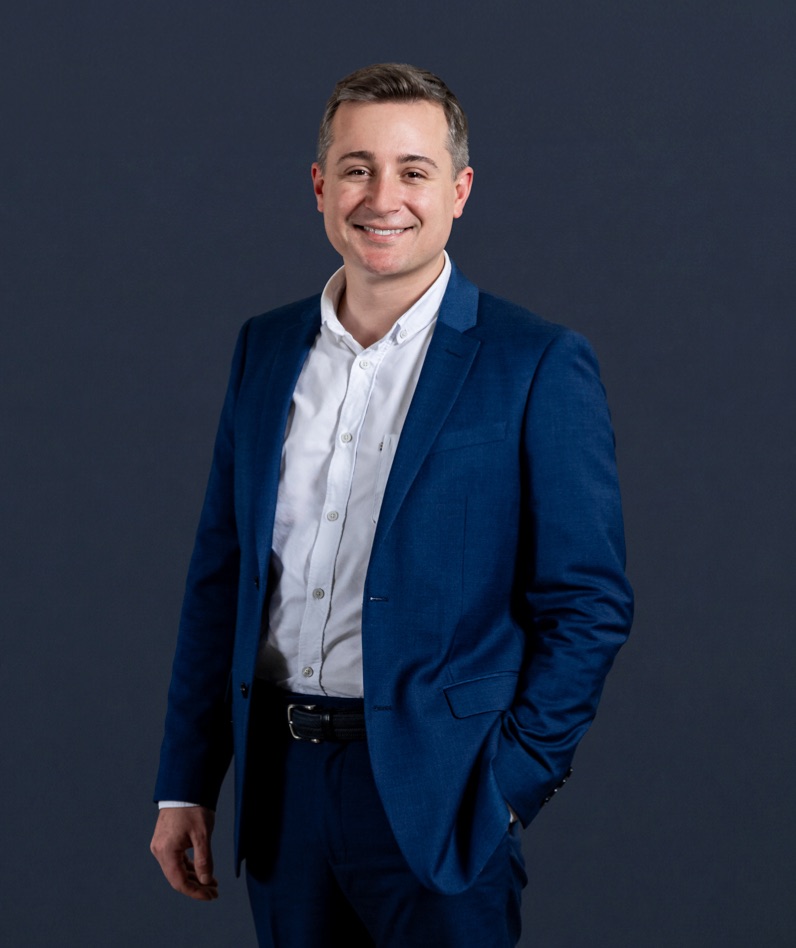
Meet the Specialist Protecting Your Asset: Michael, Facilities Manager
Behind every rapid emergency turnaround and every contractor audit is a specialist who refuses to let small defects turn into expensive building failures.
With more than 15 years of hands-on experience across commercial and residential property, Michael does not wait for tenants to complain before taking action. He gets into the plant rooms, scrutinises maintenance logs, and spots hidden compliance and mechanical risks early – protecting your asset value and keeping your tenants operating without interruption.
Backed by a Bachelor of Business majoring in Real Estate and Property Development, Michael pairs practical operational grit with strict commercial accountability. You get straight answers, honest reporting, and a facilities manager who treats your capital budget like his own.