Category: <span>Capital Transactions Insights</span>

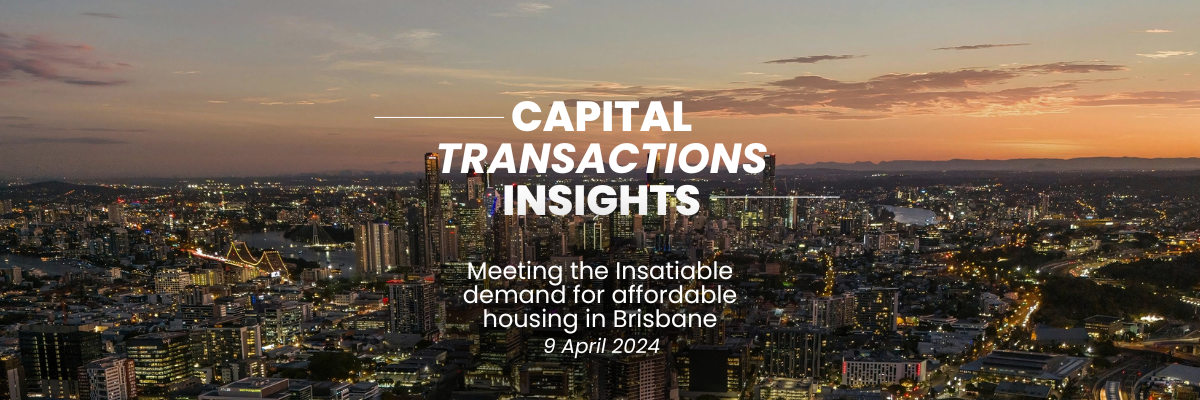
Meeting the Insatiable demand for affordable housing in Brisbane

April 9, 2024

A roof over their head is a basic right that Brisbane residents are struggling to find. With significant population growth of 3.1% over the past year, boosted by interstate and overseas migration, Brisbane property prices increased by 14.8% year-on-year to January 2024 (ABS, 2024).
With a median price tag of $899,474 purchasing a home seems much more achievable for residents from the southern capitals who have flocked in numbers to the Sunshine State and will continue to do so with Queensland’s population forecasted to grow by more than 16% by the 2032 Olympics.

Although there still is a demand to sell at these inflated prices, with listings across the city growing minorly, there is a bottleneck of stock where there are a lot of people who want to move but have nowhere to buy or rent in the short term (ABC, 2024). This is evident by Brisbane’s 0.9% residential vacancy rate and median rent at $717 per week (Domain, 2024).

Both private and institutional investors want to ramp up their exposure to the living sector, and the solutions lie in purpose-built accommodation.

Land availability

Affordable land is scarce in the CDB, and converting office space into residential apartments is a potential solution. This is a popular model in some Asian and European markets. However, to financially succeed, assets need to be heavily discounted as the cost to convert is significant. This is also unlikely to play out as strong tenant demand is coming back into the office sector.

Instead, more affordable land in inner-city locations such as Spring Hill and Fortitude Valley, as well as prime locations at the bookends of the cross-river rail in Bowen Hills and Woolloongabba, function as perfect development sites for new residential projects, with value boosted due to the location of new infrastructure and amenities.

A prime example of new residential stock in these inner-city locations is Lendlease and QuadReal’s new BTR under construction in Bowen Hill, which will bring 443 apartments by the end of 2025.

Government acquiring assets, there are better solutions

To cover the shortfall of public housing in Brisbane, the Queensland Government spent:

  • $33.99 million on the Park Hotel (551 Wickham Terrace)
  • $27 million on the Menso Hotel (68 Cordelia Street)
  • $44 million on a vacant residential village in Tanah Merah to be repurposed for public housing, and
  • $9.4 million on an old retirement village at 51 Norman Parade Clayfield

These repurposed lots will have 94, 66, 124, and 30 rooms, respectively, boosting the housing supply for the cities struggling (ABC, 2023).

These assets may meet some demand for immediate housing. However, to reduce the overspending of taxpayer dollars, the Government should move to relax financial and physical parameters to help private and institutional investors ramp up their exposure in the living sector. Steps have already been taken to boost BTR construction, subject to qualifying criteria:

  • Reduction in management investment trust (MIT) withholding tax coming into effect on July 1st.
  • A reduction in land tax of up to 50% for up to 20 years for BTR developments that feature at least 10% of rental homes as affordable housing; and
  • A full exemption for the 2% foreign investor land tax surcharge for up to 20 years

Additionally, the Government could adopt an asset-light model via a public-private partnership (PPP), supplying debt funding agreements and guaranteeing rental income on the finished product.

In addition to fast-tracking development approvals, providing developers with affordable housing benefits and re-zoning select inner city sites provides flexible structures for developers, helping to ease the burden of high construction costs and producing more affordable housing.

Purposed built

Purpose-built housing seems to be the beacon of light and a way forward to keep up with residential demand.

Purpose-built student accommodation (PBSA) proves to be an attractive option for both institutional investors and students alike. There is enormous demand for centrally located student housing, which is being met by a huge influx of developments around the Brisbane CBD.

Currently, there are 3,172 beds in the city and city fringe, which receive a premium weekly rent, most often on a 52-week lock-in contract. These include three prominent Student One’s, Iglu, UniLodge, and Scape facilities. In addition, there are well over 2,000 more beds in the pipeline; some of the major pipeline projects are Brookfield’s student accommodation under construction at 240 Margret Street and Marquette’s proposed conversion of Mineral House into student accommodation.

Build-to-rent (BTR) proposals are booming in popularity to offset the fall in Build-to-Sell (BTS) projects. These projects provide a steady income stream for developers while also offering capital leveraging in a challenging lending market.

Prime examples of these in the city fringe area are MIRVAC LIV Anura in Newstead and Frasers’ development on Brunswick Street. However, many BTR projects have slowed constriction or acquired DA approval but are not breaking ground yet. Why is this the case?

With rising construction costs and tightening lending rates, margins are too thin, and these projects do not appear as attractive as they did during the pandemic.

The affordable housing crisis is in the media spotlight. With the Queensland general election scheduled for October this year and campaigning kicking off, we are likely to hear from our leaders about significant funding promises and creative solutions to deal with the crisis. Watch this space.

For a complete list of weekly commercial transactions in Queensland, visit McGees Wrap Up | McGees Property Brisbane

Disclaimer: The information provided in this blog is for general informational purposes only and does not constitute legal, financial, or professional advice. While we strive for accuracy, we make no guarantees regarding the completeness or timeliness of the content. Always seek independent advice before making any financial or real estate decisions. We are not liable for any loss or damages arising from your reliance on the information provided.

Liability Limited by a Scheme approved under Professional Standards Legislation
Latest News

McGees Wrap Up 23 October 2026

October 23, 2026

McGees Wrap Up 23 October 2026

Queensland Commercial Property Weekly Wrap-Up Week Ending 23 October 2026 South East Queensland commercial property is accelerating as the 2032 Olympic deadline forces developers and investors to lock in projects before resource bottlenecks intensify. Population growth continues to fuel exceptional…

October 23, 2026 McGees Wrap Up
McGees Wrap Up 16 October 2026

October 16, 2026

McGees Wrap Up 16 October 2026

Market Overview Queensland commercial property is drawing intense local and cross-border capital as investors race to secure assets ahead of long-term infrastructure delivery (Bleby, 2026; Lenaghan, 2026). The Brisbane central business district office sector has reached Australia's tightest vacancy rate…

October 16, 2026 McGees Wrap Up
McGees Wrap Up 9 October 2026

October 9, 2026

McGees Wrap Up 9 October 2026

Market Overview South East Queensland commercial property continues to experience fierce capital competition driven by severe supply constraints and infrastructure connectivity. While broader macroeconomic headwinds such as falling building approvals and rising retail operational costs challenge feasibility, developers and investors…

October 9, 2026 McGees Wrap Up

October 1, 2026

McGees Wrap Up 2 October 2026

Rising sovereign bond yields and tight consumer budgets are testing commercial property valuations across Queensland, but capital continues to find a home where tenant demand and infrastructure investment remain clear. Australian ten-year government bond yields have climbed past 5.3 per…

October 1, 2026 McGees Wrap Up
View all

Over 45 years of national property excellence.

Contact our experienced team today.

First Name(Required)
Last Name(Required)

BRISBANE COMMERCIAL REAL ESTATE – 2023 REVIEW 2024 FORECAST

December 18, 2023

The best way to sum up 2023 is "RE”, and I don't mean Real Estate. Across the board, we saw investors and developers REvaluing, REassessing opportunities, REassuring investors, REsilience of strategy, REtargeting assets and REdirecting capital.

2023 saw a noticeable shift in Brisbane’s commercial real estate market, significantly reducing transaction volumes. The shift mainly triggered by two factors:

  1. Continuing high inflation numbers, forcing the Reserve Bank of Australia (RBA) to tighten monetary policy by increasing the cash rate, 13 times since May 2022, now sitting at 4.35%, a 12-year high.
  2. The continuation of skyrocketing construction prices making many development sites not financially viable.

This shift influenced the majority of investors and developers to adopt a wait-and-see approach.

While some owners chose to de-leverage, we saw the yield appetite from the institutional and private markets accelerate at different rates.

2023 Brisbane’s performance

Transaction volumes ↓ (~60% drop Y-o-Y): muted investment activity as a result of fewer assets coming to market and an increasing spread between seller and buyer expectations, making negotiations more challenging to bridge the gap.

Capitalisation rates ↑(up 50bps – 150bps Y-o-Y): Core and core plus assets have seen marginal cap rate expansion whilst value-add and opportunistic offerings have been repriced based on the risk & return profile of the opportunity. A significant higher cost of debt and slower decision-making from banks’ credit committees has created an increasing opportunity for non-bank lenders.

Performing sectors – consumer-led retail and logistics sectors are showing the greatest resilience off the back of population growth across Greater Brisbane and substantially improved discretionary spending power from Generation Z and Boomers.

Office sector – current CBD vacancy according to recent PCA reports is sitting at 11.6%, a significant reduction from the 15.4% vacancy rate in Q1 2022. Increasing demand from government and educational tenants have absorbed large tranches whilst SME’s continue to gravitate to fitted office suites. Limited supply for the near future is enticing investors to deploy capital back into CBD office. The outlook here is strong.

Living sector – PBSA (Purpose Built Student Accommodation), BTR (Build –to-Rent) and Luxury BTS (Build-to-Sell) have been standout performers as the occupier demand for these assets is robust and not wavering. Site cost + construction price has dampened development appetite.

While all sectors perform differently, certain outliers, such as industrial and medical, continue outperforming the overall market.

2024 Forecast

The burning question on investors and developers lips: “is the trajectory of inflation slowing enough for the RBA to hold rates or will we see another one or two cash rate increases in 2024?”

Although inflation is tracking down in the right direction, the consensus is we are entering into a higher interest rate environment for longer. A recent AFR survey suggested the RBA will cut rates in August 2024. In the US, the Federal Reserve held rates last week and indicated three cuts coming in 2024.

The current housing crisis and our low unemployment rate, Brisbane’s 3.1% Vs Australia’s 3.9% (well below the government preferred rate) are problematic for the quick recovery we would like.

South East Queensland will continue to see strong population growth, particularly from interstate migration, despite the government’s plan to half the overseas migrant intake and tighten student visa rules.

2024 is an election year for Brisbane City Council (March 2024) and Queensland State Government (October 2024). Elections historically create a level of indecisiveness in the market.

Get positioned for a strong recovery across the following sectors in Brisbane:

Office sector – has the largest growth potential in 2024. Quality assets will outperform as the recovery strengthens with limited supply over the next few years to cater for the demand. WFH (Work for home) is out, BTTO (Back to the office) is in.

Consumer lead sectors, such as logistics and retail, will continue to show strong results off the back of South East Queensland population growth.

Development sites – location, location, location. Following the infrastructure lines and cater to the market. The end product has a flight to quality, and creating a differential factor will be key.

For those who view uncertainty as an opportunity and not a risk, 2024 will be the year to deploy capital to take advantage of where we are at in the cycle. Our ongoing infrastructure projects and the construction commencement of Olympic-related projects in 2025 and 2026 will materially reshape our city. The commercial real estate market is poised to be a major benefactor.

For a complete list of weekly commercial transactions in Queensland, visit McGees Wrap Up | McGees Property Brisbane

Disclaimer: The information provided in this blog is for general informational purposes only and does not constitute legal, financial, or professional advice. While we strive for accuracy, we make no guarantees regarding the completeness or timeliness of the content. Always seek independent advice before making any financial or real estate decisions. We are not liable for any loss or damages arising from your reliance on the information provided.

Liability Limited by a Scheme approved under Professional Standards Legislation
Latest News

McGees Wrap Up 23 October 2026

October 23, 2026

McGees Wrap Up 23 October 2026

Queensland Commercial Property Weekly Wrap-Up Week Ending 23 October 2026 South East Queensland commercial property is accelerating as the 2032 Olympic deadline forces developers and investors to lock in projects before resource bottlenecks intensify. Population growth continues to fuel exceptional…

October 23, 2026 McGees Wrap Up
McGees Wrap Up 16 October 2026

October 16, 2026

McGees Wrap Up 16 October 2026

Market Overview Queensland commercial property is drawing intense local and cross-border capital as investors race to secure assets ahead of long-term infrastructure delivery (Bleby, 2026; Lenaghan, 2026). The Brisbane central business district office sector has reached Australia's tightest vacancy rate…

October 16, 2026 McGees Wrap Up
McGees Wrap Up 9 October 2026

October 9, 2026

McGees Wrap Up 9 October 2026

Market Overview South East Queensland commercial property continues to experience fierce capital competition driven by severe supply constraints and infrastructure connectivity. While broader macroeconomic headwinds such as falling building approvals and rising retail operational costs challenge feasibility, developers and investors…

October 9, 2026 McGees Wrap Up

October 1, 2026

McGees Wrap Up 2 October 2026

Rising sovereign bond yields and tight consumer budgets are testing commercial property valuations across Queensland, but capital continues to find a home where tenant demand and infrastructure investment remain clear. Australian ten-year government bond yields have climbed past 5.3 per…

October 1, 2026 McGees Wrap Up
View all

Over 45 years of national property excellence.

Contact our experienced team today.

First Name(Required)
Last Name(Required)

Around the Grounds – A Shifting Market

August 10, 2023

RATES & INFLATION

Last week our ever-prudent Reserve Bank decided to keep interest rates on hold at 4.1%. This was off the back of the June quarter, where inflation fell to 6% (slowing from 7% in March), falling short of the expected 6.2%. The fall in CPI can be attributed to cost decreases in domestic travel and accommodation, as well as automotive fuel, while the costs of most other goods and services continued to rise (ABS, July 2023). The interesting thematic in our economy at the moment is labour markets continue tightening, and hiring managers are busy, yet business and consumer sentiment continues to weaken. You can almost understand why the Reserve Bank is chasing its tail.

HOUSING SECTOR

The housing sector continues to suffer the constraints of a construction industry struggling to acclimatise to limited labour supply, increased cost of materials and rising capital costs. Our vacancy rate sits at circa 0.9% while our population continues to grow at a strong 2.2% per annum, compared to 1.6% nationally. It’s hard to see how this accommodation crisis will be resolved.

The State Government continues to incentivise and has recently announced a 50,000m2 land release at Northshore Hamilton which will provide 1,500 new homes, 13% of which will be for social and affordable housing. They also announced another 1,100 lots within the Caloundra South Priority Development Area. This is a drop in the bucket compared to the 380,000 additional homes required in Queensland by 2027 (Dept. of Housing).

OFFICE

Landlords are starting to breathe a sigh of partial relief as demand is picking up. Brisbane CBD and Inner City office vacancy rates have both compressed Quarter on Quarter to circa 12% and 15% respectively. With limited CBD supply over the coming years, more tenants want to engage with their landlord now or consider relocating while the rental rates are still low and incentives high.

There has been a distinct shift in the office market, and investors are keen to position themselves now to ride the cycle. Flexible office space demand continues to increase along with the price per desk per month.

DEVELOPMENT SITES

As capital costs rise, lending policies tighten, and the availability of labour decreases, developers continue to focus on projects that offer holding income and a clear line of site to completion either via qualified pre-sales or an end user locked in before project commencement. Some developers appear willing to take a risk on their project exit strategy, provided they are developing into a buoyant sector such as PBSA & Residential Accommodation.

Developer appetite for highly speculative developments has almost disappeared and will likely remain so until costs come back to earth or rents grow to make the projects feasible.

YIELDS

The discussion around the appropriate risk-adjusted yield is intensifying each time a new data point is released. There remains a chasm between buyer and seller expectations in certain parts of the market, largely dictated by price-point. Sub $4 million industrial and single-tenant retail still achieve 4-5% yields.

Larger retail, commercial and mixed-use asset yields are expanding to 6-8%, depending on an array of factors, including WALE, location, tenant quality and future use. We are seeing investors accepting low acquisition yields to secure reliable income with in-built rental growth, enjoying a higher yield over the long term.

OPPORTUNITY

We are in a market where investors can purchase significant multi-tenanted income producing assets at yields that have not been seen for years. If long-term reliable income is the mandate, there are quality options in most sectors. It is important to note that the “Real” interest rate, (Interest rate adjusted for inflation) is -1.9% based on 6% annualised inflation and the cash rate of 4.1%.

Again, cash appears to be the worst performing asset class over a prolonged period and there is material benefit to investors with exposure to growing rents and appreciating capital values.

Data Points to watch:

5/9 – RBA Rates Decision

6/9 – Aus GDP

12/9 – Westpac Consumer Confidence Index

12/9 – NAB Business Confidence

For a complete list of weekly commercial transactions in Queensland, visit McGees Wrap Up | McGees Property Brisbane

Disclaimer: The information provided in this blog is for general informational purposes only and does not constitute legal, financial, or professional advice. While we strive for accuracy, we make no guarantees regarding the completeness or timeliness of the content. Always seek independent advice before making any financial or real estate decisions. We are not liable for any loss or damages arising from your reliance on the information provided.

Liability Limited by a Scheme approved under Professional Standards Legislation
Latest News

McGees Wrap Up 23 October 2026

October 23, 2026

McGees Wrap Up 23 October 2026

Queensland Commercial Property Weekly Wrap-Up Week Ending 23 October 2026 South East Queensland commercial property is accelerating as the 2032 Olympic deadline forces developers and investors to lock in projects before resource bottlenecks intensify. Population growth continues to fuel exceptional…

October 23, 2026 McGees Wrap Up
McGees Wrap Up 16 October 2026

October 16, 2026

McGees Wrap Up 16 October 2026

Market Overview Queensland commercial property is drawing intense local and cross-border capital as investors race to secure assets ahead of long-term infrastructure delivery (Bleby, 2026; Lenaghan, 2026). The Brisbane central business district office sector has reached Australia's tightest vacancy rate…

October 16, 2026 McGees Wrap Up
McGees Wrap Up 9 October 2026

October 9, 2026

McGees Wrap Up 9 October 2026

Market Overview South East Queensland commercial property continues to experience fierce capital competition driven by severe supply constraints and infrastructure connectivity. While broader macroeconomic headwinds such as falling building approvals and rising retail operational costs challenge feasibility, developers and investors…

October 9, 2026 McGees Wrap Up

October 1, 2026

McGees Wrap Up 2 October 2026

Rising sovereign bond yields and tight consumer budgets are testing commercial property valuations across Queensland, but capital continues to find a home where tenant demand and infrastructure investment remain clear. Australian ten-year government bond yields have climbed past 5.3 per…

October 1, 2026 McGees Wrap Up
View all

Over 45 years of national property excellence.

Contact our experienced team today.

First Name(Required)
Last Name(Required)

Build-to-Rent Government Incentive Has Developers Re-valuing and Re-evaluating

June 8, 2023

Tax incentives on offer for BTR in Queensland

  • A reduction in land tax of up to 50% for up to 20 years for BTR developments which feature at least 10% of rental homes as affordable housing;
  • A full exemption for the 2% foreign investor land tax surcharge for up to 20 years; and
  • A full exemption from Additional Foreign Acquirer Duty (AFAD) for the future transfer of BTR sites.

(KPMG, 2023)

It’s clear we are seeing a structural shift in the way the institutional market meets the housing and accommodation needs of a rapidly rising population in a time of unique and paralysing supply side constraints. As the natural supply vs demand equation Queensland’s housing market has enjoyed for years is artificially altered by the minefield of manufacturing and logistical constraints, traditional accommodation models are quickly being reconsidered by our largest developers.

Being the biggest recipient of net migration since 2021, the shortage in affordable accommodation has hit the Queensland market particularly hard. Given we don’t have the infrastructure to sprawl, our next move is to go for density via the wildly popular BTR model, but with a housing shortage of these proportions, social and affordable housing sites close to employment and transport hubs are rare and expensive. The private sector is in control of the vast majority of sites that would be considered appropriate for Affordable Housing, hence a collaborative approach is needed to cater to the immense pent-up demand of residential tenants.

“Overall, there are approximately 150,000 households across Queensland whose needs for affordable housing are currently unmet – that is, they are either homeless by ABS Census definitions or otherwise low-income recipients living in private rental housing and paying more than 30 per cent of household income in rent”

(UNSW, 2023)

To encourage developers to allocate a portion of their developments to affordable housing, the government offers a myriad of tax incentives to make these developments more financially feasible in a market that would otherwise encourage them to produce a development that would deliver the highest margin. These incentives are geared towards inviting further cooperation from the private sector in tackling the housing shortage.

From a developer’s perspective, affordable housing is the scheme in which the government pays a portion of the tenants rent so that the tenant has access to reliable, quality accommodation at a discounted rate. Determining the definition of affordable housing is “not a precise exercise, as in Australia it doesn’t have a common meaning across jurisdictions and government programs.” (AHURI, 2023)

The wall of capital wanting to deploy funds into the accommodation space is unprecedented and is providing institutional investors with diversification into a sector otherwise unexplored in the Australian market. The State Government’s incentive schemes are bridging the gap between much needed institutional investment funding and the developers on the ground who are trying to make projects financially feasible, whilst at the same time providing a solution for the widespread shortage in affordable accommodation. The next step is to further clarify what is deemed “affordable housing” so that developers can more accurately evaluate their projects.

For further information contact:

Hugh Menck MRICS

Head of Capital Transactions

hmenck@bne.mcgees.com.au

+61432560589

For a complete list of weekly commercial transactions in Queensland, visit McGees Wrap Up | McGees Property Brisbane

Disclaimer: The information provided in this blog is for general informational purposes only and does not constitute legal, financial, or professional advice. While we strive for accuracy, we make no guarantees regarding the completeness or timeliness of the content. Always seek independent advice before making any financial or real estate decisions. We are not liable for any loss or damages arising from your reliance on the information provided.

Liability Limited by a Scheme approved under Professional Standards Legislation
Latest News

McGees Wrap Up 23 October 2026

October 23, 2026

McGees Wrap Up 23 October 2026

Queensland Commercial Property Weekly Wrap-Up Week Ending 23 October 2026 South East Queensland commercial property is accelerating as the 2032 Olympic deadline forces developers and investors to lock in projects before resource bottlenecks intensify. Population growth continues to fuel exceptional…

October 23, 2026 McGees Wrap Up
McGees Wrap Up 16 October 2026

October 16, 2026

McGees Wrap Up 16 October 2026

Market Overview Queensland commercial property is drawing intense local and cross-border capital as investors race to secure assets ahead of long-term infrastructure delivery (Bleby, 2026; Lenaghan, 2026). The Brisbane central business district office sector has reached Australia's tightest vacancy rate…

October 16, 2026 McGees Wrap Up
McGees Wrap Up 9 October 2026

October 9, 2026

McGees Wrap Up 9 October 2026

Market Overview South East Queensland commercial property continues to experience fierce capital competition driven by severe supply constraints and infrastructure connectivity. While broader macroeconomic headwinds such as falling building approvals and rising retail operational costs challenge feasibility, developers and investors…

October 9, 2026 McGees Wrap Up

October 1, 2026

McGees Wrap Up 2 October 2026

Rising sovereign bond yields and tight consumer budgets are testing commercial property valuations across Queensland, but capital continues to find a home where tenant demand and infrastructure investment remain clear. Australian ten-year government bond yields have climbed past 5.3 per…

October 1, 2026 McGees Wrap Up
View all

Over 45 years of national property excellence.

Contact our experienced team today.

First Name(Required)
Last Name(Required)

Private Capital Gets To Work – Brisbane’s World Class Precincts

May 5, 2023

Rainforest Tower (QIC – $1.2bn)

QIC’s “Rainforest Tower” is located at 101 Albert Street, in the heart of Brisbane’s CBD and fronting onto the new Albert Street Cross River Rail Station. The 2,500m2 site will be home to around 45,000m2 of mixed use space in the form of a 40 level structure incorporating a 5-level podium with an additional 35 level tower above. The building will offer over 4,000m2 of “Outdoor Space” and will house a myriad of dining and entertainment venues.

Station Square (Trenert – $1.2bn)

Station Square is the latest scheme unveiled in the Woolloongabba Priority Development Area. The development will propose 5 towers consisting of residential apartments, an affordable housing component, prime office space and a 320 room 5-star hotel. One of the main features of this scheme is the footbridge over Stanley Street, connecting the development to the Cross River Rail Station. The first stage will include the development podium and 5 levels of basement carpark.

Yeerongpilly Green Riverside (Consolidated Properties & CVS Lane – $850m)

Yeerongpilly Green is a joint venture between Don O’Rourke’s Consolidated Properties and CVS Lane Capital Partners which will create over 1,200 homes, a Woolworths supermarket spanning over 11,000m2 as well as multiple specialty retailers, a dining precinct and a major gym and wellness centre. Construction giant Hutchinson Builders are getting to work on stage 1 of the 14ha site, which will include a release of apartments and luxury terrace homes as well as the Woolworths anchored supermarket. Stage one is due for completion in the second half of 2023.

Buranda Village (Vicinity – $750m)

Buranda Village is a $750m development scheme which proposes two distinct precincts; the Lifestyle Precinct and the Working precinct. The lifestyle precinct is made up of 4 towers, each standing 15 levels and providing a combined 627 apartments with retail and entertainment space taking up the five level podiums. The Working Precinct will be home to over 67,000m2 of commercial GFA across 3 towers. The Lifestyle Precinct will be built first and will include all of the communal and retail space on the ground and podium levels, as well as the 627 1, 2 & 3 bedroom apartments which will be held under a Build-to-Rent ownership structure.

What to Watch

  • Myer Centre, Queen Street Brisbane (Vicinity Centres & ISPT)
  • Riverside Quays, Tenerife (Kokoda Property)
  • Treasury Building, Brisbane CBD (Charter-Hall/Star)
  • Toombul Shopping Centre, Toombul (Mirvac)

The scale and increasing velocity of Brisbane’s transformation is the exciting part. What an incredible time to do business and invest in Queensland.

For further information contact:

Hugh Menck MRICS

Head of Capital Transactions

hmenck@bne.mcgees.com.au

+61432560589

For a complete list of weekly commercial transactions in Queensland, visit McGees Wrap Up | McGees Property Brisbane

Disclaimer: The information provided in this blog is for general informational purposes only and does not constitute legal, financial, or professional advice. While we strive for accuracy, we make no guarantees regarding the completeness or timeliness of the content. Always seek independent advice before making any financial or real estate decisions. We are not liable for any loss or damages arising from your reliance on the information provided.

Liability Limited by a Scheme approved under Professional Standards Legislation
Latest News

McGees Wrap Up 23 October 2026

October 23, 2026

McGees Wrap Up 23 October 2026

Queensland Commercial Property Weekly Wrap-Up Week Ending 23 October 2026 South East Queensland commercial property is accelerating as the 2032 Olympic deadline forces developers and investors to lock in projects before resource bottlenecks intensify. Population growth continues to fuel exceptional…

October 23, 2026 McGees Wrap Up
McGees Wrap Up 16 October 2026

October 16, 2026

McGees Wrap Up 16 October 2026

Market Overview Queensland commercial property is drawing intense local and cross-border capital as investors race to secure assets ahead of long-term infrastructure delivery (Bleby, 2026; Lenaghan, 2026). The Brisbane central business district office sector has reached Australia's tightest vacancy rate…

October 16, 2026 McGees Wrap Up
McGees Wrap Up 9 October 2026

October 9, 2026

McGees Wrap Up 9 October 2026

Market Overview South East Queensland commercial property continues to experience fierce capital competition driven by severe supply constraints and infrastructure connectivity. While broader macroeconomic headwinds such as falling building approvals and rising retail operational costs challenge feasibility, developers and investors…

October 9, 2026 McGees Wrap Up

October 1, 2026

McGees Wrap Up 2 October 2026

Rising sovereign bond yields and tight consumer budgets are testing commercial property valuations across Queensland, but capital continues to find a home where tenant demand and infrastructure investment remain clear. Australian ten-year government bond yields have climbed past 5.3 per…

October 1, 2026 McGees Wrap Up
View all

Over 45 years of national property excellence.

Contact our experienced team today.

First Name(Required)
Last Name(Required)

The State of Play Address

March 20, 2023

The Gabba and Brisbane Live arena

The state and federal governments have reached a funding agreement to redevelop the Gabba and Brisbane Live. Queensland state government will fund the Gabba to the tune of $2.1bn, up from the original estimation of $1bn in 2021, with demolition commencing in 2026 after the Ashes cricket tests in 2025. Monumental cost blowout aside, this is a big win for some property owners. The state government has expanded the Woolloongabba PDA (priority development area), allowing urban renewal to be fast-tracked in certain locations between Woolloongabba and South Bank.

Brisbane Live arena is expected to host the Olympic swimming in 2032, with the federal government chipping in $2.5bn in funding for the 18,000-seat venue. The legacy of Brisbane Live post-Olympics is of greater benefit to Brisbane as opposed to the rebuild of the Gabba, which only increases the stadium capacity from 42,000 to 50,000.

101 Albert Street

Major Queensland Developer QIC has lodged plans for a 40-level commercial tower at 101 Albert Street, aiming to “create a distinctive urban marker in the heart of Brisbane city” according to QIC. The project is positioned directly opposite the Albert Street Cross River Rail Station, bordering Brisbane CBD’s midtown and government precincts. The significance of this project reinforces the notion that the nucleus of our CBD is changing, new thoroughfares are being created, and there is every reason to be excited about the shape our city is taking.

Rates & Yields

The spread between buyer and seller expectations has widened and led to a decrease in transaction volumes compared to the prior corresponding period last year. This has been instigated by the huge divergence in forecasts from the most well-respected economic institutions and commentators. It is difficult to get to a valuation or development conviction when the outlook changes so drastically from one forecast to the next. The one clear thing is that we are at an inflection point, and this month’s data releases will go a long way towards clarifying what’s next for inflation, interest rates and commercial property values. The latest guidance from the RBA is that rate increases may pause in the near future, possibly, somehow, depending on a few things, no promises… So it’s easy to understand why some buyers AND seller are sitting on the fence.

Student Accommodation

“The students are back!” it’s a great boost to our economy and is the latest thematic on display from the larger end of town. Major institutions are pivoting towards student accommodation projects due to the expected influx of students over the coming period, triggered by China’s decision to stop recognising online learning at foreign universities. Already in the midst of a housing supply crisis, it is hard to understand how these students will be housed without a significant chunk of investment into the sector. It will also be interesting to see how quickly these projects can come out of the ground, given the labour and material shortages Brisbane is experiencing will make it difficult to meet demand. This should put more pressure on traditional housing market vacancy.

The Usual Suspects

As well as student accommodation, developers and investors continue to pursue projects and investments in the Industrial sector and traditional build-to-sell residential markets, as vacancy shows no signs of easing in either space, no matter how hard and fast the RBA push rates. Industrial and residential rents continue to tick upwards and as construction costs plateau or reduce, more and more projects in these sectors will become viable.

Data Points

March Data So far:

  • February NAB Business Survey

“Overall, the survey confirms the ongoing resilience of the economy through the first months of 2023, though we continue to expect a more material slowdown in demand later in the year when the full effect of rate rises has passed through.” (Alan Oster, NAB Chief Economist)

  • February Labour Force Survey

“The February increase in employment follows consecutive falls in December and January. In January, this reflected a larger than usual number of people waiting to start a new job, the majority of whom returned to or commenced their jobs in February.” (Bjorn Jarvis, ABS head of labour statistics)

Keep your eyes on:

  • February Retail Sales (28/3)
  • February Monthly CPI Indicator (29/3)

For further information contact:

Hugh Menck MRICS

Head of Capital Transactions

hmenck@bne.mcgees.com.au

+61432560589

For a complete list of weekly commercial transactions in Queensland, visit McGees Wrap Up | McGees Property Brisbane

Disclaimer: The information provided in this blog is for general informational purposes only and does not constitute legal, financial, or professional advice. While we strive for accuracy, we make no guarantees regarding the completeness or timeliness of the content. Always seek independent advice before making any financial or real estate decisions. We are not liable for any loss or damages arising from your reliance on the information provided.

Liability Limited by a Scheme approved under Professional Standards Legislation
Latest News

McGees Wrap Up 23 October 2026

October 23, 2026

McGees Wrap Up 23 October 2026

Queensland Commercial Property Weekly Wrap-Up Week Ending 23 October 2026 South East Queensland commercial property is accelerating as the 2032 Olympic deadline forces developers and investors to lock in projects before resource bottlenecks intensify. Population growth continues to fuel exceptional…

October 23, 2026 McGees Wrap Up
McGees Wrap Up 16 October 2026

October 16, 2026

McGees Wrap Up 16 October 2026

Market Overview Queensland commercial property is drawing intense local and cross-border capital as investors race to secure assets ahead of long-term infrastructure delivery (Bleby, 2026; Lenaghan, 2026). The Brisbane central business district office sector has reached Australia's tightest vacancy rate…

October 16, 2026 McGees Wrap Up
McGees Wrap Up 9 October 2026

October 9, 2026

McGees Wrap Up 9 October 2026

Market Overview South East Queensland commercial property continues to experience fierce capital competition driven by severe supply constraints and infrastructure connectivity. While broader macroeconomic headwinds such as falling building approvals and rising retail operational costs challenge feasibility, developers and investors…

October 9, 2026 McGees Wrap Up

October 1, 2026

McGees Wrap Up 2 October 2026

Rising sovereign bond yields and tight consumer budgets are testing commercial property valuations across Queensland, but capital continues to find a home where tenant demand and infrastructure investment remain clear. Australian ten-year government bond yields have climbed past 5.3 per…

October 1, 2026 McGees Wrap Up
View all

Over 45 years of national property excellence.

Contact our experienced team today.

First Name(Required)
Last Name(Required)

The Transformation of Neighbourhood Retail

February 20, 2023

In general terms, the performance of the Neighbourhood Retail sub-sector has been exceptional, driven initially by covid related themes such as compulsory masks, lockdowns and the push for ongoing work-from-home arrangements, largely accommodated by the major corporates and the public service sector. This has created a reluctance to travel to major centres and has curved our daily spending habits within city centres, with the major beneficiary being the local retail offering. This increase in spending at the local centre has led to a significant increase in rents and hence, high investor interest in a time of uncertainty.

The performance of neighbourhood retail centres can differ significantly from catchment to catchment and asset to asset. The owner or manager is challenged to find the appropriate tenant mix, tenant configuration and visual aesthetic to make it an appealing option for local shoppers. These elements will vary depending on the spending behaviours of that specific catchment. For example, certain specialty stores perform well in affluent catchments.

Conversely, businesses offering essential services such as grocery and bulk-billed medical may perform better in a catchment with a lower discretionary budget. Investors are deep diving into the catchment demographic and the needs driving the local community. Each catchment has different requirements for its retail offering, and it is important to consider what these requirements are to achieve optimal performance.

Paired with the right tenant mix and configuration, one of the major drivers behind neighbourhood retail performance is the centre’s proximity to population hubs such as schools and retirement communities. These hubs provide a local following and repeat business for operators within the centre as shoppers make it part of their routine. As a result, locals develop fierce loyalty.

The elevated investor interest has created a new breed of neighbourhood offerings. Savvy asset managers are taking the 20 – 30 year old retail centre and transforming it into a modern facility full of amenities and customer experience benefits, future-proofing the asset in order to grow rents and value over time organically. The transition to a modern facility opens the door for appropriate reconfigurations and additional income streams such as modern signage and EV charging stations.

Arguably more than any other asset class, Neighbourhood centres require an active management approach to keep rents at market and prevent outgoings running wild. The high volume of foot traffic and the varying requirements of each tenant within the centre means there is a significant amount of upkeep to the centre’s infrastructure and aesthetic. As a result, the quality of local centres can fall quickly. It is important to be ahead of the curve by ensuring public areas are presentable, patrons feel safe, plant and equipment works well, and the tenants you welcome into your centre are suitable for your catchment.

For further information contact:

Hugh Menck MRICS

Head of Capital Transactions

hmenck@bne.mcgees.com.au

+61432560589

For a complete list of weekly commercial transactions in Queensland, visit McGees Wrap Up | McGees Property Brisbane

Disclaimer: The information provided in this blog is for general informational purposes only and does not constitute legal, financial, or professional advice. While we strive for accuracy, we make no guarantees regarding the completeness or timeliness of the content. Always seek independent advice before making any financial or real estate decisions. We are not liable for any loss or damages arising from your reliance on the information provided.

Liability Limited by a Scheme approved under Professional Standards Legislation
Latest News

McGees Wrap Up 23 October 2026

October 23, 2026

McGees Wrap Up 23 October 2026

Queensland Commercial Property Weekly Wrap-Up Week Ending 23 October 2026 South East Queensland commercial property is accelerating as the 2032 Olympic deadline forces developers and investors to lock in projects before resource bottlenecks intensify. Population growth continues to fuel exceptional…

October 23, 2026 McGees Wrap Up
McGees Wrap Up 16 October 2026

October 16, 2026

McGees Wrap Up 16 October 2026

Market Overview Queensland commercial property is drawing intense local and cross-border capital as investors race to secure assets ahead of long-term infrastructure delivery (Bleby, 2026; Lenaghan, 2026). The Brisbane central business district office sector has reached Australia's tightest vacancy rate…

October 16, 2026 McGees Wrap Up
McGees Wrap Up 9 October 2026

October 9, 2026

McGees Wrap Up 9 October 2026

Market Overview South East Queensland commercial property continues to experience fierce capital competition driven by severe supply constraints and infrastructure connectivity. While broader macroeconomic headwinds such as falling building approvals and rising retail operational costs challenge feasibility, developers and investors…

October 9, 2026 McGees Wrap Up

October 1, 2026

McGees Wrap Up 2 October 2026

Rising sovereign bond yields and tight consumer budgets are testing commercial property valuations across Queensland, but capital continues to find a home where tenant demand and infrastructure investment remain clear. Australian ten-year government bond yields have climbed past 5.3 per…

October 1, 2026 McGees Wrap Up
View all

Over 45 years of national property excellence.

Contact our experienced team today.

First Name(Required)
Last Name(Required)

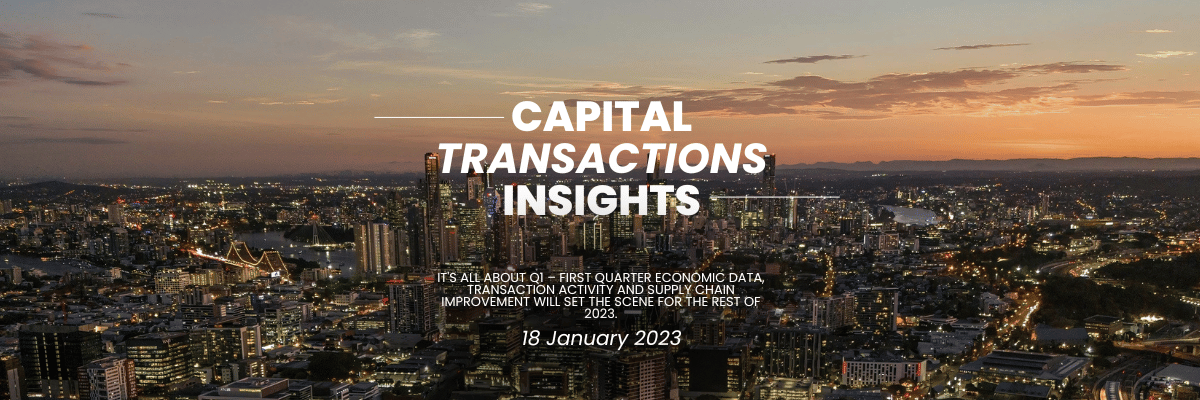
IT’S ALL ABOUT Q1 – FIRST QUARTER ECONOMIC DATA, TRANSACTION ACTIVITY AND SUPPLY CHAIN IMPROVEMENT WILL SET THE SCENE FOR THE REST OF 2023.

January 19, 2023

As we hit the ground running with optimism and gusto in the New Year, our Capital Transactions team conducted a think-tank session analysing Brisbane’s commercial real estate economy and what our clients need to know when investing and developing in the current environment. The result was that we needed to investigate the stubbornly high inflation figure better to understand the interest rate cycle we are in.

Increasing rates is a central bank strategy that aims to slow the growth in the economy by reducing demand, but is our economy that strong? If so, why are our households under such budget pressure? Why aren’t purchasing managers expanding their inventory? Why is consumer sentiment falling off a cliff?

The answer is that price inflation is not driven by heightened demand and strong economic growth but by a global supply chain in disarray, leaving us fighting over the limited materials, food and fuel that find their way into our market.

This is the real impact of Covid and Russia’s war on Ukraine: The Pandemic and the war has disrupted our supply chains, forcing the central banks to combat the subsequent price inflation when our households and businesses are in no position to endure an aggressive upward cycle. With household saving rates falling off a cliff and further rate raising damaging an already fragile economy, another two or three rate raises could be the catalyst for a hard economic landing later this year.

The narrative that logistical supply chain issues have driven inflation is a more credible scenario than saying underlining demand is robust. The solution the RBA has adopted by pushing up interest rates eight consecutive times is like putting a band-aid on an infected wound; the wound never heals, further adding to the theory that until supply chains are somewhat normalised, central banks have no choice but to pour cold water on an already fragile economy.

We are on the recovery path, but patience is needed. China, our biggest trading partner, is entering the Lunar New Year and suffering a massive wave of COVID. It will likely be another two to three quarters before we see any light at the end of the tunnel and before we see material supply chain improvement in China’s factories and ports. In addition, global geo-political headwinds are slowing down the supply chain recovery.

On the ground, the demand for asset class themes we saw during COVID continues to play out. The COVID hangover is pushing investors to allocate capital towards retail, industrial and residential accommodation based investments. Whilst capitalisation rates have adjusted and continue to expand, investors are looking for rental growth and repositioning opportunities to create better efficiencies and higher income. Counter-cyclical investment into prime office is also gathering momentum as institutional investors are calling the bottom of the office market, citing an improvement in leasing activity and a re-energising CBD.

Investors are being enticed with a barrage of in-direct opportunities in the private debt and syndication market. Attractive high-yielding opportunities, which were paying 6% – 7% 12 months ago, are now paying 8% – 9%. No detail is too small when considering these opportunities and valuations are shifting quickly.

On the development front, continued activity in the residential accommodation sector is evident, and rightly so. Essential serviced-themed developments are still in hot demand, although underwriting of the exit yield is unlikely to be sub 5%. Continued pressure on construction prices will further impact land values, with some sectors and locations being adversely affected more than others.

We continue to see a large portion of seller’s preferring to treat on an off-market basis. This theme is likely to extend into 2023. While investors and developers navigate the unpredictability of the market’s external factors, the physical characteristics of bricks & mortar, tenant lead demand and location are even more important than ever.

For further information contact:

Hugh Menck MRICS

Head of Capital Transactions

hmenck@bne.mcgees.com.au

+61432560589

For a complete list of weekly commercial transactions in Queensland, visit McGees Wrap Up | McGees Property Brisbane

Disclaimer: The information provided in this blog is for general informational purposes only and does not constitute legal, financial, or professional advice. While we strive for accuracy, we make no guarantees regarding the completeness or timeliness of the content. Always seek independent advice before making any financial or real estate decisions. We are not liable for any loss or damages arising from your reliance on the information provided.

Liability Limited by a Scheme approved under Professional Standards Legislation
Latest News

McGees Wrap Up 23 October 2026

October 23, 2026

McGees Wrap Up 23 October 2026

Queensland Commercial Property Weekly Wrap-Up Week Ending 23 October 2026 South East Queensland commercial property is accelerating as the 2032 Olympic deadline forces developers and investors to lock in projects before resource bottlenecks intensify. Population growth continues to fuel exceptional…

October 23, 2026 McGees Wrap Up
McGees Wrap Up 16 October 2026

October 16, 2026

McGees Wrap Up 16 October 2026

Market Overview Queensland commercial property is drawing intense local and cross-border capital as investors race to secure assets ahead of long-term infrastructure delivery (Bleby, 2026; Lenaghan, 2026). The Brisbane central business district office sector has reached Australia's tightest vacancy rate…

October 16, 2026 McGees Wrap Up
McGees Wrap Up 9 October 2026

October 9, 2026

McGees Wrap Up 9 October 2026

Market Overview South East Queensland commercial property continues to experience fierce capital competition driven by severe supply constraints and infrastructure connectivity. While broader macroeconomic headwinds such as falling building approvals and rising retail operational costs challenge feasibility, developers and investors…

October 9, 2026 McGees Wrap Up

October 1, 2026

McGees Wrap Up 2 October 2026

Rising sovereign bond yields and tight consumer budgets are testing commercial property valuations across Queensland, but capital continues to find a home where tenant demand and infrastructure investment remain clear. Australian ten-year government bond yields have climbed past 5.3 per…

October 1, 2026 McGees Wrap Up
View all

Over 45 years of national property excellence.

Contact our experienced team today.

First Name(Required)
Last Name(Required)

FINANCE – THE COST OF CAPITAL IS PUTTING PRESSURE ON UNDERPERFORMING ASSETS AND DEVELOPMENT SITES, BUT BANK APPETITE IS UNHINDERED…

December 8, 2022

1. How has the appetite of the top-tier lenders changed over the past 6-months? And how is that reflected in their lending policy? (LVR, ICR, Geographical/Asset Class Appetite)

The biggest change in appetite has been driven by the rising cost of funds and its effect on the Interest Coverage Ratio’s & overall serviceability. Recently, I’ve observed some banks reducing their coverage ratios, allowing them to continue lending at traditional LVR’s. Overall appetite for certain asset classes & geographical locations remains varied across the banks; however, no major changes have been observed.

2. Are any areas of the market or asset classes proving particularly difficult to obtain funding for?

· Tighter-yielding assets can make it difficult to meet metrics if you don’t have a substantial cash contribution.

· Partially tenanted assets, low WALE assets can be problematic in meeting bank assessment hurdles and require lenders to up the risk curve.

· Development finance has been problematic with increased funding & construction costs resulting in higher project equity requirements.

· NDIS Assets – I haven’t observed any major banks adopt a consistent approach to this emerging asset class.

· Interestingly, for developments, I’m observing project-related site values coming back less than “as is” values indicating that land values or construction costs need to reduce to make sites stack for developers.

3. Will the role of private lenders change as we continue this upward Interest rate cycle?

Private lending is more suitable for value-add projects looking to benefit from increased gearing against end values. Banks are reducing coverage ratios, so I won’t see this type of lending for passive hold investors. Non-bank lending may assist some commercial property borrowers if their asset values decline and they want to maintain interest rates. If construction costs continue to rise, lower presale requirements will also make private lending attractive, allowing developers to recoup elevated costs when selling on project completion.

4. What are lenders saying about construction costs? Are they pricing further escalation into credit applications?

Banks are still scrutinising the builders of projects and the financial means of sponsors to complete projects in case of cost & time overruns. They are still adopting higher-than-traditional contingencies in place for overruns.

5. Are you recommending your clients fix their rates?

I don’t recommend fixing rates unless clients want certainty around repayments and/or are hedging against major lease expiry. In my opinion, the premium for longer-term money compared to current floating rates makes it quite unattractive. Recently, when we have reviewed hedging strategies, capped rates or blended capital structure has provided a good combination of stability and overall cost of funding.

For further information contact:

Hugh Menck MRICS

Head of Capital Transactions

hmenck@bne.mcgees.com.au

+61432560589

For a complete list of weekly commercial transactions in Queensland, visit McGees Wrap Up | McGees Property Brisbane

Disclaimer: The information provided in this blog is for general informational purposes only and does not constitute legal, financial, or professional advice. While we strive for accuracy, we make no guarantees regarding the completeness or timeliness of the content. Always seek independent advice before making any financial or real estate decisions. We are not liable for any loss or damages arising from your reliance on the information provided.

Liability Limited by a Scheme approved under Professional Standards Legislation
Latest News

McGees Wrap Up 23 October 2026

October 23, 2026

McGees Wrap Up 23 October 2026

Queensland Commercial Property Weekly Wrap-Up Week Ending 23 October 2026 South East Queensland commercial property is accelerating as the 2032 Olympic deadline forces developers and investors to lock in projects before resource bottlenecks intensify. Population growth continues to fuel exceptional…

October 23, 2026 McGees Wrap Up
McGees Wrap Up 16 October 2026

October 16, 2026

McGees Wrap Up 16 October 2026

Market Overview Queensland commercial property is drawing intense local and cross-border capital as investors race to secure assets ahead of long-term infrastructure delivery (Bleby, 2026; Lenaghan, 2026). The Brisbane central business district office sector has reached Australia's tightest vacancy rate…

October 16, 2026 McGees Wrap Up
McGees Wrap Up 9 October 2026

October 9, 2026

McGees Wrap Up 9 October 2026

Market Overview South East Queensland commercial property continues to experience fierce capital competition driven by severe supply constraints and infrastructure connectivity. While broader macroeconomic headwinds such as falling building approvals and rising retail operational costs challenge feasibility, developers and investors…

October 9, 2026 McGees Wrap Up

October 1, 2026

McGees Wrap Up 2 October 2026

Rising sovereign bond yields and tight consumer budgets are testing commercial property valuations across Queensland, but capital continues to find a home where tenant demand and infrastructure investment remain clear. Australian ten-year government bond yields have climbed past 5.3 per…

October 1, 2026 McGees Wrap Up
View all

Over 45 years of national property excellence.

Contact our experienced team today.

First Name(Required)
Last Name(Required)

RETAIL SECTOR – SEASONAL SPENDING TO BOLSTER ECONOMY HOWEVER CONSUMER SENTIMENT IS SOFTENING, INVESTORS NOW NEED TO ADOPT A BOTTOM-UP APPROACH.

November 22, 2022

Despite ongoing pressure on household budgets, Queensland’s Retail trade has remained remarkably strong throughout the year, recording its 9th straight month of growth. Queensland’s seasonally adjusted retail turnover has increased by 9.7% over the past 12 months.

Australian hospitality businesses are set to benefit the most from the imminent Christmas spending spree, with trade volumes forecast to increase by 16.3% to $9 billion.

Regardless of the strength in our recent retail trade data, it is our view that the impact of continued pressure on household budgets is understated, and therefore retail sales volumes will weaken significantly post-Christmas.

The Household Savings Ratio, which measures Household Savings against disposable income, is falling rapidly. Household Income is expected to remain steady but as the cost of living increases, the ratio will fall further as household access their savings to pay for the essentials, leaving less and less in the budget for the finer things.

This is reflected in Westpac’s November Consumer Sentiment Survey, which shows sentiment has fallen 6.9% over the past month and is now below the low-point of the GFC. The drop in confidence can be attributed to the threat of sky-high energy prices and a stubborn inflation figure which continues to defy the RBA’s strategy. As interest rates, fuel prices and residential rental rates continue to rise, it is our discretionary spending (i.e. Luxury Retail, Fine Dining, Entertainment) that suffers eventually. Non-cyclical industries (i.e. Grocery, Fuel, and Alcohol) will remain in high demand.

Hence, Retail assets are not exempt from the overarching “flight to quality” thematic that we are seeing play out in the wider market. As discretionary spending is impacted more and more by the cost of living, interest will gravitate towards essential retail offerings with strong anchors. We are seeing investors and developers flock to assets or development opportunities anchored by Quick Service Restaurants (QSR’s), grocery and fuel as they are seen as essential, regardless of the strength of the economy or what stage of the interest rate cycle we are in. This is happening despite there being higher rental income on offer for lower quality covenants, with landlords who opt for higher quality covenants and lower income being rewarded with a much sharper capitalisation rate on valuation.

In summary, the forced savings created by lockdowns, as well as the financial aid provided by the government throughout the pandemic, is largely responsible for pushing sentiment and inflation into unreasonably high territory, the effects of which have only been exacerbated by Covid-related supply chain issues and conflict-affected energy prices. In response, the measures Central Banks have put in place to contain inflation continues to apply pressure on household budgets, which is resulting in consumers losing confidence and withdrawing from non-essential spending.

Lower household disposable income with the risk of ongoing energy, supply chain and labour market issues, means you should be selective with the retail assets in your portfolio and ensure you are well positioned to meet the demands of a changing market.

For further information contact:

Hugh Menck MRICS

Head of Capital Transactions

hmenck@bne.mcgees.com.au

+61432560589

For a complete list of weekly commercial transactions in Queensland, visit McGees Wrap Up | McGees Property Brisbane

Disclaimer: The information provided in this blog is for general informational purposes only and does not constitute legal, financial, or professional advice. While we strive for accuracy, we make no guarantees regarding the completeness or timeliness of the content. Always seek independent advice before making any financial or real estate decisions. We are not liable for any loss or damages arising from your reliance on the information provided.

Liability Limited by a Scheme approved under Professional Standards Legislation
Latest News

McGees Wrap Up 23 October 2026

October 23, 2026

McGees Wrap Up 23 October 2026

Queensland Commercial Property Weekly Wrap-Up Week Ending 23 October 2026 South East Queensland commercial property is accelerating as the 2032 Olympic deadline forces developers and investors to lock in projects before resource bottlenecks intensify. Population growth continues to fuel exceptional…

October 23, 2026 McGees Wrap Up
McGees Wrap Up 16 October 2026

October 16, 2026

McGees Wrap Up 16 October 2026

Market Overview Queensland commercial property is drawing intense local and cross-border capital as investors race to secure assets ahead of long-term infrastructure delivery (Bleby, 2026; Lenaghan, 2026). The Brisbane central business district office sector has reached Australia's tightest vacancy rate…

October 16, 2026 McGees Wrap Up
McGees Wrap Up 9 October 2026

October 9, 2026

McGees Wrap Up 9 October 2026

Market Overview South East Queensland commercial property continues to experience fierce capital competition driven by severe supply constraints and infrastructure connectivity. While broader macroeconomic headwinds such as falling building approvals and rising retail operational costs challenge feasibility, developers and investors…

October 9, 2026 McGees Wrap Up

October 1, 2026

McGees Wrap Up 2 October 2026

Rising sovereign bond yields and tight consumer budgets are testing commercial property valuations across Queensland, but capital continues to find a home where tenant demand and infrastructure investment remain clear. Australian ten-year government bond yields have climbed past 5.3 per…

October 1, 2026 McGees Wrap Up
View all

Over 45 years of national property excellence.

Contact our experienced team today.

First Name(Required)
Last Name(Required)